The Italian crisis and the extinction of Ferraris

The tittle may be shocking, but it explains what is going on in the troubled Italy with expensive cars. According to Bloomberg news the situation with luxury cars is becoming dramatic in Italy because of the financial crisis and governments measures. It is not only a matter of new car sales figures, which are down an incredible 20%, but is also about the impossibility of having the Ferraris, Maserati, Porsche or Lambos in a country where new taxes appear every day and the fight against tax evaders has become an official duty. That’s why many Italians are exporting their super cars in order to avoid tax payments or the persecution of police. According to the article, the number of secondhand high performance cars exported from Italy was up 177% in the first 5 months of 2012, when 13.633 cars were taken out of the country. Italian authorities began a raid against all tax evaders going to exclusive places where all the millionaires go with their supercars. By doing it they could know who was really declaring the right income and therefore paying enough taxes. And as expected, Italian police has found several people enjoying their ‘toys’ and having the ‘dolce vita’ without paying the right amount of taxes. It is certainly a pity in a country known by its supercars in its wonderful roads.

Ferrari and Maserati sales figures in their main markets during 2011. They are Fiat’s most profitable brands. Source: Ferrari Annual Report via Torque News.

The rise on taxes to luxury cars has affected for the first time high performance luxury brands. Most of the times, this kind of cars is more resilient to economic crisis as millionaires are the last ones to suffer the consequences of a recession.  But in Italy things are different and Ferrari for example forecasts a fall on its new car sales of 47%, while they keep increasing their exports to China, the Middle East and the US. Eventhough local market is decreasing for Ferrari and Maserati, they keep being Fiat Group’s most profitable brands. Just in the first half of the year both brands had a combined operational profit of 175 million euros, with an awesome margin of 12.2%, beating BMW’s 11.6%, and helping Fiat Group to decrease its losses. It seems Italian economic crisis is not only affecting the small Panda and 500 but also the gorgeous Ferrari 458 and Maserati Gran Turismo.

Fiat-Chrysler 2012 First half results analysis

After some days waiting for official data now is possible to have a close analysis to Fiat-Chrysler sales figures in the main markets and most important models. The overall result could be considered more or less good though the troubled European market may change that at the end of the year. The whole group has sold around 1.8 million cars* in the first six months of 2012, up 5.7%, which is not considered bad in current conditions, especially taking into account that Italy counts for 13% of total sales and is a market that dropped 20%. It all means that the small growth in units sold is due to the great success most of Chrysler Group models are having in the US and Canada. Brazil would not be included in the list of good results as Fiat brand slow down its growth following the total market (-0.3%). The analysis by models shows two different worlds: Europe with terrible results for old products, and USA for good results for most of all the models, no matter the fact they are mostly old models.

ITALY

Italy is Fiat’s main problem nowadays. The dependence of the group is evident and therefore total sales and practically all models are having very bad results. What used to be Fiat’s best selling car now occupies a second place and is severely affecting the whole company. The Punto, which counts for almost 23% of the group sales and drops 32%, much more than the market, and than its rivals. The ‘restyling’ gotten at the beginning of the year has not had any effect because consumers of B-Segment seem to prefer the new generation of Toyota Yaris (a fall of just 5.5%) or the new Peugeot 208 (4200 units). Then comes the Fiat 500 that falls even more due perhaps to the fact that is now facing its 5th year on the market without any significant change (see analysis of Fiat 500-Panda vs. VW Up! for June 2012). These two models count for 76% of main models fall. But in terms of percentage fall, the winner is the C-Compact Bravo with a spectacular fall of 47%, or 6.063 units less. This car is not old at all but the positioning given by the brand has not been the best allowing the VW Golf to keep its pole position among C-Segment cars. Nevertheless the german compact begins to suffer the consequences of its old age which can be seen by the good result gotten by the Giulietta (the best selling compact in April, May and June), which ‘only’ falls 18%, but is an alarm sign to Alfa as it is the only competitive product and is just 2 years old. Other really bad performers are Alfa MiTo, which just sold 16% more than Mini and 20% more than Audi A1, and Lancia Delta, down 36%. In a market that falled 20%, the Panda, Ypsilon and Freemont did quite well. The new generation Panda helped this popular model to maintain its sales figures and allowed it to become the country’s best selling car by far. Same situation for the Ypsilon, very popular in Turin. Fiat as a brand falled as much as the market, while Lancia did better only falling 11% and Alfa Romeo dropped 31%.
Total sales of B segment main models in Italy. The latest launches had the best performance, while those with more years in the market dropped their sales. Source: http://www.bestsellingcarsblog.net

Although Giulietta’s sales have fallen in Italy during the first half, it was Italy’s best selling compact car (C-Segment) in May and June. Very bad results for the Fiat Bravo. Source: http://www.bestsellingcarsblog.net and http://www.unrae.it

Thanks to new Panda, Ypsilon and somehow the Giulietta and Freemont, Fiat Group has been able to rise its market share in Italy. The evolution of each model is compared to the performance of each segment according to UNRAE. Source: http://www.bestsellingcarsblog.net and http://www.unrae.it

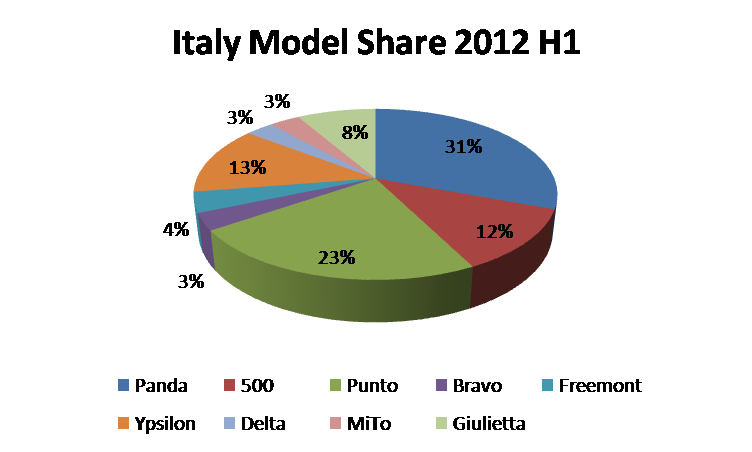
Fiat Group’s model composition in Italy during the first half of 2012. Source: http://www.bestsellingcarsblog.net and http://www.unrae.it

USA

As usual, American sales figures are just amazing. The total market has returned to pre crisis numbers but Chrysler Group is doing much better, eventhough the new entry model, Dodge Dart, is available from late June. The Ram grew 24%, much more than its rivals, thanks to the good results got by the luxury versions. If rumors are confirmed, a diesel version would have a positive impact for the rest of the year. But in terms of the largest impact on the total growth on sales, the Chrysler 200 is certainly the main character, because it represented 16% of total growth, or 37.000 more cars. The deep facelift that received the Chrysler Sebring has made consumers to come back to Chrysler in the C-Segment. Besides the good Ad campaign regarding its American origin has given it more awareness among consumers. With less sales figures but equal interesting results, the Chrysler 300 took off, up an amazing 200% (anyway it is still far away from its rivals, most of them already renewed). As most of models had great performances (thanks to better economic situation), only those having bad results deserved a close analysis: the old couple Compass/Patriot did not well during the period. The Compass falled 1%, while the Patriot grew 12%, below total market. It is clear that these models are old enough and competition gets really hard with all new models, but it is weird that the Compass and not the Patriot falled when the only the first one had an interesting restyling. Another fact to consider is that minivans don’t count in Chrysler’s sales as much as they did one year ago, and now Jeep Grand Cherokee and Wrangler occupied the second and third place of best selling Chrysler models. The group, included Fiat sales numbers, grew up two times more than total markets allowing it to increase its market share up to 11.5%. By brands only Dodge/Ram had stable growth, while Chrysler had an amazing growth of 75%, Jeep up 28% and the Fiat 500, up 319% to 20.706 cars, more than the whole year 2011.

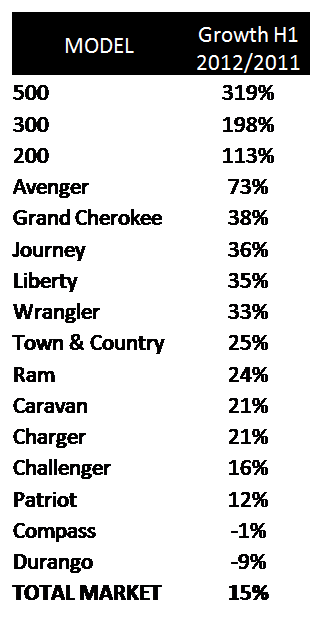
The Fiat 500 had the best performance compared to H1 2011. Anyway most models did better than the whole market. It is weird what happened to Dodge Durango which has been on sale for less than 2 years, shares platform and components with the successful Jeep Grand Cherokee. Source: http://www.goodcarbadcar.net

The figure shows the total units sold during the first half and then the change in terms of percentage and units. After that there is the contribution of each model to total growth in terms of units. Chrysler models are the ones which contributed the most for the total growth. Source: http://www.goodcarbadcar.net

EUROPE

Outside Italy the situation is really bad. Without taking into account UK and Austria figures (only Czech Rep., Denmark, France, Germany, Greece, Ireland, Netherlands, Poland, Slovakia, Slovenia, Spain, Sweden and Switzerland), the main models of the group sold 115.275 units, down 17.5%, a bit less than what happened in Italy. Of course not all the markets had the same performance as the largest ones had the deepest fall: France down 25%, and Germany down 13%, compared to a total fall in France of 14% while Germany grew 0.7% (part of that growth due to self-sales). But the top 9 models had the worst fall in Greece, a market that dropped 41% in the first half. Spain, other troubled market, surprisingly was good for these models, which grew up 4%, or 500 more units. Once again the Fiat Bravo got the worst figures falling in all markets as a response to Fiat’s decision of reducing the range and options. Germany has been the largest market for the Punto after Italy, but this year the model has fallen 48% over there, even more than the fall seen in Greece, but less than the horrible result in Spain and the Netherlands. Certainly the model is not anymore popular. The Panda had good and bad results but in general the car continues to be popular, though its total result was severely affected by the deep fall in France, where the market is going bad. As in Italy Lancia goes better thanks to the Ypsilon, which had excellent numbers in terms of growth but still low numbers in terms of units delivered. One year ago the old model barely sold one thousand units but with the arrival of the new 5 door generation the Lancia sold 4 times more, and is especially popular in Greece where it has become one of top 20. Alfa Romeo does not do good at all with its 2 models falling in the ranking, especially the MiTo, which never had good results. In terms of the dependence of the models on the Italian market the situation changes a lot according to the car. Without any doubt the Fiat 500 is the most international model of the group as only 34% of its sales are done in Italy. Surprisingly the Alfa MiTo is the next model to have less sales share in Italy, as 52% of them are done outside Italy. It is certainly interesting to see the result of the MiTo taking into account that the Giulietta is more popular. The Lancias continue to be popular only in Italy and it seems the new generation Ypsilon will depend on Italian market no matter the fact is built in Poland.

This figure shows the Export ratio of Fiat Group’s main models in Europe. The Fiat 500 is the one less dependant on Italian market thanks to great sales in the UK, France and Germany. On the other hand there is the Lancia Ypsilon, whose new generation has not been able to change its strong dependance on Italy. Europe includes: CZ, DK, F, D, GR, IR, NL, PL, SK, SL, E, S, Switzerland and the UK. Source: www.bestsellingcarsblog.net
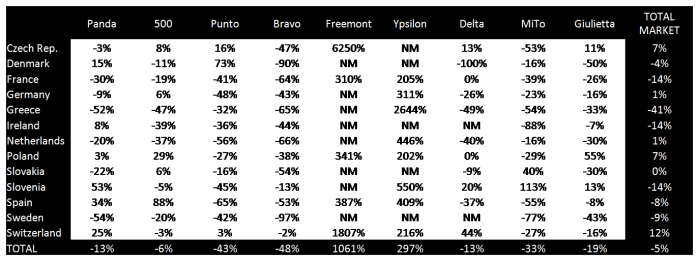
Sales growth of each model in each market for the first half of 2012. Good results for the Ypsilon, Freemont and 500. To bad for the Punto, Bravo and MiTo. Source: http://www.bestsellingcarsblog.net
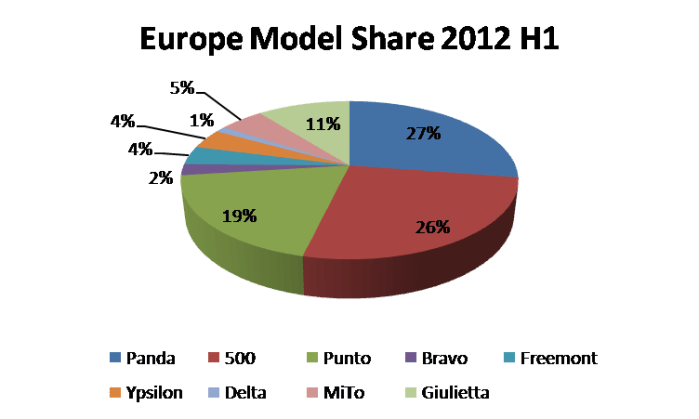
One year ago the Punto was Fiat’s best selling car outside Italy (28% of total sales). In 2012 H1 the fall of its sales allowed the Panda, 500 and Ypsilon to have better share among Fiat models. Source: http://www.bestsellingcarsblog.net

BRAZIL

In Brazil the analysis gets larger as more models are really popular over there. The market is stable with a tiny fall of 0.3% and is expected more sales in the second half thanks to some incentives given by the government. In this context Fiat continues to be the leader and keeps its market share above 22% thanks to one single model, the new Palio. Its registrations have risen 63% and is now the third bestselling car of that country, but it is still far behind from the king of the market, the VW Gol. Although year-to-date numbers are still low, the arrival of the new Siena, aka Grand Siena, has made of this model another great performer and the results will be seen at the end of the year. The Uno, in its second year, falls 11% partly because of the arrival of the new Palio, which could be catching some of its sales (Palio is B-Segment and Uno is A-Segment, but they are close in size and prices), and also because of the success the facelifted VW Fox is having (up 19%), also from A-Segment. But the worse comes from C-Segment: the Linea falls 36% and it seems it will continue like that until a deep facelift arrives. The Bravo stopped its fall in the last month thanks to new engines and features. Good for the Punto (-2%) which got its first deep facelift in July/12, and the Freemont, with 1 thousand units sold per month, not bad considering its high price. The small 500 is doing also good allowing the Toluca plant to keep working. For the second semester things will get hard for Fiat with the arrival of the facelift of VW Gol/Voyage and the all new Hyundai HB20, exclusively designed for Brazilian market.

The new Fiat Palio has had a great start. The new Siena will also change total year’s result. Source: http://www.bestsellingcarsblog.net

CANADA & ARGENTINA

The situation in Canada is not as spectacular as in USA. Chrysler group (included Fiat 500 figures), had the same growth of total market, but it is much more than its competitors from Ford and GM. Actually the group has the second place and sells more than GM, but is now facing the threat of a strong Toyota in fourth place and growing much more. Fiat sold 4.920 cars, up 92% and it seems the small 500 has reached its maximum. The Ram (up 16%) and Grand Caravan (down 6%) are among top 5 best selling cars of that country. In Argentina where total market continues its instability, Fiat is doing good with the new Siena, up 10%, the Uno, up 11%, and the Strada, up a massive 74%, or 2105 units more. Bad for the Palio (the new generation just began local production some weeks ago), the Punto (the restyling will arrive by the end of the year). The small 500 sold almost 2.000 units.

The Fiat 500 sells more than many other Chrysler models. Source: http://www.bestsellingcarsblog.net

*Fiat, Lancia, Alfa Romeo, Chrysler, Jeep and Dodge.

Source: www.carsitaly.net, www.bestsellingcarsblog.net, http://www.goodcarbadcar.net

Marchionne points how to get out of the crisis

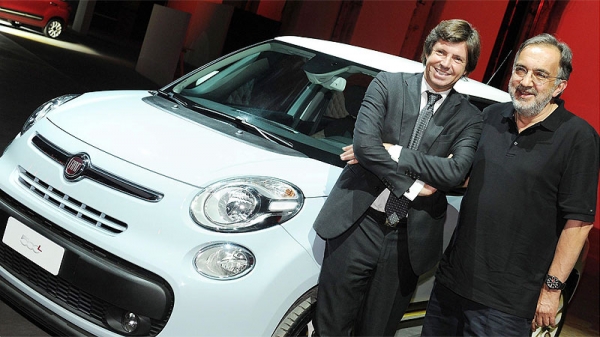
Once again Sergio Marchionne is the source of news. This time, as usual from last months, bad news. Yesterday at the presentation of Fiat 500L, he surprised the press when he said that one of Fiat’s plant in Italy could be closed. It would be the second one after the one in Termini Imerese in Sicily, closed in December 2011. “If current overcapacity conditions continue within the next 24-36 monts, there is one factory in excess in Italy” said Mr. Marchionne. Nothing precise but again one more warning from Fiat’s AD to Italy’s authorities looking to change current labor conditions and make easier the production of cars in that country. Of course it was just a estatement, but after it he practically confirmed his intentions. He said he was not expecting good times in Europe for the next 24-36 months and again he defended the idea of cutting $500 million in Europe’s investement included the launch of new generation of Punto, “it would be a flop” he said.

Italian Fiat’s plants. Source: Corriere della Sera

Currently Fiat has 5 production plants in Italy, all of them facing real tough times. The largest one, Val di Sangro in Chieti employs 6.217 people and in 2009 used only 33% of its capacity and is expected to use 69% by the year 2014. According to Italian newspaper Corriere della Sera, estimations for production in the other plants is better but a bit pessimistic and opposite to what Marchionne thinks will be the market in the next 2 years. 2 years ago Fiat signed an agreement with Italian government to bring back the production of more cars to Italy as part of Fabbrica Italia plan. Today the situation is completely different although Fiat kept its word bringing back the production of its bestselling mini car, the Panda from Poland to Pomigliano plant. It is perhaps the plant with better future as that model is very popular in Italy and will continue to be Italy’s best seller. But things don’t work like that for the other plants. Mirafiori factory in Turin, Fiat’s first plant, faces a big challenge: or it changes or it disappears. Nowadays just produce the Alfa Romeo MiTo as the Lancia Musa and Fiat Multipla are no longer produced. The MiTo has never been a success not even in Italy and now is living the decline period of its commercial life. It means that the big Mirafiori plant needs urgently more models to produce if it wants to survive. Fortunatelly for Turin, Fiat is thinking to produce there the new family of small SUV for Fiat brand and Jeep to sell not only in Europe but in America. Actually, yesterday during the presentation of the 500L, Olivier Francois, Fiat brands CEO, showed a quick outview of what will be the Fiat 500X, the compact SUV based on the 500 and that will share body type and components with a future small Jeep.

Fiat 500X. The model was quickly showed during the presentation of the 500L. Photo by Autoblog.com

It all means that for coming years Fiat must face the current crisis doing both: closing a second plant and using the remaining ones as its maximum as they will export to America. The first option seems to be easier because European made cars have never been popular in the US market because of Currency reasons. However it is expected a less expensive Euro and it would allow European cars to be more competitive in the opposite shore. Toyota will soon do it with its Yaris to arrive in America from its French factory. The lack of demand in Europe could be replaced by the good times car industry is having now in USA and Canada, and it could fit perfectly for Fiat-Chrysler as their American plants are working almost 100% of their capacity (see production problems for Jeep Wrangler) and they need other sources of production. If Italian plants continue to depend exclusively on European market their future will be committed as short and midterm situation will not improve. They need to look outside Europe: America, Africa and Middle East. The possibility of closing a plant was one of the headlines of Italian news yesterday. Actually the governor of Piemonte region (where Fiat was born), Roberto Cota, said that Fiat has had a lot from Piemonte territory and must not forget it. At the same time Susana Camusso, the general secretary of CGIL, one of Italy’s most important Labor Unions, said that the government should look for another car maker to come and produce locally, “also Japanese could work”, she said. To close a plant has never been easy for any producer. It means less investment and more unemployment. Marchionne knows it and that’s why he is just making assumptions that at the end will become a reality.

The Cassino plant in Frosinone where they produce the Bravo, soon to be replaced by a Chinese model?

But what to do in this case? if Fiat is loosing money in Italy and situation does not seem to get better, they must do something quickly. Of course the easiest way is closing a factory or firing people. But there are more solutions. Italian government could help not by giving incentives but changing the labor conditions there are right now in Italy. For Mrs. Camusso is easy to say to bring other car makers to the country, but which one could come to Italy with current labor conditions? I personally doubt that any car maker would invest in Italy if they keep labor code. It is not about becoming the new China in terms of workforce and welfare, but it is to understand that the world has changed and Europe can not be competitive anymore if they keep their status quo. There is now more competition from the south and  investors are looking there to take their money. And it works not only for car industry but for everything. Italy must change. Otherwise the complains saw in the press about the origin of the new Fiat 500L will become an usual fact. Complains about the fact that the car was going to be produced in Serbia while Marchionne was thinking to close a factory in Italy. Of course are not good news for Italy, but Italians should think about the reason for this, because the 500L was initially going to be produced in Mirafiori plant but then Fiat decided to shift it to Serbia as non flexible labor conditions and strikes have become an usual scenario. Fiat must keep Italy as one of its core markets, but Italy must reconsider its relationship with Fiat.

The lack of competition and disgrace of Alfa and Lancia

To describe Alfa/Lancia situation and think of their future is a difficult thing to do, besides becoming a bit boring as is a frequent topic among car specialists. However, the fact that both brands are perhaps facing their worst crisis ever, is a good reason to go deep and find the origins of this bad situation and maybe find a solution. One of the main characteristics of capitalism is competition. In an open market the usual thing is to find several offers competing to get customer’s attention and purchase. It has worked for centuries and has become the rule for modern world. Competition is getting hard as globalization allows companies from every corner in the planet to sell their goods or services globally. It works like this for every sector and, though it may be considered unwanted sometimes, is really important for the health of a company.

Alfa Romeo Giulia Sprint GTA and Lancia Fulvia in late 60’s. Photos by Stelvio.dk and Straightspeed Blog

Before they were absorbed by Fiat, Alfa Romeo and Lancia had the worst of the wars between them. With a lot of differences, their goal used to beat each others’ in order to get more sales piece of Italian premium segment. Their rivalry was even seen in races while they were always launching new models, most of them extremely popular and still remembered today. The fact that they were always trying to beat each others’ allowed them to survive to several crisis and at the same time become more and more competitive with interesting offers. That is why successful models like the Alfa Giulia, Duetto, or the first generation of Giulietta, or the Lancia Fulvia, Stratos or first generation of Delta were all conceived. They used to work really hard to win the match. Great products, the best quality and awesome designs were the result of this fight. And it was certainly a good thing for them as they were growing up always innovating and becoming better. That’s how competition works: if one wants to survive one needs to work hard, otherwise you are out.

Alfa Romeo 164 and Lancia Thema in late 80’s. One of first models of both brands under Fiat hands. Photos by Octane and Auto-Types.com

Lancia became part of Fiat in 1969 after the acquisition of Ferrari and Autobianchi. Then in 1987 was the turn for Alfa Romeo. Both brands are now part of Fiat Group and are dealing with a lot of problems to survive. So after decades of hard competition Lancia and Alfa Romeo stopped looking each other as eternal enemies and became brothers of Europe’s largest car maker by that time. Certainly the move by Fiat allowed both brands to survive, but at the same time it created their worst problem: the lack of competition. Without any direct competitor their work became easier in the sense that they did not have to worry so much about what the other one would be doing. Now they were part of the same company and they could share projects and save money. In one hand this allowed Fiat to concentrate its power in Italy with several brands, but in the other one the lack of competition made of these 2 brands to become ‘lazy’. No competition, no worries. No worries, no development. And no development (or at least slowly development) is the main cause of the problem they have now. One would think that there is in fact competition, and a real tough one: BMW, Mercedes and Audi are very strong nowadays. And yes, they are now the rulers of premium segment even in Italy as Alfa and Lancia are not competitive and lack of real premium products. But by the years they were absorbed by Fiat, European markets were not as opened as they are now. There were more restrictions to imports and at the same time more government help to Fiat Group. In this context, they did not really have to worry about premium segment as they had the whole market for them.

Alfa Romeo 146 and Lancia Delta in mid 90’s. Photos by coches.net and lancia.es

The same situation would apply to Fiat brand but with less bad consequences as it has opened its market outside Europe. Nevertheless, Fiat became Italy’s unique car maker without any direct competitor after buying all its Italian competitors. In the 80’s Fiat used to be Europe’s largest car manufacturer thanks to its successful models like the Uno and first generation of Panda, which were not only popular in Italy but everywhere in Europe. Even VW used to take Fiat as a referent of the market to develop its products. Actually the first generation of VW Golf was conceived taking as a reference the Fiat 128. But then without any direct competitors in its native Italy, Fiat had nothing to fear and began to be less strict in quality while its competitors from the north were working harder. At the end it is known the result. The lack of competition had a very bad impact on Fiat’s development. Something that did not happen in Germany, France or even Sweden. In the first country VW had to deal with Ford and Opel, Audi did the same with Mercedes and BMW, while in France Renault was always working to beat Peugeot-Citroen. In Sweden Volvo was working more and more to fight properly with the extinct Saab. Meanwhile those brands who ruled alone in their countries were absorbed by others: Skoda and Seat by VW.

Latest Alfa Romeo Giulietta and Lancia Delta. Photos by netcarshow.com and worldspeedcrewcup.com

But inside Fiat Group there is also the opposite case that confirms that the lack of competition is harmful. Ferrari is perhaps Fiat’s most successful brand in terms of recognition and good awareness. Its success can be seen not only in F1 championships but in sales that grow every year. Those good numbers have been the result of hard work always trying to beat its eternal rival, Lamborghini that became part of VW empire some years ago. Both companies continue to compete without contemplation and that is why they offer the best of the best. It all proves that competition is good and necessary, and car makers must be careful about going forward to keep their place and always offer the best. Alfa Romeo and Lancia did not do it like that and now they suffer the consequences, but is time to think of the future and possibilities for them to survive and find a place in the market. Personally I think Alfa Romeo has more potential as it can become the perfect brand for pure Italian fashion mid size sedans and sporty cars just one step before the German premiums. People love Italian style and it’s recognized everywhere, so why not make useful of this and positionate Alfa as the stylish brand of the group? with Lancia is more difficult. It has lost its past of sportiness and has not been able to be known as a real premium brand though the big effort made by Fiat. People just don’t know about it or don’t believe in their luxury ‘wanna be’. For me Fiat must accelerate the integration with Chrysler and become of Lancia the italian chic brand for family cars with some touch of elegance and luxury. Now that both brands work together, they should focus on their future.

New versions for Ram, 500, Bravo, Linea and Giulietta

Ram 1500 Laramie Limited. Photo by netcarshow.com

The ending week brings a lot of news related to the coming versions of Ram pickup, Fiat 500 and Bravo, and the first restyling of Fiat Linea. The offer of the bick truck from Ram will add a luxury version called Laramie Limited, featured with heated steering wheel, ventilated front seats and heated rear seats, to replace the Laramie Longhorn version. It will be Ram’s most expensive pickup and is part of the strategy of the brand to cover a the fast growing segment of luxury trucks. Chrysler has seen an opportunity among those clients that are not cowboys but want a big truck to use in the city.  In fact this kind of pickups are allowing Ram to rise the average price of its products. Last year, 13% of light -duty Ram pickups were sold for at least $40.000 (+9% compared to 2010), and among heavy-duty one, those pickups with prices above $50.000 represented 29% of total sales (+22%). In other words a new subsegment has born and Ram is ready to cover it. For the coming months, though, they should develop an exclusive model (not only an update of current model) in order to address more directly this kind of client. Last year, Ram sold around 315.000 units, 78% of them in the US, up 23% on 2010 figures,  double of growth that had its eternal rivals, Ford F-150 (+11%) and Chevrolet Silverado (+12%).

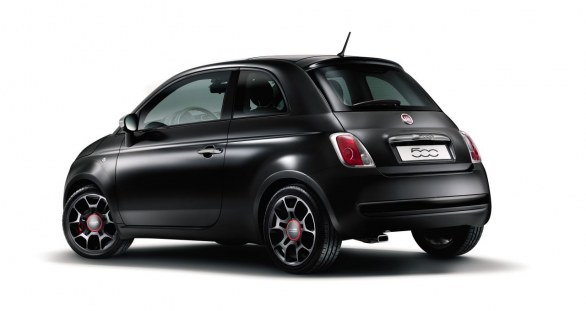
Fiat 500 Street MY 2013

Meanwhile in Italy Fiat has introduced the 500 Model Year 2013. Available in both body types, 3 door hatchback and cabrio, the car is now offered with 6 new colours and 2 new versions. The MY 2013 introduces the blue “Dipinto di blu”, the purple “Dolce”, gray “Colosseo”, red “Diva”, yellow “Sole” and Beige “Cappuccino”. They will be also available with 2 more interior options: Cioccolato/Avorio (Chocolate/Ivory) and Gray/Black. Lounge version is now possible to have with 14 axes rim of 15″. In terms of accessories, there are 2 more versions: the Street (Black Matt color, 16″ rims, spoiler, new seats, crome gearbox) starting at €13.750 for the 1.2. The other version is called Color Therapy, that according to Fiat, it develops the pop and coloured soul of the 500 through colours that had made this model so famous. MY 2013 does not mean any change in design, as Fiat is waiting for the first real facelift in the coming months in order to enhance in a better way the new rivals.

Fiat Bravo Sporting for Brazilian market

After some weeks of the presentation of Fiat Bravo MY 2013 for Brazilian market, they have showed the Sporting version. From next week Brazilians will be able to buy the Bravo with 17″ rims with new sporty touch outside and inside. It adds a red frame in the grill, a spoiler and a suspension 25mm lower than its ‘common’ brothers. Sky Dome roof is standard. Will be available with both gearbox, manual or Dualogic starting at R$58.140 (€23.000). Is then more expensive than Essence version R$53.140 (€21.000) and cheaper than Absolute (€24.600) and T-Jet versions (€26.200). The engine is 1.8 E-torQ and is only available with 4 different colors: yellow, white, red and green. Fiat , which is Brazil’s best selling carmaker, is trying to recover its market share in C-segment due to the fall of sales of its Bravo and Linea. During the first 5 months of 2012 they have sold 3.478 Bravos and 3.419 Lineas, far away from the leader of the segment, Toyota Corolla with 20.681 units sold so far.

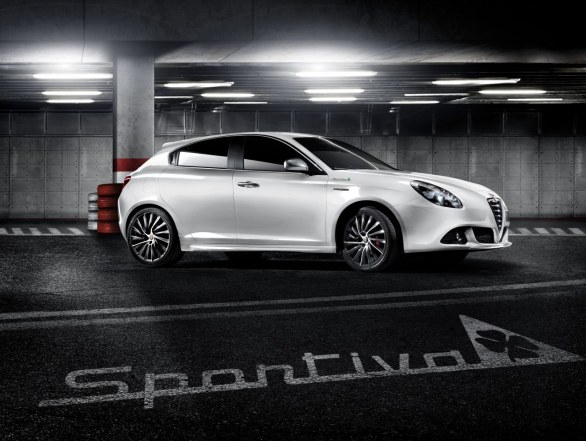
Alfa Romeo Giulietta Sportiva

Alfa Romeo wants to keep the good results of its C-segment Giulietta. In April and May it was Italy’s best selling car in its segment surpassing VW Golf. After the arrival of entry level version of 1.4 T with 105 HP, now is turn for a more sporty version. The Supersportiva will arrive soon offering an interesting sporty package with 1.4 MultiAir 170 HP , 2.0 JTDM 140 HP or 2.0 JTDM 170 HP. It comes with 18″ rims (the same of QV version) with Brembo brakes, darken stop lights, matt external mirrors; sporty pedals, leather seats with red stitching, among others. A good way to keep shaking the market in a moment when all segment sales are droping. This year is expected to be really hard for Alfa Romeo’s sales figures as they just count on 2 models and Giulietta one is now having problems outside Europe with the arrival of new competitors. In Italy this car should take the comand of C-Segment sales, thanks to a wider range of versions and GPL options, now more appreciated by Italians. YTD sales figures indicate the Giulietta is just 2.951 units behind the Golf, but it seems this gap will reduce as the Giulietta was in May, for second month in a row, the best selling compact in Italy.

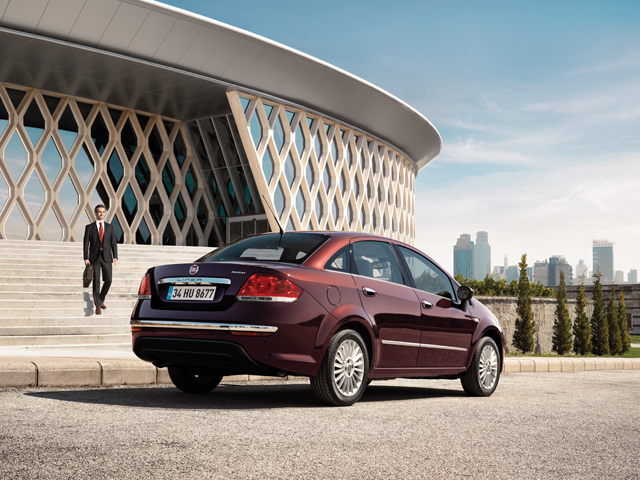
Fiat Linea 2013

Finally from Turkey arrives the last news. The Linea, Turkey’s  best selling car, has received its first facelift since it was introduced in 2007. The make up affects the outside and inside design and allows it to look much better and elegant. Now it comes with a rear spoiler and inside there is a new design for the steering wheel and redesigned instrument panel, and a new dashboard. Engines don’t change: 1.4 Fire with 77HP, 1.3 MultiJet 95 HP and 1.6 MultiJet 105 HP. Inside the whole dashboard and panel were changed and took from the Punto Evo but adding better looking materials. Fiat produces the Linea along with local producer, Tofas, and this year it has become country’s best selling cars beating its rivals from Renault, the Thalia and Fluence. Jan-Apr sales figures indicate that 8.710 units of this sedan (C-segment in Turkey) were delivered, up 13% in a whole market that drops 19%. Eventhough the good result, it is practically the unique successful model of the company as the Albea sedan (B-segment) is getting really old and its sales falling dramatically. Turkey is an important market that is expected to grow to interesting levels in the next years.

Fiat Linea interior

Source: Automotive News, FGA, Auto Esporte

Fiat Italy: Mirafiori staff will go home for 8 days

Fiat’s headquarters will close for 8 days, 4 in June and 4 in July, saving the company $1 million euros per day. This means all staff members: Centro Stile, engineering and manufacturing operations, sales and marketing, purchasing and administrative functions. The people working in these fields will go home and get payed 80% of their salary to be funded by Cassa Integrazione, Italian temporary layoff program. The source says that these days will be June 14-15 and 20-21, and 4 more days in July, besides the regular vacations they all have during August. This move intends to reduce costs as car sales continue to drop in Italy and Europe, and consequently profits. Nevertheless overall results are being well supported by America’s operations (Chrysler Group) and Brazilian car market.

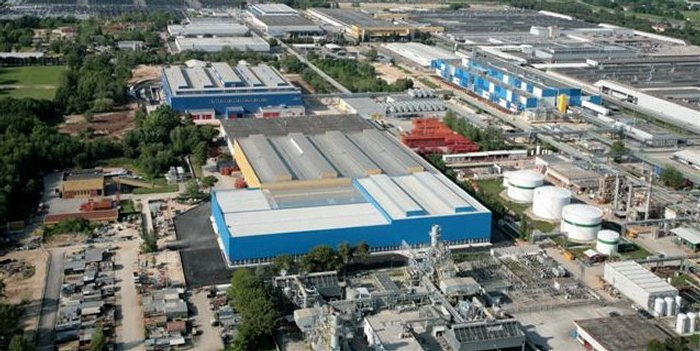
Mirafiori Turin Factory and Headquarters for Europe, Middle East and Africa. For years it used to be Europe’s largest car factory. Photo by Michele D’Ottavio/BuenaVista, Copyright

Meanwhile Marchionne is looking for help in European Commission to face the problem of overcapacitiy in production most of European car makers are dealing with. Marchionne, who is also president of ACEA, European auto lobby group, said this week that the EU should create an extraordinary plan for a common framwork for factory closures across countries, as he identifies serious overcapacity problems in Germany (Opel), France (Renault and PSA) and Italy (Fiat). According to IHS Automotive, the excess of production may be about 2 million cars in 2012 while sales fall with an estimated cost of $7.4 billion euros, according to UBS estimations. In the other hand there are VW, Daimler and BMW that oppose to this European intervention as they are using around 90% of the capacity of their factories selling their cars not only in Europe but in China also, while the rest of Europeans car makers are using 60-75% of capacity.

Source: Bloomberg and Automotive News

Why so good in America and so bad in Italy? Opinion

Illustration by Automobile Magazine

On friday Fiat SpA released the Group’s results for May 2012 in Italy and USA. Unsurprisingly sales figures confirmed the recent trend: America’s rise up and Italian deep crisis. Those are frequent results since last year when the new Fiat-Chrysler Group began to see a shift in car registration growth from its native Italy to its new native America. 3 years ago, when Marchionne signed the deal with Obama’s government, was Fiat saving Chrysler from bankruptcy. Now is not that Chrysler is saving Fiat from disaster, but because of several facts to be explained in this article, Chrysler Group is now leading the match to make of the Group one of ‘big six’ of the world, while Fiat Group deals with big problems in Europe and tries to maintain its success in Brazil. To try to explain the reasons of this situation with only one fact would be unsuitable. Behind the uprising of Chrysler and the crisis of Fiat, there is a connected net of things that can explain why Chrysler, without any all-new model is having continuos sales growth while Fiat, with some new models, is looking deseperate for solutions to not to sink.

First of all there is the Economic crisis reason. The financial problems that took place in USA in late 2008 affected first American economy and then European one. But while America is more or less getting over it Europe add the debt crisis of some of its EU members like Greece, Ireland, Portugal, Spain and Italy. Althouhg developed countries are all facing the new scenario in which emerging markets are catching investment flows, the situation of America is much better than Europe’s. The worst has already passed in the US, but not in Europe where is expected a full year 2012 and 2013 with lot of difficulties in terms of unemployment, demand and social destabilization. Italy is part of both, the problem and the solution. Its debt problems are making Italian authorities to rise taxes, and therefore restrict consumption. And with no good perspectives in the short term, here comes the second reason of the gap between F-C sales in USA and Italy. Italians are pesimistic about their future, about getting a job and go ahead. Americans are still having problems but their mood is different as they see the light at the end of the tunnel. And mood is a factor that explains perfectly the situation. When people don’t believe in better things to come they don’t care about the future and rather think of their present as a survival exercise. In the other hand, when some of main economic indicators show that the worst of the crisis has just passed, then people start to change their habits and be more positive about coming days. The mood certainly affects car industry, as a car is a product that costs, and is part of people’s main assets.

Auburn Hills now shines. Photo by http://news.ottawadodgechryslerjeep.com

Actually the mood among citizens (or buyers) can be seen in other fields. If one watches any interview or statement of Sergio Marchionne, it will be evident the change of mood when he talks about Chrysler and America and when he mentions Fiat and Italy. His face changes. Yes, Fiat Italy is just giving him problems, but the good mood he projects when he is in Auburn Hills should be the same or better when he is in Mirafiori. People notice it and coming from him, has an impact on the organization, composed by powerful labor unions that every day communicate Italians their dissatisfaction with corporate decisions. It is not the intention to evaluate who is right in their demands, but this tense situation between board of directors and labor unions is generating a bad image of Fiat among Italian buyers. And that’s the other reason that can explain the gap between Chrysler’s sales in USA and Fiat’s in Italy. All car makers are having sales drops in Italy, but Fiat also worries because of the economic impact of its latest corporate decisions. Italians don’t like the idea of shifting production abroad (Poland, Serbia, USA, Mexico and now China), and they blame Fiat of being part of the unemployment problem there is now in Italy. If it is true or not, the reality is that ‘Fabbrica Italia’ plan has not been enough to project the idea that Fiat works for Italy. And that is probably the main problem now: Italians are tired of the status quo that has not brought the solution for their problems, and Fiat is part of the status quo.

Of course it is also a matter of offer. Although the new Panda was introduced in late 2011, and new Ypsilon or the rebadged Fiat Freemont are doing a good work since their launch in Geneva 2011, it has not been enough to change the trend. Fiat has decided to postpone the launch of new models waiting for better economic scenario arguing that most of European car makers are loosing money with their latest products. Fiat may not be loosing money but they are certainly loosing market share. The Punto, which was among Europe’s best selling cars, is now passing through its 7th year of lifecycle with remarkable sales drop Italy included, and there is no replacement model until 2014. Fiat Group’s model range in Italy is dramatically reducing: Fiat just offers 3 different small cars, Alfa has just 2 models at all, and Lancia survives thanks to its Ypsilon, that by the way is only successful in Italy. In this context, selling cars become a hard job. Fiat can not depend on economic cycles to develop its models. The models must be able to generate cash and support the production eventhough there is a big economic crisis, so a decision like the postponement of next Punto is going to increase the sales drop in a market that loves A and B-segment cars.

FIOM Labor Union protests. Photo by selvicenza.blogspot.it/

Finally, another fact that is playing against Italian Fiat’s sales is the role of government. Italian authorities continue to atack car industry through new taxes (super bollo, etc.) and making more expensive the price of gas. It has a direct impact on the demand in a moment in which people are struggling to keep their jobs and go on. The coming incentives for low emission and electric cars may be a good solution, but at the end an industry that depends on economic help is a none feasible industry. The role of government should be of generating good conditions for the whole industry and not creating new obstacles or distorting it with artificial and unsustainable incentives. Fiat made a good move with the gas promotion announced recently. All of these factor explain the increasing gap between the results in both sides of the Atlantic. What is next is to learn from what’s happening in America and anticipate it in Italy, but quickly, really quickly.

Italy’s figures include Fiat, Alfa and Lancia numbers only. Source: carsitaly.net, Chrysler Communications and Quattroruote.it

Italy: Fiat-Chrysler falls 11% in a whole market that drops 14%

It seems that Fiat Panda will become Italy’s best selling car this year dethroning Fiat Punto, always #1 since 1993. Photo by netcarshow.com

Again bad news coming from Italy. In May the whole market falled 14.3% with sales of 147.102 units against 171.559 of May/11. Economic crisis and high prices of gas continue to affect negativelly Italian’s will of buying new cars. Nevertheless the overall fall May 2012 is the best performance in the whole year after even worse months in Jan-Apr/12. It does not mean that the trend is changing but it means it is more or less stabilizing. Of course Fiat-Chrysler Group is feeling the bad results. Unlike what happens in the USA, the group continues to see bad numbers and May was not the exception eventhough the total number of registrated cars falled less than the whole market allowing to have a better market share. In the last month the whole group quota rised to 31.6% more than the result obtained in 2011 when it was 30.57%. In other words Fiat is suffering the car industry crisis but not as much as its competitors (especially Ford). It is good news in a bad context.

The lack of new generation is affecting negativelly the performance of Fiat Punto, on market since 2005. Photo by netcarshow.com

The rise of F-C’s market share is explained by excellent performance of Fiat Panda during May/12. A total of 12.813 new Pandas were registrated, 27.5% of the 46.500 units sold by the whole group. The Panda has had the best market share (8.7%) since May 2009 when it reached 8.8%. It has been also the best month of the year for the small car and it grows 6.2% compared to May 2011. The rise on the whole group’s market share is also explained by the good results of Lancia Ypsilon, which was up 15.1% on an annual basis. Other models that did quite well were the Alfa Rome Giulietta, +3.1%, Fiat Freemont, up 239% (it was introduced one year ago) and Jeep Grand Cherokee, up 278% from 47 to 178 units. But all these good results were not enough to offset the bad performance of Fiat Punto (-26.4%), Fiat 500 (-19.5%), Lancia Delta (-36%), Lancia Musa (-40.5%), Alfa Romeo MiTo (-41.9%),  and others. Certainly the fall of Punto is dramatically affecting the group’s results. B-segment is Italy’s biggest one and Fiat seems to postpone and postpone the arrival of new generation making buyers to move to other brands such as Toyota or Peugeot (the new Yaris was up 31.4% and new 208 begins to like Italians). In the case of Fiat 500, total sales were down but it had its best month during the year and is still far away from its new feared rival, the VW Up! that seems to finally take off with 1.224 units delivered. It is also important to mention that Alfa Giulietta sold more units than its eternal rival, the VW Golf: 3.473 vs. 3.116. The lack of a Station Wagon for the C-segment Alfa does not allow to obtain much better numbers as this kind of body type is really appreciated in Italy (in May they had a market share of 8.4%). The VW Golf had a spectacular fall of 44.8%. All brands falled: Fiat was down 9.8%, Lancia (-10.1%), Alfa (-20.8%), Jeep (-13.6%). The luxury ones had the deepest fall, Maserati (-86.6%) and Ferrari (-58.6%), explained mostly by the superbollo tax that affects considerably expensive cars.

In May/12 the Alfa Romeo Giulietta sold more units than its eternal rival, the VW Golf. Photo by netcarshow.com

May 2012 leaves two main conclusions: Italian car market will not stop dropping for long and new models of the Group (Panda, Ypsilon, Giulietta, Freemont, Grand Cherokee) are doing their best to compensate the fatigue of old Punto, Bravo, Delta and MiTo. But this situation is unsustainable and if new generations are not coming, Fiat will see its home market share to drop dramatically.


Source: Unione Nazionale Rappresentanti Autoveicoli Esteri and bestsellingcarsblog.com

Italy: buy a Fiat and get more than 3 years of gas at $1 Euro

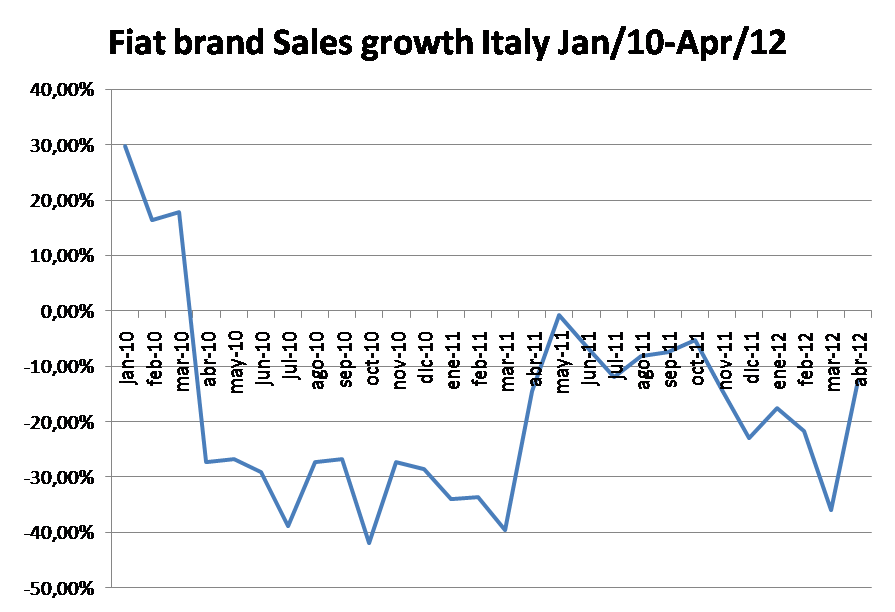
Today Fiat announced its latest promotion. All the people in Italy who buy a Fiat (only Fiat brand) until July 31/12, will have gas price at $1 Euro/Liter until December 31 of 2015! The user will be able to buy the gas in any IP gas stations (3.700 in Italy) using a card that only works for his Fiat. The promotion varies depending the model: for example, with this price, the Fiat Panda will have available up to 1.200 liters during the period of time, while the Punto will have 1.700 liters and the Bravo up to 2.000 liters. It is certainly an interesting promotion especially if it takes into consideration that the price of $1 Euro/L will not change until December 31 of 2015. Fiat brand is facing a drop on sales in Italy since April 2010 because of European debt crisis that is affecting Italy and other European markets.

Fiat brand has not been able to have positive sales growth in Italy since April 2010

Opinion: Alfa must stay

Image

There is one Golden rule in business which says that you should never reveil your real intentions especially when it is about something you really want. It has been a constant since negotiation has been part of society. People, companies and countries have been doing it in order to get whatever they want. Car industry is not the exception. Although the big deals became popular about 20 years ago, all car makers that still exist had to negociate to grow. Nowadays the fact of closing a deal means to survive.

Alfa Romeo Giulietta. Currently on production for C-segment

Alfa Romeo Giulietta. Currently on production for C-segment

Three years ago, Fiat Group Automobiles signed a deal with American government to get a part of troubled Chrysler in exchange of technological transfer. This smart play allowed Italians to finally access to the American market with an important market share. Meanwhile Fiat’s board was dealing with another problem: Lancia and Alfa Romeo’s sales. Both companies have been loosing market share in Europe during the last ten years. Lancia, strongly dependant on Italian market, got its first life vest from Chrysler. But Alfa Romeo was in a worse situation: even though is less unpopular than Lanchia in the rest of Europe, its model range was being reduced as the demand was dropping dramatically. But ‘suddenly’ appeared Volkswagen.

Alfa 4C Concept presented in Geneva 2011. Available from 2013

Alfa 4C Concept presented in Geneva 2011. Available from 2013

Current financial crisis has been the scenario for three different situations: those car makers that finally died, Saab, Pontiac, Mercury; those struggling to survive, most; and those car manufacturers making useful of it, VW. Germans from Volkswagen keep a sales growth despite the deep crisis in its native Europe. This good moment allowed Mr. Ferdinand Piech, chairman of the supervisory board of Volkswagen Group, to look for more brands to increase its size and power. What Mr. Piech forgot was the golden rule: he made public his intentions to take over Alfa Romeo. And he has not done it once: more than three or four times he has repeated VW wants Alfa to be part of it.

Alfa Romeo MiTo. Photo by es.autoblog.com

Alfa Romeo MiTo. Photo by es.autoblog.com

Behind this public statements, there is for sure his intention to destabilize Alfa, its immediate future (coming plans and models) and generate a debate among Italians. Is it convenient to sell the Biscione to Germans? Can’t really Fiat take it to the road of success? some people say that if it is necessary for the brand to survive, the sale to Germans should be done. Other think Alfa is Italian and must continue being so. Personally I think Fiat guys ce la fanno: they can and must do it. This is not the first big crisis they have had. Fiat people are really prepared to face problems: two world wars, oil crisis, quality problems in late 90s and the begining of 00s. All of those periods have been tests they have been able to performed quite well. Besides the new scenario for Fiat after Chrysler’s takes over, offers an excellent perspective for Alfa as it opens them world’s second largest market, while they keep working in other fronts such as Asia. Fiat has the know how of making awesome shapes and great technologies to project excellent Alfas. They have the factories to do it. And the most important: the people.

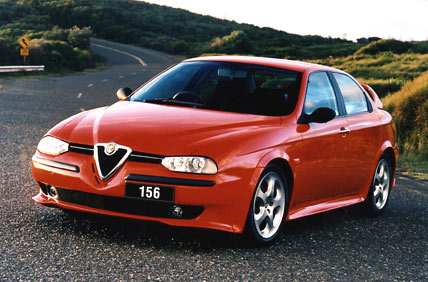
1997 Alfa 156, a big success for the company. Photo by drive.com.au

1997 Alfa 156, a big success for the company. Photo by drive.com.au

And they must do it. Fiat-Chrysler has to demonstrate the world they can deal with this situation of taking Alfa to become a global profitable brand. It’s a matter of telling the industry that capability and will are part of their people. It is a message to people in which they say is just a matter of time. The problem is that time is short and expensive, and therefore they must hurry: Alfa has just two models on production and several plans (return to the US market, futury sporty cars, SUV, etc.) but they need to become real as soon as possible as Germans are gaining the world, while Koreans keep pushing and Japanese defend their empire.

Alfa Romeo has to be part of Fiat Group because Fiat belongs to Alfa as Alfa belongs to Fiat. They need each other. Alfa’s potential of offering a big range of sporty Italian models is a big opportunity to conquer not only America but the Middle East, the rising rich China and Russia. Alfa is part of Italy and therefore it must stay in Italy making use of what only Italians can do: the ‘Made in Italy’ touch with the passion they have for making cars.