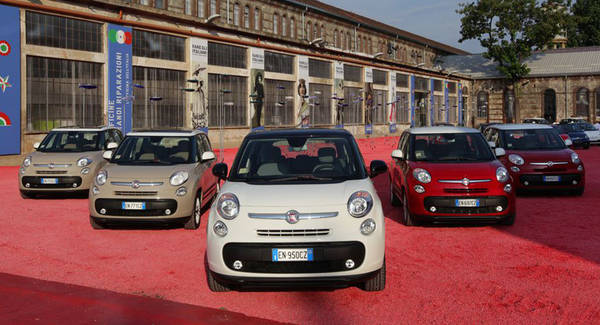
Italy: 500L helps Fiat to keep its share in Nov/12

Photo by: Ansa.it

Photo by: Ansa.it


One more terrible month for Italian car market. In November 2012 the market fell 20.1%, which is as bad as the months before October, when the fall slowed down (-12.4%). One year ago the market fell 9.3% compared to November 2010, but two years ago, in November 2010, the market had a deeper fall (-21.1%). All those numbers explain the hard moment of Italian auto industry and the difficult coming months. However analysts have said that the fall should stop in 2013, and the recovery should come in 2014. Now Italy is Europe’s fourth largest market far behind its eternal rival, France. In that scenario Fiat Group maintained its market share thanks to some specific models. The whole group plus Jeep managed to rise its market share from 28.49% on Nov/11 up to 29.74% last month. This is particularly good news in current situation. Fiat Group sells fewer cars now but is catching share from other auto makers, which are doing worse than the Italians. Nevertheless the ‘good’ fact is explained by only one brand of the group, Fiat, which is down ‘only’ 14%, far from total market’s fall, farther than the other brands of the group, and even much farther than competitors from Germany and France. That is why Fiat brand occupies a bigger place in the group: last year its sales counted for 71% of the group’s total. This year its share in the group is up to 73.5%, which is too much, but is explained by the fact that Lancia and Alfa Romeo (the other 2 ‘big’ brands) don’t have a big range of products. This time Alfa Romeo had a big fall and its Giulietta model did not maintain its sales figures as it happened in previous months. Lancia, down 23.4%, is in complicated situation as it is really dependent on Italian market and the new Ypsilon keeps falling more than total market.

Among mainstream brands Fiat did quite well. Alfa and Lancia continue to fall. Too bad for VW, Renault and Opel. Source: UNRAE, bestsellingcarsblog.net

Among mainstream brands Fiat did quite well. Alfa and Lancia continue to fall. Too bad for VW, Renault and Opel. Source: UNRAE, bestsellingcarsblog.net

After Fiat, then comes Ford as the best-selling brand in Italy. It was down a massive 21%. Then comes VW, which for the first time falls more than total market, down a shocking 27% (it is perhaps its worst result in Europe). A worse situation for Opel, Citroen and Renault. The only big brand to have positive results is Peugeot (now ahead of Lancia). Toyota fell 9%, while Kia is up an incredible 10%. So compared to its main rivals Fiat did very well, but Lancia is in a difficult situation, while Alfa Romeo does not that bad considered the fact that it only offers 2 models. There is concern about Lancia, as it can’t reach not even 5% of the market and Italy represents more than 85% of its sales. So, Lancia faces two difficulties: it does not sell as before in a market that continues to fall. Alfa Romeo is somehow in a better situation, as it is not that dependent on Italy. This year will be by far the worst for both brands in the last 2 decades. Going further, Fiat Group’s share increases due to specific models. Fiat models to have positive result were the new Panda (a tiny growth) and the new 500L which could be the protagonist of the month. The new small MPV was Italy’s 10th best-selling car and could be Fiat’s new star in coming months according to what happened in November. More than 2.000 units were sold that month. That’s a result that can be analyzed from two points of view. 2 thousand units for an all-new model in its third month of life is nothing. But if current situation is taken into account, then the 500L is a complete success. It can be also a kind of savior of Fiat Punto as its gets old while the 500L is a B-MPV that can perfectly fit the needs of those looking for a subcompact. In the opposite side the 500 had a big fall, even worse than Punto. Lancia sold almost 3.100 Ypsilon, down a massive 37%, which is a lot. The Musa, which should be out of production soon, increased its registrations 54%. Finally the Giulietta, which used to be in top 10, now occupies place 14th with almost 1.800 units, down 26%. It was the deepest fall among Alfa Romeo models.

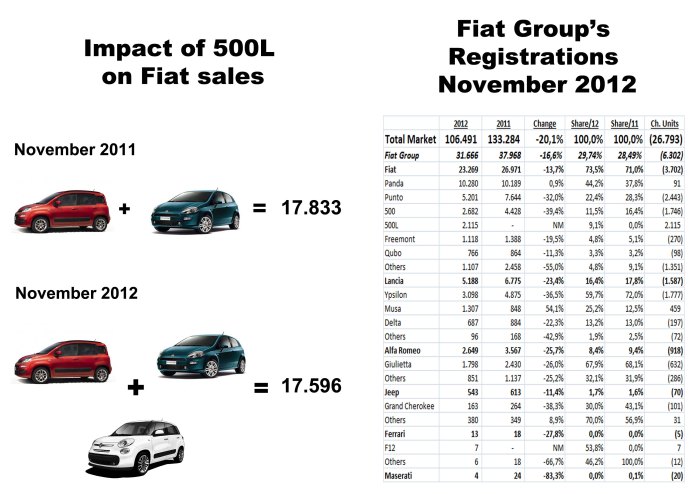
The Panda is the only important model to grow in November. The 500 had a terrible month. The Punto continues to fall and is extremely close to Ford Fiesta's registrations. Too bad for the Ypsilon. The Giulietta falls but not as much as all of its competitors. Source: UNRAE, bestsellingcarsblog.net
The Panda is the only important model to grow in November. The 500 had a terrible month. The Punto continues to fall and is extremely close to Ford Fiesta’s registrations. Too bad for the Ypsilon. The Giulietta falls but not as much as all of its competitors. Source: UNRAE, bestsellingcarsblog.net

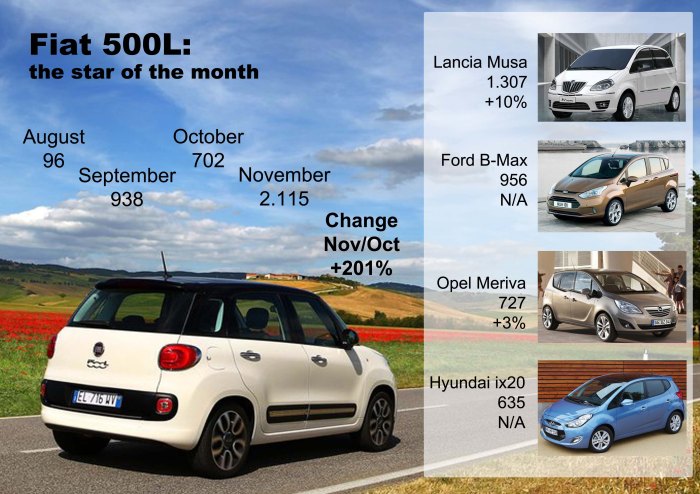
The 500L was Fiat Group's 5th best-selling car in Italy. It is the leader of the segment. Good month for the Musa and B-Max. Source: UNRAE
The 500L was Fiat Group’s 5th best-selling car in Italy. It is the leader of the segment. Good month for the Musa and B-Max. Source: UNRAE

Panda stable. Punto declines. 500L grows. The right equation for the crisis. Source: UNRAE

Panda stable. Punto declines. 500L grows. The right equation for the crisis. Source: UNRAE
Click here to see Italy December 2012 results

Click here to see Italy October 2012 results

Brazil November/12: concern about Fiat Uno

The Uno Cabrio Concept should be the first Marketing exercise of what Fiat could do with the popular model in order to explore other subsegments

The Uno Cabrio Concept should be the first Marketing exercise of what Fiat could do with the popular model in order to explore other subsegments

Last month Fiat sold 71.333 cars in Brazil. It means the brand keeps its pole position with sales up 7.6% compared to Nov/11. It is also good from the point of view of market share that rises up to 24.02%, 3.23 points ahead of VW. All of that was possible thanks to higher passenger sales registrations (+10.3%) and due to the fall of total market (-9.1%). However there are some things that did not go that good such as Fiat Uno and LCV’s registrations. From Fiat’s total, 82% corresponded to passenger cars while LCV lost market share (last year they counted for 20% vs. 18% last month). Nonetheless Fiat is the leader in both segments: 25.16% of share in passenger  segment (2.56 points ahead of VW), and 19.89% in LCV segment (5.62 points ahead of VW). Fiat continues to grow in a relatively stable market despite the arrival of more competitors with really interesting products. It is good but does not tell anything about coming months, which will be very difficult not in terms of economic forecasts but in terms of competition. For the first time last month Hyundai was part of top 10 best-selling passenger cars brands surpassing Honda, Toyota, Nissan and Citroen. That’s  certainly an amazing result that shows how far Koreans can go and what their plans for Brazil are. The reason for that growth is the introduction of the B-Segment HB20, an interesting subcompact hatchback that will be a headache for Fiat Palio’s sales in 2013. The problem is that no all-new Fiat  is planned to arrive in the next months, so Fiat could begin to feel the presence of the Korean.

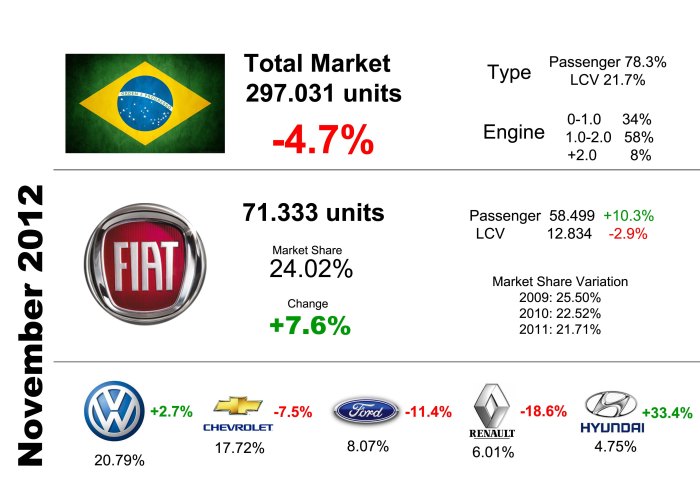
Fiat was again the leader in both segments, Passenger and LCV. Most of car sales correspond to engines between 1.0 and 2.0 liters. Fiat's share is much better than previous year's. Very bad results for Renault. Hyundai impresses. Source: Fenabrave

Fiat was again the leader in both segments, Passenger and LCV. Most of car sales correspond to engines between 1.0 and 2.0 liters. Fiat’s share is much better than previous year’s. Very bad results for Renault. Hyundai impresses. Source: Fenabrave

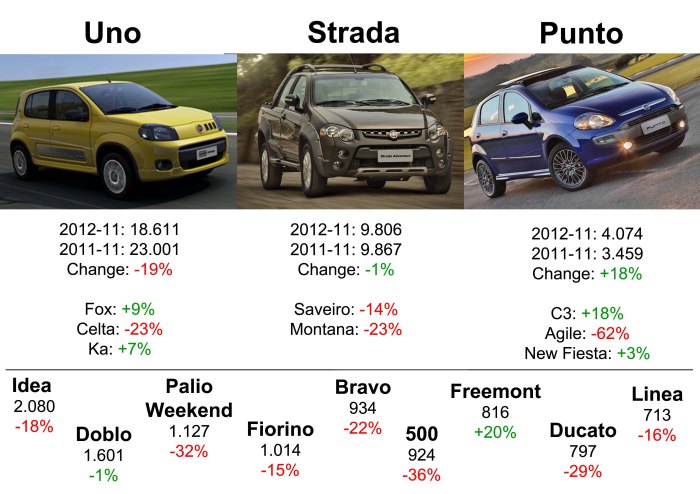
Fiat did better than VW. Last year 6.161 units separated them. Last month Fiat was ahead of VW with 9.589 cars. Fiat increased its registration 7%, while VW is up 3%, and GM, third largest Brazilian car maker, is down 8%. The arrival of Hyundai has had a direct impact on Ford and Renault, down 11% and 19%, while the Korean is up a massive 33%. For Passenger cars only, Fiat is up 10%, VW +4%, GM -8%, Ford -19%, Renault -31% and Hyundai +62%! The new HB20 is catching Renault Sandero and Ford Fiesta’s sales while Gol and Palio one’s don’t suffer yet. But the arrival and success of the locally made Hyundai is not the unique event. Fiat’s top seller, the Uno, continues to slow down while the Palio is really close in terms of units sold. In November the small Fiat is down 19% and the Palio is up 78%. If a close analysis is made, Uno’s decrease is not due to spectacular increases of its rivals. It means that maybe there is cannibalism between the Uno and Palio. They belong to different segments but cheapest Palios may be catching sales from expensive Unos. However the Uno continues to be Brazil’s second best-selling car and a very important product for Fiat, but something must be done in order to stop the fall (a restyling should arrive next year). Other products did quite well: the Siena (+63%) and the Punto (+18%), but not the Strada, down 0.6%. At the end there is more positive than negative news coming from Fiat Brazil, though it does not mean that more must be done and new products should arrive. One of them should be a small SUV, in process at Centro Stile in Turin, to gain market share in this segment which will have a big growth in the coming years.

This figure shows that Fiat's growth is mainly explained by the good performance of Palio and Siena. Too bad for Bravo/Linea and 500. Source: Fenabrave

November 2012 Brazil. This figure shows that Fiat’s growth is mainly explained by the good performance of Palio and Siena. Too bad for Bravo/Linea and 500. Source: Fenabrave

The new Palio and Siena are the protagonist of Fiat's growth. Both of them do much better than its closest competitors. The new Hyundai and Chevrolet Onix may impact Palio's sales in 2013. Source: Fenabrave

The new Palio and Siena are the protagonist of Fiat’s growth. Both of them do much better than its closest competitors. The new Hyundai and Chevrolet Onix may impact Palio’s sales in 2013. Source: Fenabrave

Click here for Brazil October 2012 Results

Japan: when a threat becomes an opportunity

Japan-Europe FTALast week some auto news talked about the coming negotiations between European Union and Japan looking for a Free Trade Agreement. Both economies could sign a deal in which their exports could access to each market without paying taxes. Europe needs to increase the number of destinations for its goods while Japan could benefit from having free access to one of world’s largest markets. This would be the ideal scenario: both parts could strongly benefit from the deal. However it is not always like that every time a trade agreement is signed, a part of the economy is not necessary a beneficiary of it. This time it seems European car industry could have problems in case Japanese car industry gets free access to Europe. According to ACEA the industry could lose around 73.000 jobs as a consequence of more cars coming from Japan. They say that by eliminating 10% tax to imported Japanese made cars, Japan could become the ideal place to build cars and therefore the current situation of over capacity production in Europe could get even worse. Certainly a scenario like that is not good for any European auto maker, but looking at it closer, some opportunities could arrive to specific car companies. The challenge is to make this big threat an opportunity and Fiat with its small cars and its possible alliance with Mazda, could be a big winner of the agreement.

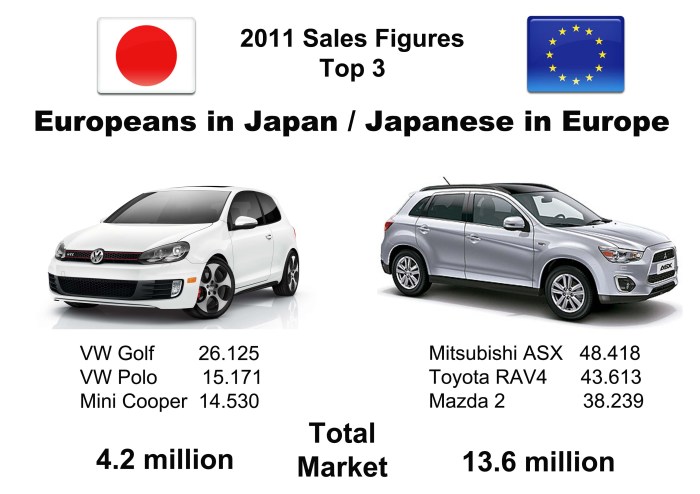
Last year the Golf occupied place # 30 among best-selling cars in Japan. Japenese sold more units but had less market share as they produce a big part of their cars in Europe. Source: bestsellingcarsblog.net

Last year the Golf occupied place # 30 among best-selling cars in Japan. Japenese sold more units but had less market share as they produce a big part of their cars in Europe. Source: bestsellingcarsblog.net

Currently Japan does not charge any taxes to regular cars coming from Europe, while Japanese made cars must pay 10% of taxes to enter European market. However when it is about small cars (Kei-cars) the legislations is completely different. Every imported kei-car must pay 35% of taxes to access Japanese market and that is the big deal of the agreement. Kei-cars are a category of small vehicles that must comply some requirements in order to benefit from fiscal incentives. The idea was born just after WWII when most Japanese people did not have enough money to buy a car but a motorcycle. It is why since 1949 the government created this segmentation in which any car under 2.8 m length and 150 cc engine could benefit from fiscal incentives. More than 60 years later Kei-cars are Japan’s most popular segment with almost all Japanese auto makers making part of it. Now Japanese legislation indicates that only those cars under 3.4 m length, 1.48 m width, and maximum 2 meters tall, with a maximum engine of 660 cc and 64 HP, can apply to become a kei-car. They are charged with 3% VAT against 5% for other cars. Besides the owner of a kei-car pays less total weight taxes (30% less than regular cars). Insurance cost is about 187 euro every 2 years, while regular cars must pay 222 euro. As this kind of cars are powered by small engines, their owners have to pay less displacement taxes. In other words driving a kei-car in Japan means money-saving*.

This year Kei-cars increased their market share up to 36.7%. This kind of cars makes of Japan the world's largest market for A-Segment cars. A good opportunity for a possible kei-car Fiat. Source: Autoblog Español, bestsellingcarsblog.net

This year Kei-cars increased their market share up to 36.7%. This kind of cars makes of Japan the world’s largest market for A-Segment cars. A good opportunity for a possible kei-car Fiat. Source: Autoblog Español, bestsellingcarsblog.net

That is mainly the reason for their success. Kei-cars are so popular in Japan that last year they made 36% of total sales, with more than 1.5 million units. This year sales are up 36% till October with more than 1.7 million units sold, 36.7% of total sales. Daihatsu and Suzuki have been traditionally the leaders, but Honda, Nissan, Toyota, Mitsubishi, Mazda and Subaru are part of the segment. As it is an important part of Japan’s car market, Japanese do really protect it from imports. Therefore all imported kei-car must pay 35% import tax, which is really high and explains the lack of offer coming from abroad. No foreign auto maker sells a specific car for this segment as it is not profitable for them to develop a car under those conditions. A possible free trade agreement with European Union could solve this problem. One of the things European auto makers ask is to eliminate this tax for imported kei-cars, and that is where the opportunity appears. Though it is not really probable Japanese authorities will open their kei-car market to European imports, a possible scenario like that could really compensate the increase of sales of Japanese cars in Europe, and Fiat would be for sure a clear winner.

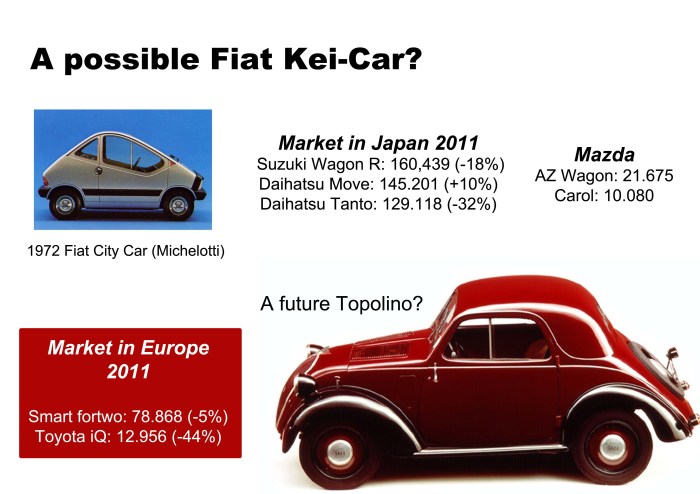
In case Europeans have access to Japanese Kei-Car market, Fiat could start production of a new version of the Topolino in its Italian factories (not Serbia as it is not part of the EU). In the 70's they already tried with the concept 'City Car'. Mazda's position in the segment is still small. Source: bestsellingcarsblog.net

In case Europeans have access to Japanese Kei-Car market, Fiat could start production of a new version of the Topolino in its Italian factories (not Serbia as it is not part of the EU). In the 70’s they already tried with the concept ‘City Car’. Mazda’s position in the segment is still small. Source: bestsellingcarsblog.net

At the same time all this was happening, Mazda’s CEO, Takashi Yamanouchi, said at LA Auto Show that both companies, Fiat and Mazda, are analyzing what other models they can build together, besides the Alfa Spyder and next Mazda MX-5. Mazda is not Japan’s leader but is an important auto maker over there and now is looking for partners to develop its future cars. Its position in Europe is not quite good, but it knows it must do more in order to get more. A possible alliance with Fiat could mean to produce jointly developed cars at Fiat’s Italian factories. But Fiat could gain too. Having a deal with a Japanese car maker means to have a better position in that market in case FTA negotiations succeed. Besides, Fiat is Europe’s leader in A-Segment, with its popular Panda and 500. Though both models are longer than 3.4 meters, just the fact of having free access to a market of more than 1.7 million units/year would make Fiat to consider or accelerate its plans of a future mini A-Segment car. For some years press has speculated about a possible arrival of a mini citycar such as the Smart made in Serbia, and called to be the successor of the extinct Fiat Topolino. Launching a car like that under current European scenario would be a disaster, but taking into account the possibility of exporting it to Japan paying zero taxes, would be certainly a good move. If the alliance with Mazda is also considered, then a big and stable market could be just right in the corner. Besides, Fiat’s position in Japanese car market is not bad at all. The 500 is not as popular as in Europe but has sold more than 18.000 units since it was introduced in 2008. If this small Fiat reaches these numbers, and not being included as a Kei-car, then Fiat has a great potential in kei-cars if the tax is abolished.


*Revistadelmotor.es

Fiat Europe October/12: good and bad

The results for Fiat Group plus Jeep in Europe last month are good and bad. Good because Fiat brand decreased its fall and did well in the UK and Spain. But bad because Alfa Romeo and Lancia shrink and German and French registrations continue to fall. European car market fell 4.6% in October 2012 and the whole group did it too but even more: 5.8%. Its market share falls from 6.6 one year ago to 6.5. Total fall could had been worse if Lancia and Alfa Romeo counted for more share inside the group. Their sales in EU + EFTA countries, declined 15% in the case of Lancia and 17.6% for Alfa Romeo. Jeep, which sold only 2.322 units, is up 6%. Once again the group loses market share but this time the fall slows down as Fiat brand managed to increase it. The brand sold 2.7% less than previous period allowing it to increase its share from 4.7% to 4.8%. In October 2012 the group sold 64.736 units (4.016 units less), and Italy counted for 52.6% of them vs. 55.3% of October 2011. It means the group sells fewer cars in Italy (but keeps stable its share over there) and the fall outside Italy is not that deep. The main problems come from the native Italy and France, which is Alfa Romeo’s second market. Compared to its rivals, Fiat Group did much better than Renault, GM and Ford, but is a step behind PSA. VW Group continues to impress increasing its sales volume and therefore its share to a massive 25.5%, almost 4 times Fiat Group’s. Fiat brand occupies place number 8 even after Audi and BMW that now sell more cars. If market conditions continue to aggravate next year Fiat brand could be surpassed by Skoda, which sold 8.557 less cars and is really close to Toyota brand (120 units behind).

It is amazing the way VW manages to rise its market share. Audi and Mercedes stole market share from Renault, Ford and Opel, mainly. Fiat Group did not fall that much as Renault, GM and Ford. Hyundai keeps growing and in October the whole group (Hyundai + Kia) sold 61.810 cars, just 2.926 cars behind the whole Fiat Group. Source: ACEA

The reason for the tiny fall of Fiat brand is explained by the good results in the UK and Spain. Thanks to optimal registrations of the 500 model (in the top 10 best-selling cars in October), the brand is up a massive 39% in a market up 12%. Contrary to those good results, Alfa Romeo does not stop falling, this time 33%, which is too much compared to the good results of Chrysler, up 288%. Alfa Romeo sold 786 units in Oct/11. Last month Alfa Romeo and Chrysler combined sold 686 units. UK has become a kind of substitution market for French bad numbers but the group is still really small in terms of market share (3.4% for Oct/12 vs. 2.9% for Oct/11). Jeep did also good, up 178%, with 339 units delivered. Something similar occurs in Spain: the whole group’s share is up to 3.36% from 2.91% last year. It gained market share due to a lower fall compared to total’s market. Fiat Group plus Jeep fell 9.5% while Spanish car market declined 22%. Fiat brand is up 7.6%, Jeep is up 15%, but Alfa Romeo shrinks a massive 47% and Lancia sells 2 fewer cars. Once again, interesting results but not enough to help the troubled Italian and French figures.

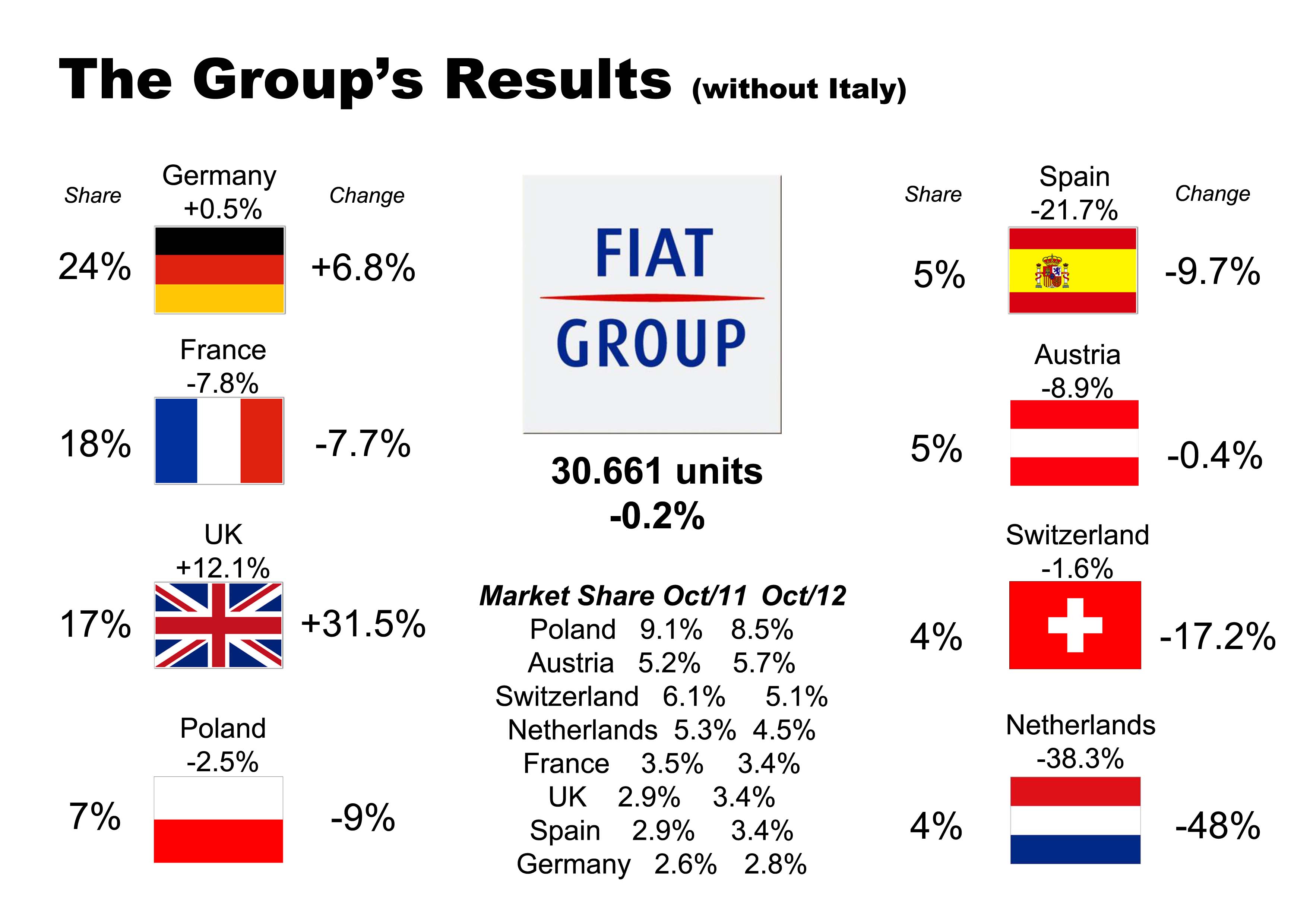
Fiat Group is not really suffering outside Italy. Germany is the largest market in terms of units sold but is the lowest in terms of market share. Good for the UK, Spain and Austria. France is some how stable while the Netherlands and Switzerland did very bad. Source: Autoblog Español, Automotive Austria, ACEA, Rai Netherlands, Auto-Suisse, Carsitaly.net

In France things are going bad but during October 2012 the fall slows down. The market is down 7.8%, much better than previous months results, and Fiat Group declined its registrations by 7.7% thanks to a lower fall of Fiat brand mainly. The brand fell 5.3%, while Lancia increased its registration 1.8% (or 8 more cars), but Alfa Romeo is down 23% (or 259 fewer cars). As it happened in the UK, the 500 model was the protagonist of the month. A record of 2.204 units were sold in October, counting for 54% of the brand’s sales. In Germany, which is Fiat Group’s second most important market after Italy, the group had mix results: Fiat brand is up 8.9% in a market that grew up only 0.5%. But Alfa Romeo declined 20% and Lancia sold only 153 cars, down 0.6%. All brands together (plus Jeep, Ferrari and Maserati) sold 7.244 units against 6.784 in October 2011 (+6.8%). Market share is extremely low at 2.79% against 2.62% for Oct/11. Once again the Fiat 500 is the star with a record sales of 2.310 units. Germany was the largest market for Jeep brand in that month. Too bad in the Netherlands (-38%) where the group sold 1.199 units, down 48%. In Austria (-9%) they all sold 1.497 cars, down 0.4%. In Switzerland all brands sold 1.354 cars compared to 1.637 of last year. In Poland, where Fiat’s share is historically higher than in any other European country, the Group sold 2.169 units (8.5% of the market), down 9%. Generally speaking, Fiat is still strongly dependent on Italian market, which affects its performance as Italy is doing really bad while the good results in other markets is not enough.

This Figure shows the percentage of homeland sales. Almost 53% of Fiat Group’s sales in Europe corresponded to Italy during October 2012. Ford and GM depend on two main markets, while Fiat Group is highly dependent on just one market, which is not good at all. Surprisingly VW Group’s big sales are not exclusively in Germany, which counts for 41% of them. Source: ACEA, Autoblog Español

Chrysler at its lowest market share in Canada

October 2012 wasn’t the best month for Chrysler in Canada. Though they got positive results and total sales are up 3%, it was not enough to compensate the rise of total market. Chrysler plus Fiat brand sold 17.504 units, just 455 units more than previous October, while total market was up 8%. That’s why Chrysler got its lowest market share so far this year: 12.9%. The reason for this result is pretty similar to what happened in USA in the same period. The two best-selling brands of the group increased their sales registration but those were negatively affected by the fall of the other two. Dodge (that counted for 39% of the total) is up 11%, while Ram delivered 5.751 of its cars, up 5% (the Ram is the best-selling car of the group in Canada and occupies place number 2 in Canadian ranking). It means that only Dodge gained market share, thanks partly to the good performance of Grand Caravan (by far the best-selling MPV in the country), up 13%, the Journey (+11%) and more units of the new Dart, which is now Dodge’s third best-selling car over there. The other two brands, didn’t do like that. Jeep was down 10% (or 344 units), and Chrysler fell a worrying 14% (or 205 units). The Wrangler did again quite well (+22%) but the Grand Cherokee slowed down (+3%), the couple Compass-Patriot fell (-10% and -32%), while the Liberty disappeared from sales figures with only 10 units registered. Chrysler’s result is a direct consequence of the extreme fall of 300 model, down 59%, and Town & Country (yes, is the same model of the popular Grand Caravan). Fiat sold 474 units of its 500 model, which is not good at all, well it is the worst second result so far this year and the fourth consecutive month of fall.

Chrysler Group does not include Maserati and Ferrari figures. Source: Good Car Bad Car.

Compared to rivals, Chrysler Group occupied place number 3, but Hyundai and Toyota are really close (369 and 403 units behind). From the 3 of Detroit, they all increased their sales below total market’s, but Ford was the leader in units delivered and growth, while GM fell 5%. VW Group was the best performer of the month. By brands, Toyota, Honda, Kia and VW did better than Dodge (talking about sales growth). In SUV, Jeep fell 10% but its rival from GM, GMC, fell 22%. By models, the Ram’s growth was overcome by F-150’s. Once again Chrysler is the absolute leader of MPV segment. ‘C’ segments models (Chrysler 200 and Dodge Dart) are still far away from the leaders. And the 500 keeps delivering more units but not as in the first half of this year, and seems to resist the arrival of the Chevrolet Spark. As a conclusion, Chrysler needs to upgrade its mid-sized SUV offer, keep its leadership in MPV segment, and boost the sales of the ‘C’ segment sedans, which are really popular in Canada. The arrival of Chrysler 100 should help.

Canada 2012, Chrysler Group sales by model. Source: Good Car Bad Car

1 million Fiat 500 so far!

Not even Fiat expected these results. 5 years after its official presentation in Turin the small Fiat 500 has become one of the best hits of Fiat Group in the last 10 years. The resurrection of the 1957 Fiat 500 became a success that continues to grow and is now a referent for the future of Fiat brand. It appeared just when Fiat was struggling to survive proposing a new concept for a citycar, with a stylish approach, making use of its glorious past and promising future. Thanks to the great work of Centro Stile Fiat in Turin, which was in charged of exterior and interior design, the new 500 had everything to be successful: personality, style, and originality. Soon the car exceeded all its goals everywhere it was introduced. As soon as the car was available in dealerships, Italy was full of them in all of its roads. Then came the UK, France, Germany, Austria, Switzerland. After some months, the car began to be exported to Japan (an instant hit) and Australia. Produced in Tychy, Poland, the small car came to complete Fiat’s offer in A-Segment with the Panda, successful aswell. However the 500 was positioned one step ahead in the segment with a bit higher price to emphasize its idea of a exclusive-popular car. Unlike the Panda, the 500 was not only popular in Italy but in almost every market it was introduced. 2 years after its presentation, Fiat bought Chrysler and this was another reason to keep expanding the 500 success. Chrysler plant in Toluca, Mexico, was chosen to produce the American Fiat 500. With some tiny differences compared to the European version, the 500 made in Mexico meant the come back of Fiat brand to USA and Canada markets.

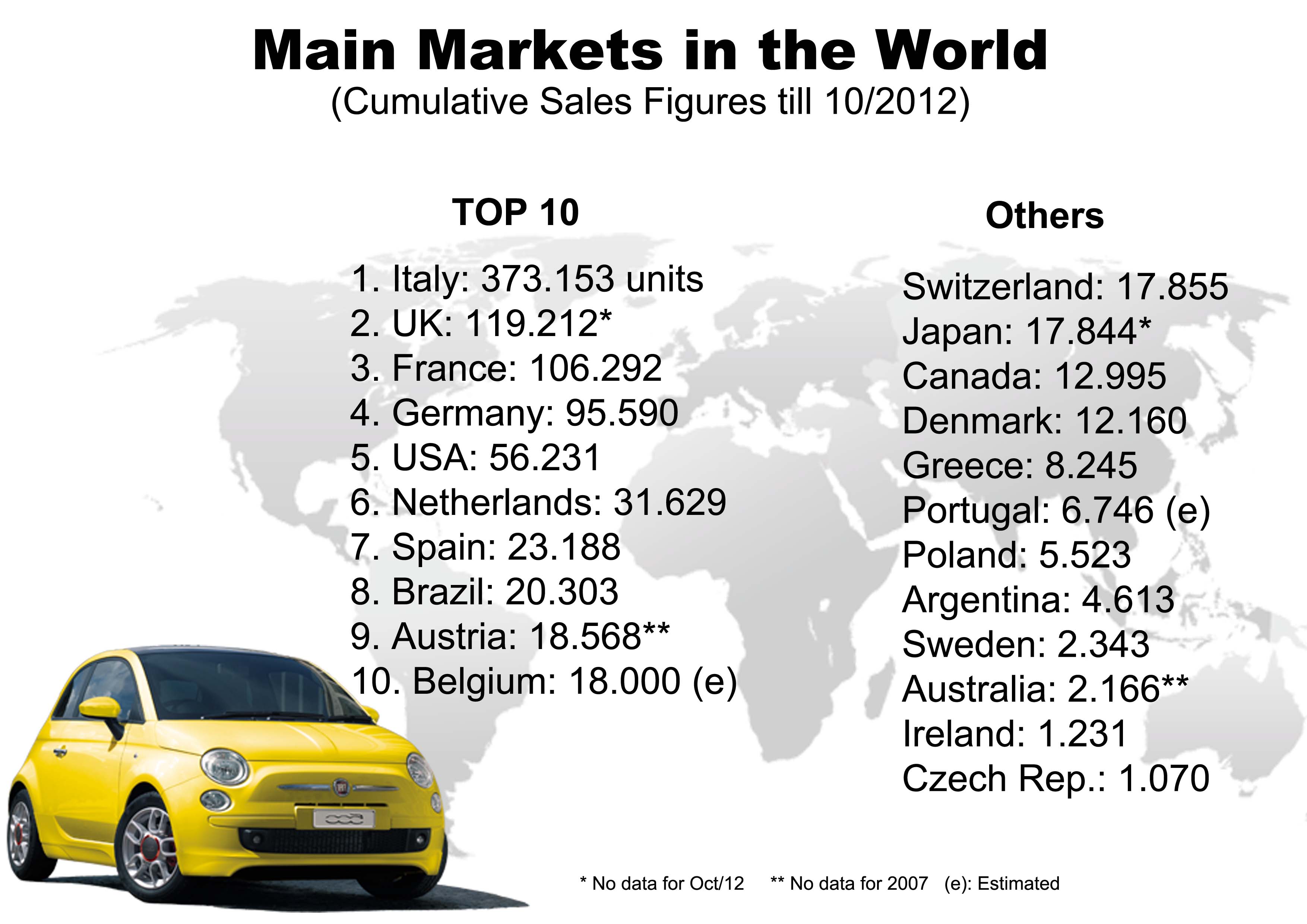
The largest markets for Fiat 500 are located in Europe. From next year US market will be 500 world’s largest one. Interesting to see that the car is not really popular in the countries it is produced, Poland and Mexico. Source: bestsellingcarsblog.net

It is one of Fiat’s most successful models in the last 20 years with so many prizes (2008 Europe’s Car of the Year) and so many special editions for targets that go from the Barbie-girl to the bad boys of Formula 1. Thanks to its success a historical name was born as a brand: Abarth. Fiat decided to overload the small car under Abarth brand with highly sporty specifications that worked extremely well. The car has been part of Fiat collaboration with other brands of the group such as Ferrari and Maserati, and also with fashion (Diesel and Gucci). The reason for this success is mainly explained by the combination of two things: a great product and awesome marketing. The way Fiat has sold the car should be a referent for doing the same for its other models and brands. It is not the cheapest car of the segment but is the second best-selling mini car in Europe. It is not the most comfortable car but has become a referent for single young people or couples. But Fiat has made a big advertising campaign, merchandising, sponsorships and big interaction with people that allow them to know the car and the most important, to desire it. All of that allowed the 500 to become the small city chic car that everybody wanted to have. The good thing is that more sales of 500 model did not affect its brothers Fiat Panda or Punto, as all of them are focused on different targets.

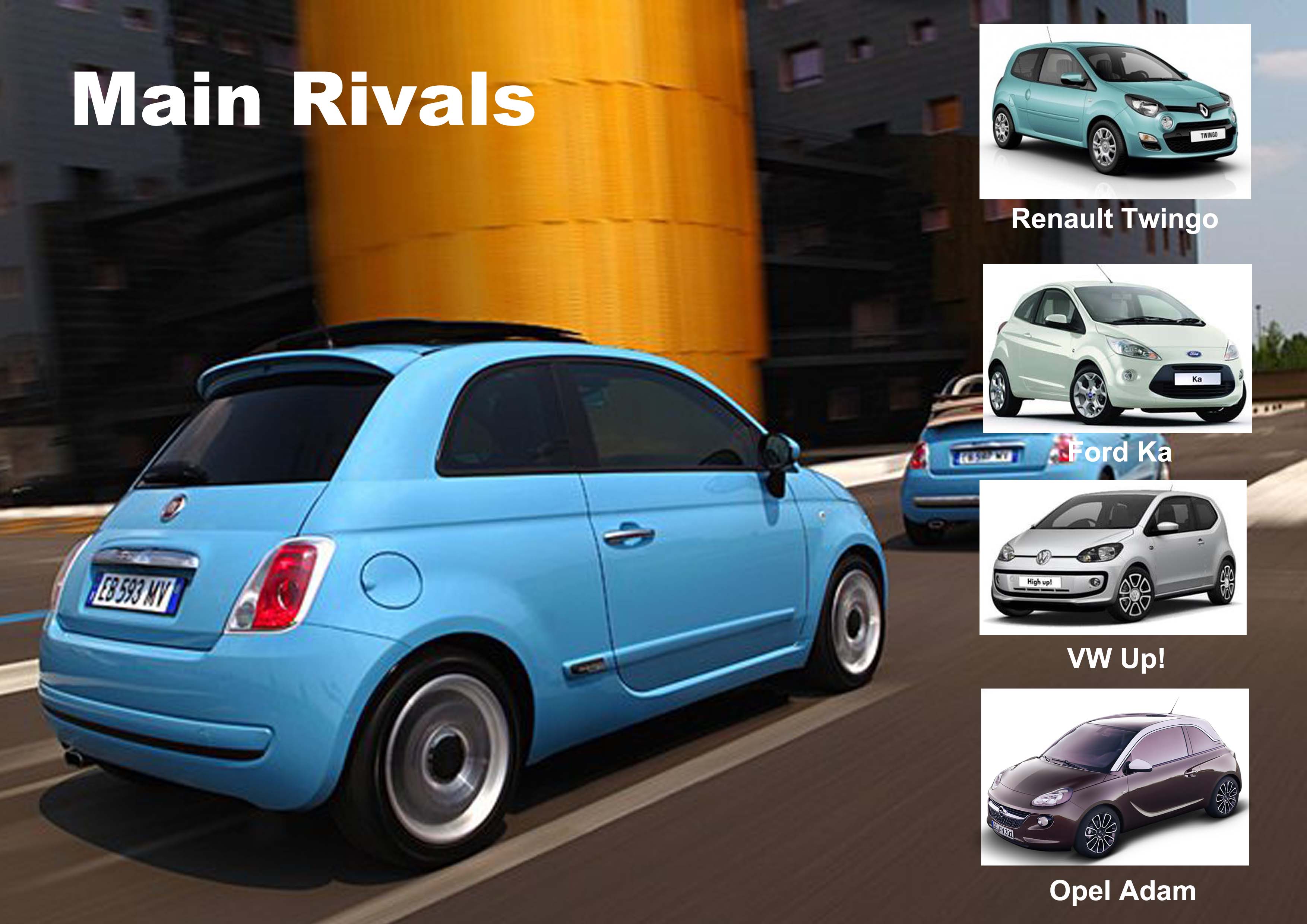
The Renault Twingo is the toughest rival so far, but the new Up! is becoming popular aswell. The Ka, not popular at all is based on the Fiat 500 and produced in the same factory. The Adam is the latest rival to arrive.

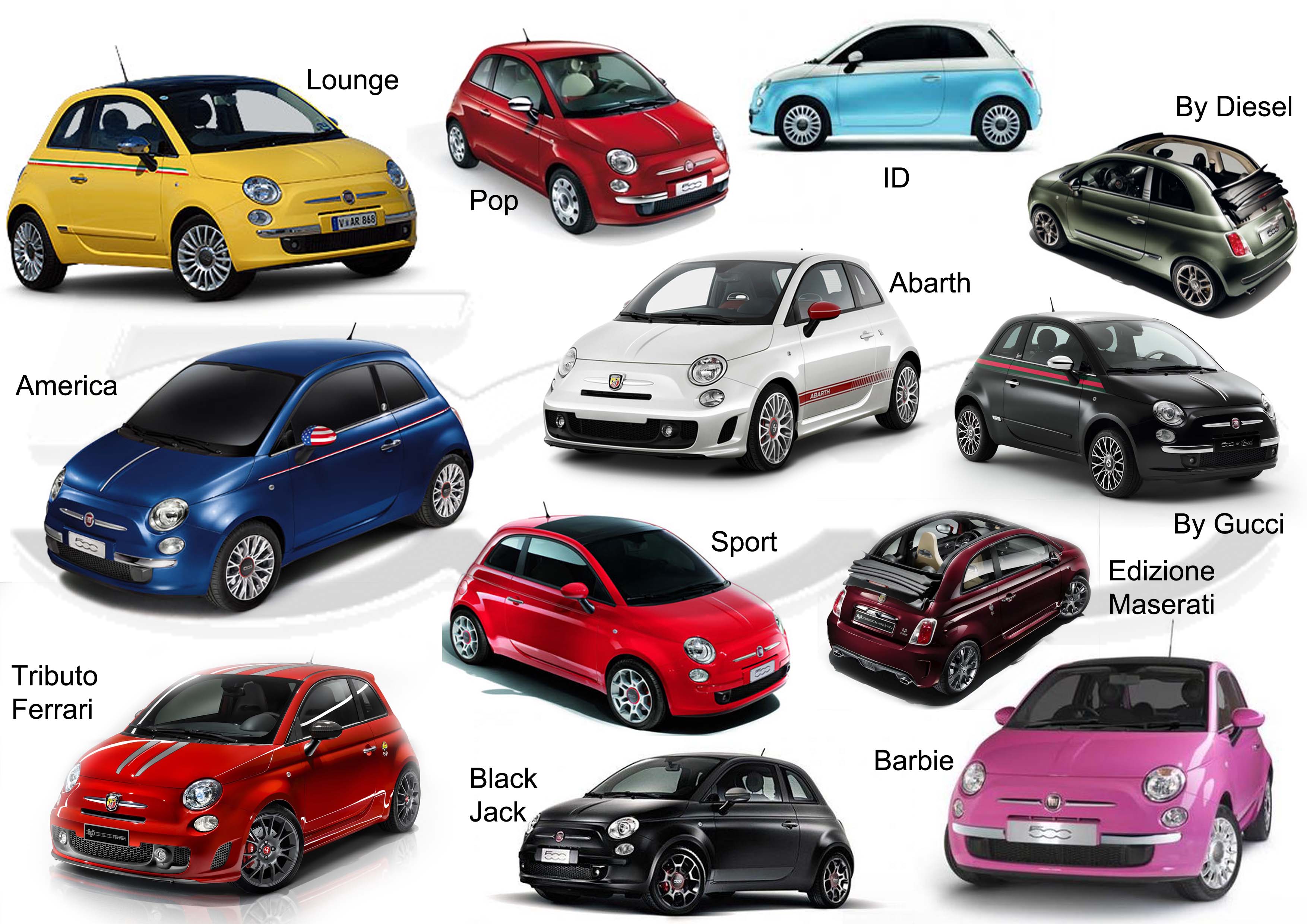
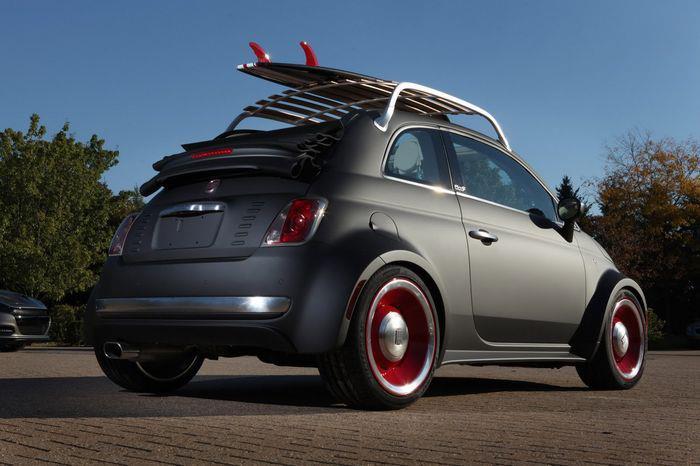
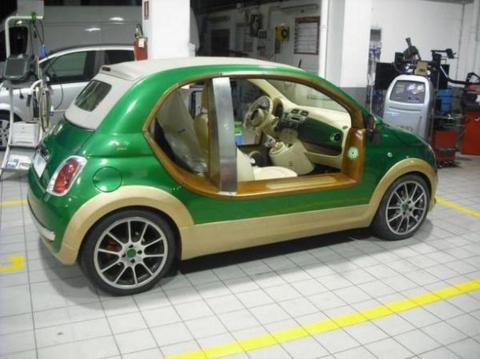
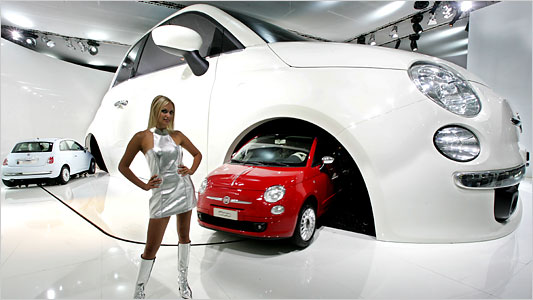
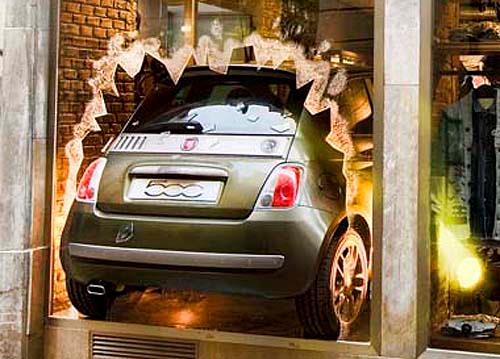
Some of Fiat/Abarth 500’s versions and Special Editions

The future for this model? Fiat wants to make use of current generation for at least 3 more years as the car enjoys of strong demand in USA, Canada, Brazil and Argentina, while in Europe is not suffering as much as a 5-year-old car is supposed to. The strategy is to enlarge the concept launching new 500 for other segments, such as the new 500L. Italy is well-known for its small and sporty cars. Fiat wants to extend the 500 success offering the concept of retro chic style in larger cars or even SUV. Some days ago Sergio Marchionne said it was possible that next Punto could make use of these values. It is more or less what Mini has done with its cars. But one thing they must remember is that doing more products like the 500 would not mean an immediate success. The formula implies an excellent marketing campaign, such as the one the 500 has always  had. 1 million units produced so far is a good number for an excellent product, and the best example of what Italians can do when they add passion to their work.

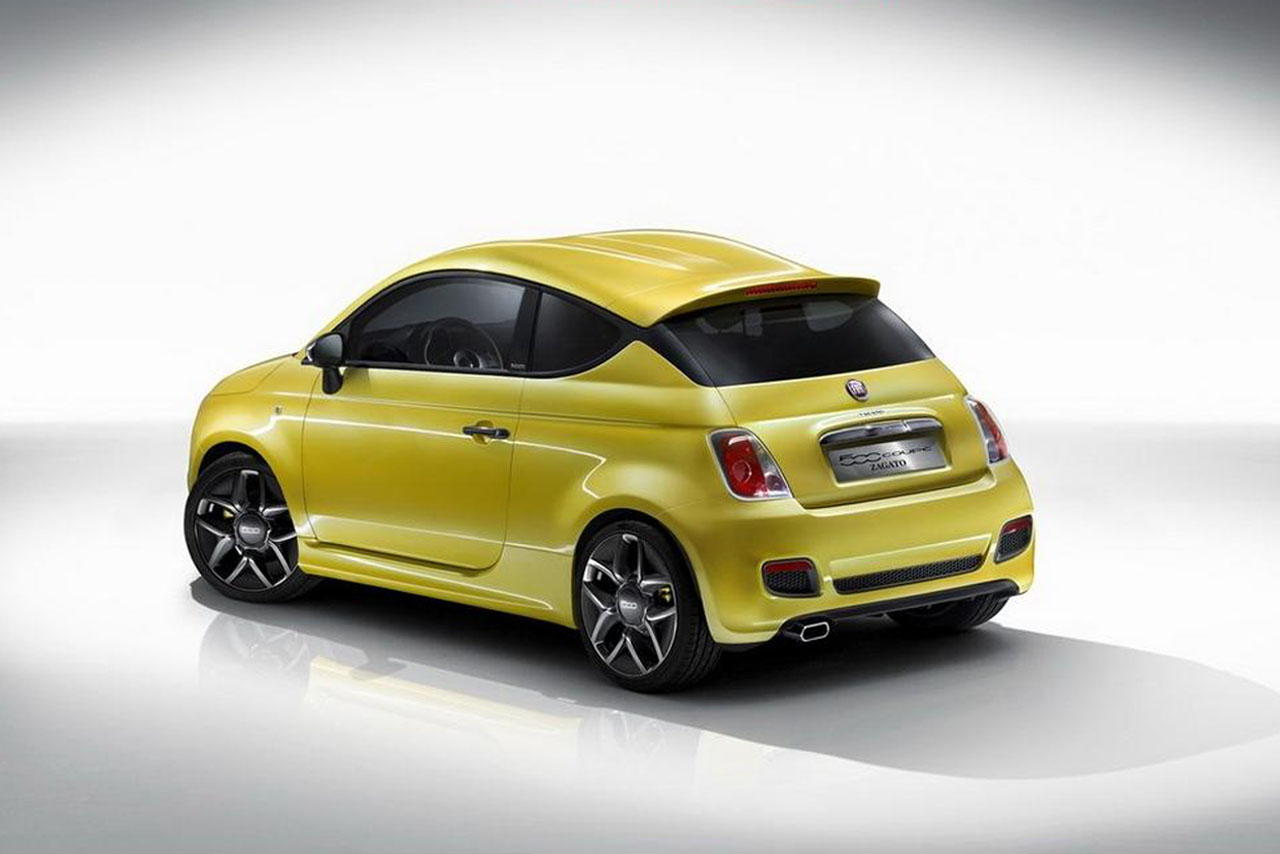
Fiat 500 Zagato presented in Geneva 2011 as a Show car

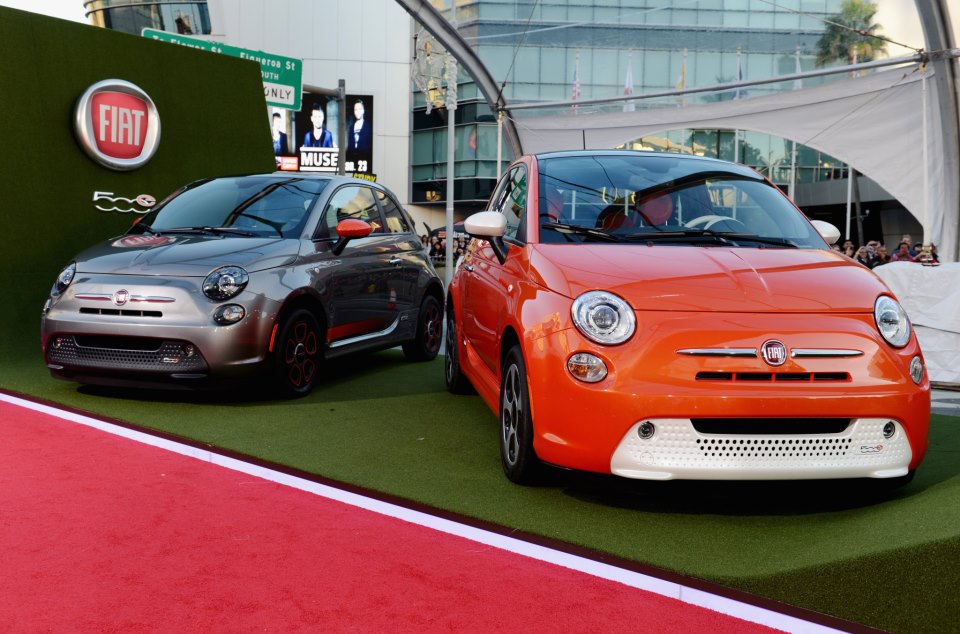
Fiat 500e makes its “green carpet” debut at the 2012 American Music Awards in Los Angeles, USA

Mopar developed its special 500 for USA

Even Gadafi fell in love with the car. He asked for a special edition only for him

Part of the success of this car is the good way it has been promoted

Nice ideas that generate or increase the model’s awareness

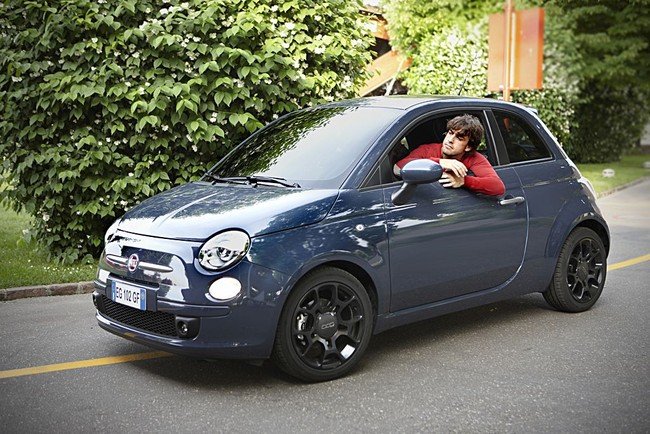
The car has been part of several Ad campaigns with important personalities. Here with Fernando Alonso

Jennifer Lopez was in charged of promoting the car in USA. It worked

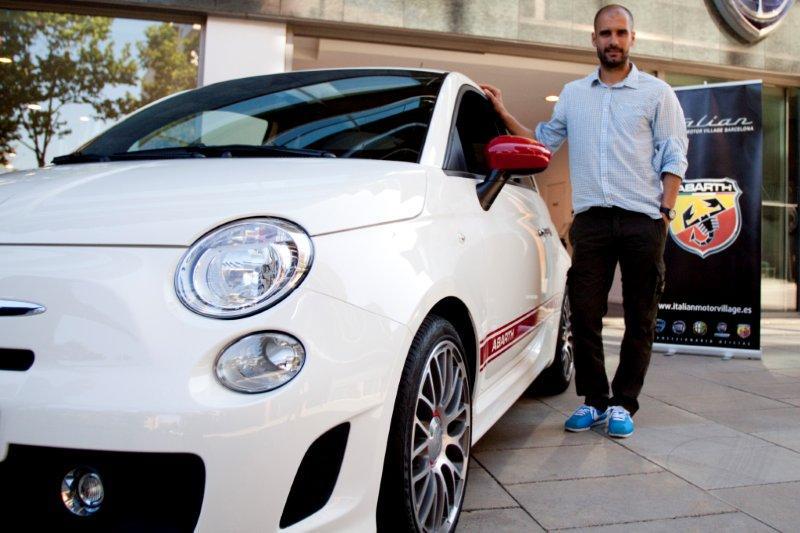
Other personalities have chosen the 500. In the picture, Pep Guardiola with its Abarth 500

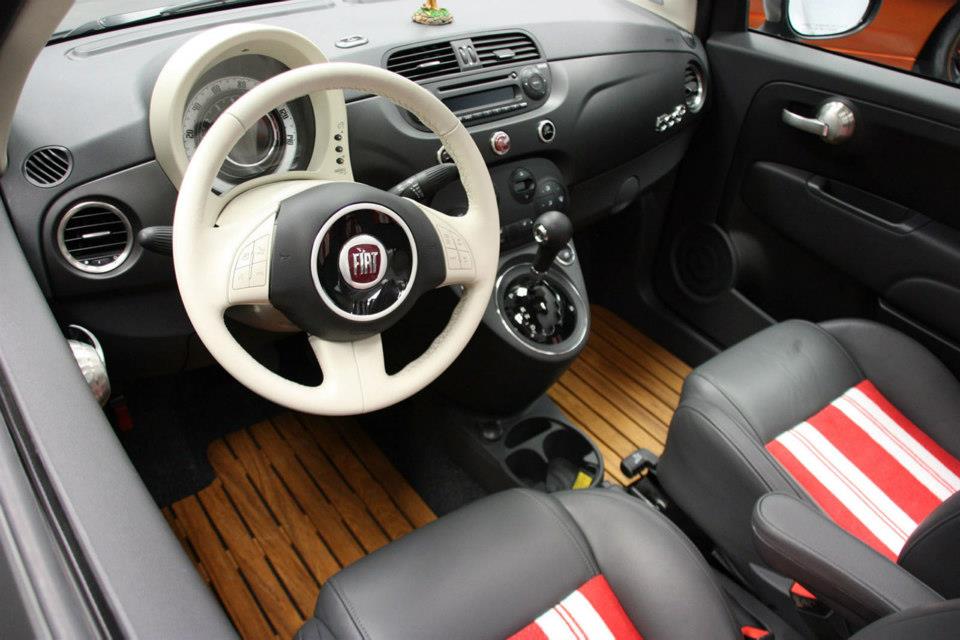
Even the interior can be personalized.

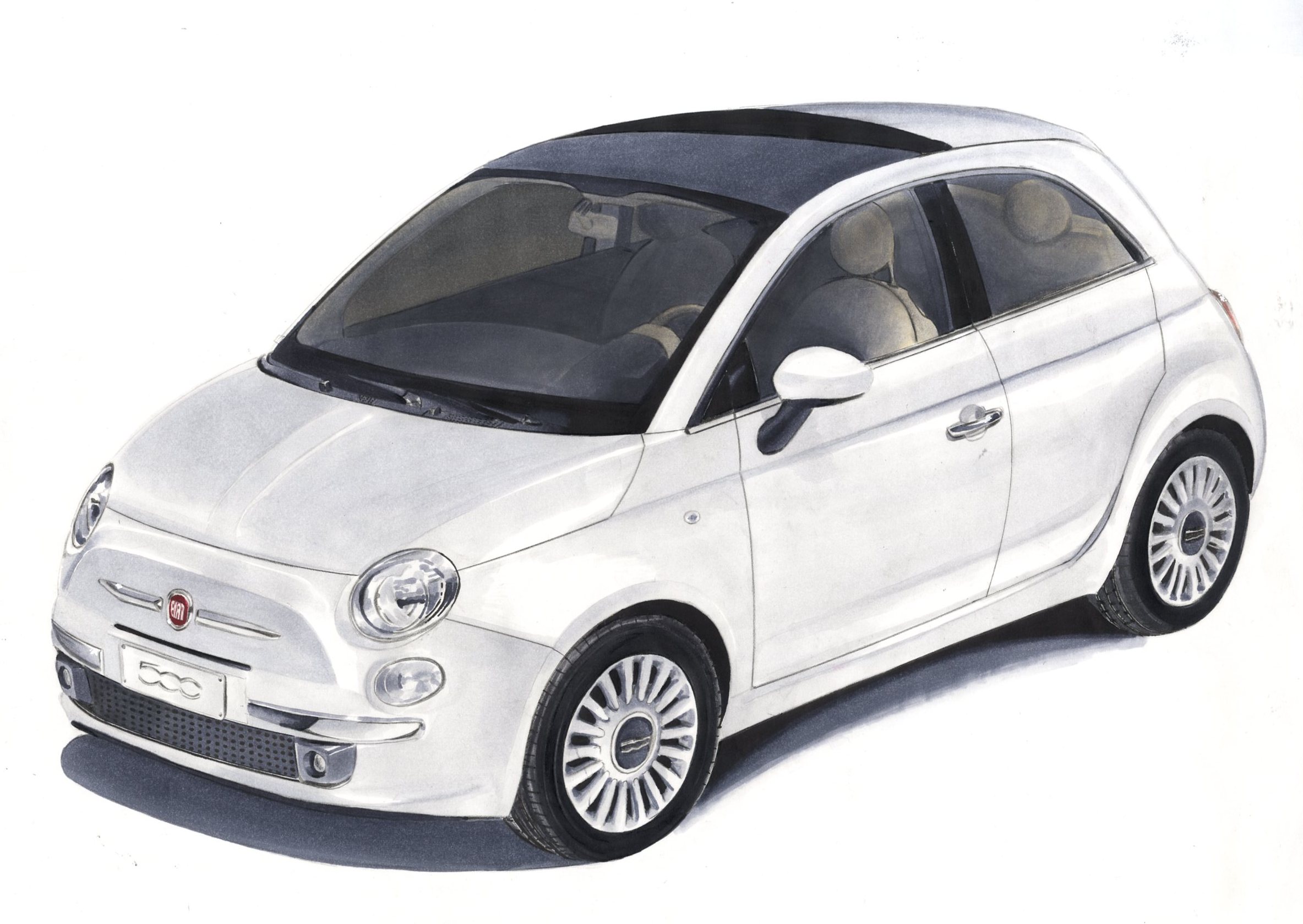
I also make part of 500 lovers. This is an illustration I made for my studies of Car design.