Trivia: good news from Colombia

Colitalia is the official distributor of Fiat and Alfa Romeo in Colombia since 2009

It is just a small number coming from a small but dynamic market, Colombia. But in these days of bad news coming from Europe, it is good to know that Fiat cars are doing quite well in a country where competition is getting really hard and the image of Italian cars is not the best. Colombian car market has become one of the most dynamic ones thanks to several factors. First of all Colombia is now facing a healthy economic period that has allowed a larger part of the population to afford its first car. Another important fact to be considered is the devaluation of Colombian Peso, the currency. Now imported cars, 60% of total sales, are no longer as expensive as they were some years ago. For example, 4 years ago a VW Jetta was available starting at US$50.000 and now people can buy paying only US$21.000. Besides current and last Colombian governments have decided to follow the Chilean and Peruvian example in terms of trade. Colombia is now a more open market to investment and free trade agreements. They have signed free trade agreements with Mexico, Chile, Peru, USA, Canada and now are coming the agreements with the European Union and South Korea. Doing so, Colombia is opening its car market to the arrival of cheap imported cars that will better compete with local made Chevrolet, Renault or Mazda. That is why Mexican cars like the Nissan Sentra, Versa, March, or VW Jetta, Dodge Journey, Ford Fiesta, or Korenas such as the Hyundai i25 and i35, Kia Rio, Sportage or Cerato, have become all so popular in this South American country. Last year a record of 325.000 cars were sold over there, up 28%, and this year is expected the same number, allowing Colombia to become the fourth largest of Latin America.

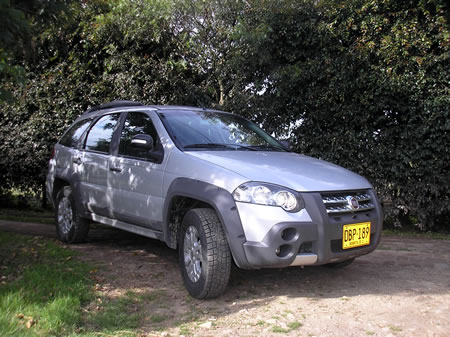
The Palio Adventure Locker is one of Fiat best selling cars in Colombia. It comes from Brazil and offers a good mix of offroad car with the advantage of not being 4WD so it does not pay a lot of taxes.

In that context Fiat-Chrysler is doing an interesting job. First of all is important to mention that Fiat brand has had a troubled history since it was established some decades ago. In the late 70’s Fiat used to assembly their 147, Mirafiori and some more in their plant in Bogota. The cars were really popular but in the 80’s Mazda bought the plant and the Fiat production moved to Venezuela. After that the representation of the brand has been scattered and has damaged the image of the brand among Colombian users. Anyway in 2009 Colitalia Autos, an Italian-Venezuelan company bought the rights of the brand to Autogermana, BMW dealer, and began the best service ever. After some years of hard work looking to regain the trust of Colombians, Fiat is now increasing its presence all over the country in order to catch a part of this important market. They sell the new Uno, Palio, Siena, Strada, Idea, Punto, all Adventures, all coming from Brazil, and the small 500, imported from Mexico. Colitalia is also the official dealer of Alfa Romeo available in Colombia since 2010. The good news is that Fiat brand is up a massive 30% in January-July 2012 thanks to new dealerships all over the country and much better products with interesting prices. They have sold 978 units, from which the Fiat Strada, Palio and Palio Adventure are the most popular. The Fiat 500 is also having a good time in Colombia due to the fact that it does not pay any import taxes as it comes from Mexico. When it was introduced for the first time, in 2009, the Polish 500 started at US$36.000 and today Colombians can buy the Mexican version for only US$20.500. The good result of sales registrations is even better taking into account that Colombian car market has stopped its growth, and is up only 1%, as a response to a decrease of general consumption of Colombians. Fiat can play an interesting role in Colombian market if Colombian economy opens its barriers to Brazilian products and at the same time boost the Mexican products.

The presence of Fiat has never been stable. Only since 2009 when Colitalia got the official distribution of the brand, Colombians began to believe again. There are tons of work yet. Source: Revista Motor

But Colombia is not the only country where Fiat is doing good. In Mexico, after the launch of the local made 500, the sales of the brand have risen 133% in January-July 2012. Certainly Mexicans begin to love this pretty car and the fact that the brand is now better represented by Chrysler, the fourth largest of the country. 2741 cars have been sold over there. All these sales figures, though they are still small numbers, are good news for a better start to open more markets for Fiat in Latin America, where it is really dependant in only 2 countries, Brazil and Argentina. Mexico, Colombia, Peru and Chile are healthy markets where the presence of the group must be increased and improved.

July/12, the lowest growth for Chrysler so far

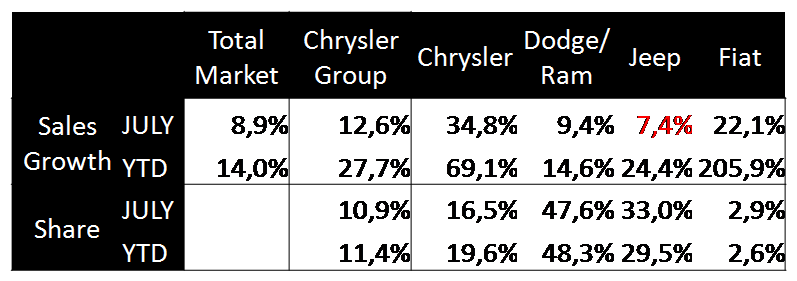
July was a good month for Chrysler in USA. But not as good as before. For the first time of this year the sales of the group grew below 20% and its market share was below 11%. Jeep, Chrysler, Dodge, Ram and Fiat sold 126.089 cars, up 12.6%, which allowed them to have a market share of 10.9%. The growth was less than 20% of June and even worse than 44% of January. However the growth was better than total market performance, 8.9%. Only Jeep grew up less than that number, 7.4%, while Chrysler was again the best brand up a massive 34.8% thanks to the great performance of Chrysler 200 and 300, both with enormous success in some states of the country. July was also a regular month for the Fiat 500, which was up ‘only’ 22%. Year-to-date numbers indicate that the whole group is doing very well. All brands sales are up 2 times what the whole market has grown, 27.7% against 14%. It means they have been able to reach a market share above 11%, just like it was when the financial crisis began 3 years ago. Its growth is much more than all main competitors: GM 3%, Ford 5%, and the same of Toyota, still in third place with total sales growth of 28%. By models, all of them had a good performance, far away from total market’s growth. And it seems the Fiat 500 will reach the initial goal settled by Mr. Marchionne, who said they could sell 50.000 units per year just in North America, but then, after some bad months, he said he was wrong with that number, to optimistic. If that trend continues, the small Fiat will sell more than 42.000 units in USA and more than 10.000 in Canada. The Abarth version has made a great job.

During July only Jeep had a lower sales growth than total market. Source: http://www.carsitaly.net

Source: http://www.carsitaly.net


Click here to see USA August 2012 Results

Fiat-Chrysler 2012 First half results analysis

After some days waiting for official data now is possible to have a close analysis to Fiat-Chrysler sales figures in the main markets and most important models. The overall result could be considered more or less good though the troubled European market may change that at the end of the year. The whole group has sold around 1.8 million cars* in the first six months of 2012, up 5.7%, which is not considered bad in current conditions, especially taking into account that Italy counts for 13% of total sales and is a market that dropped 20%. It all means that the small growth in units sold is due to the great success most of Chrysler Group models are having in the US and Canada. Brazil would not be included in the list of good results as Fiat brand slow down its growth following the total market (-0.3%). The analysis by models shows two different worlds: Europe with terrible results for old products, and USA for good results for most of all the models, no matter the fact they are mostly old models.

ITALY

Italy is Fiat’s main problem nowadays. The dependence of the group is evident and therefore total sales and practically all models are having very bad results. What used to be Fiat’s best selling car now occupies a second place and is severely affecting the whole company. The Punto, which counts for almost 23% of the group sales and drops 32%, much more than the market, and than its rivals. The ‘restyling’ gotten at the beginning of the year has not had any effect because consumers of B-Segment seem to prefer the new generation of Toyota Yaris (a fall of just 5.5%) or the new Peugeot 208 (4200 units). Then comes the Fiat 500 that falls even more due perhaps to the fact that is now facing its 5th year on the market without any significant change (see analysis of Fiat 500-Panda vs. VW Up! for June 2012). These two models count for 76% of main models fall. But in terms of percentage fall, the winner is the C-Compact Bravo with a spectacular fall of 47%, or 6.063 units less. This car is not old at all but the positioning given by the brand has not been the best allowing the VW Golf to keep its pole position among C-Segment cars. Nevertheless the german compact begins to suffer the consequences of its old age which can be seen by the good result gotten by the Giulietta (the best selling compact in April, May and June), which ‘only’ falls 18%, but is an alarm sign to Alfa as it is the only competitive product and is just 2 years old. Other really bad performers are Alfa MiTo, which just sold 16% more than Mini and 20% more than Audi A1, and Lancia Delta, down 36%. In a market that falled 20%, the Panda, Ypsilon and Freemont did quite well. The new generation Panda helped this popular model to maintain its sales figures and allowed it to become the country’s best selling car by far. Same situation for the Ypsilon, very popular in Turin. Fiat as a brand falled as much as the market, while Lancia did better only falling 11% and Alfa Romeo dropped 31%.
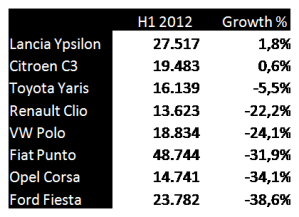
Total sales of B segment main models in Italy. The latest launches had the best performance, while those with more years in the market dropped their sales. Source: http://www.bestsellingcarsblog.net

Although Giulietta’s sales have fallen in Italy during the first half, it was Italy’s best selling compact car (C-Segment) in May and June. Very bad results for the Fiat Bravo. Source: http://www.bestsellingcarsblog.net and http://www.unrae.it

Thanks to new Panda, Ypsilon and somehow the Giulietta and Freemont, Fiat Group has been able to rise its market share in Italy. The evolution of each model is compared to the performance of each segment according to UNRAE. Source: http://www.bestsellingcarsblog.net and http://www.unrae.it

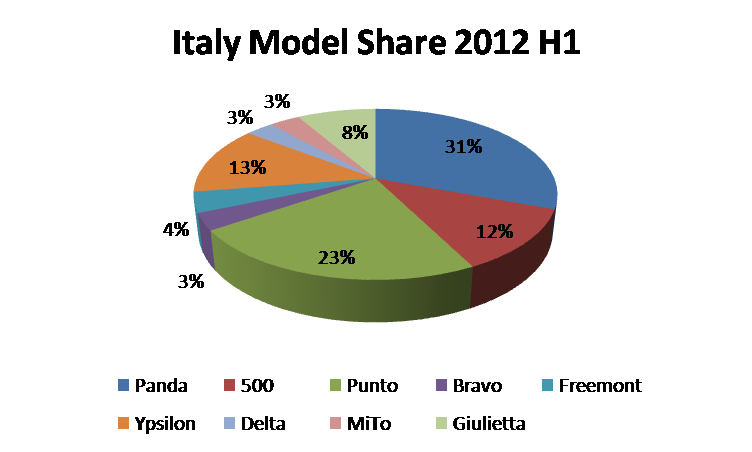
Fiat Group’s model composition in Italy during the first half of 2012. Source: http://www.bestsellingcarsblog.net and http://www.unrae.it

USA

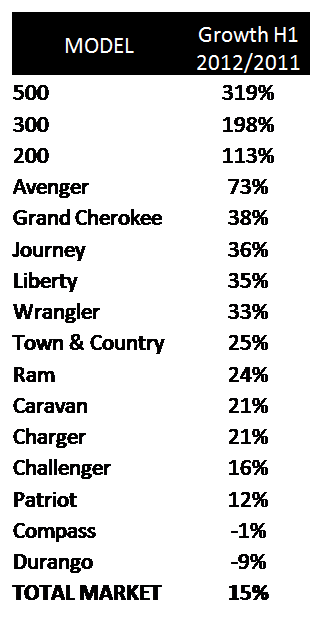
As usual, American sales figures are just amazing. The total market has returned to pre crisis numbers but Chrysler Group is doing much better, eventhough the new entry model, Dodge Dart, is available from late June. The Ram grew 24%, much more than its rivals, thanks to the good results got by the luxury versions. If rumors are confirmed, a diesel version would have a positive impact for the rest of the year. But in terms of the largest impact on the total growth on sales, the Chrysler 200 is certainly the main character, because it represented 16% of total growth, or 37.000 more cars. The deep facelift that received the Chrysler Sebring has made consumers to come back to Chrysler in the C-Segment. Besides the good Ad campaign regarding its American origin has given it more awareness among consumers. With less sales figures but equal interesting results, the Chrysler 300 took off, up an amazing 200% (anyway it is still far away from its rivals, most of them already renewed). As most of models had great performances (thanks to better economic situation), only those having bad results deserved a close analysis: the old couple Compass/Patriot did not well during the period. The Compass falled 1%, while the Patriot grew 12%, below total market. It is clear that these models are old enough and competition gets really hard with all new models, but it is weird that the Compass and not the Patriot falled when the only the first one had an interesting restyling. Another fact to consider is that minivans don’t count in Chrysler’s sales as much as they did one year ago, and now Jeep Grand Cherokee and Wrangler occupied the second and third place of best selling Chrysler models. The group, included Fiat sales numbers, grew up two times more than total markets allowing it to increase its market share up to 11.5%. By brands only Dodge/Ram had stable growth, while Chrysler had an amazing growth of 75%, Jeep up 28% and the Fiat 500, up 319% to 20.706 cars, more than the whole year 2011.

The Fiat 500 had the best performance compared to H1 2011. Anyway most models did better than the whole market. It is weird what happened to Dodge Durango which has been on sale for less than 2 years, shares platform and components with the successful Jeep Grand Cherokee. Source: http://www.goodcarbadcar.net

The figure shows the total units sold during the first half and then the change in terms of percentage and units. After that there is the contribution of each model to total growth in terms of units. Chrysler models are the ones which contributed the most for the total growth. Source: http://www.goodcarbadcar.net

EUROPE

Outside Italy the situation is really bad. Without taking into account UK and Austria figures (only Czech Rep., Denmark, France, Germany, Greece, Ireland, Netherlands, Poland, Slovakia, Slovenia, Spain, Sweden and Switzerland), the main models of the group sold 115.275 units, down 17.5%, a bit less than what happened in Italy. Of course not all the markets had the same performance as the largest ones had the deepest fall: France down 25%, and Germany down 13%, compared to a total fall in France of 14% while Germany grew 0.7% (part of that growth due to self-sales). But the top 9 models had the worst fall in Greece, a market that dropped 41% in the first half. Spain, other troubled market, surprisingly was good for these models, which grew up 4%, or 500 more units. Once again the Fiat Bravo got the worst figures falling in all markets as a response to Fiat’s decision of reducing the range and options. Germany has been the largest market for the Punto after Italy, but this year the model has fallen 48% over there, even more than the fall seen in Greece, but less than the horrible result in Spain and the Netherlands. Certainly the model is not anymore popular. The Panda had good and bad results but in general the car continues to be popular, though its total result was severely affected by the deep fall in France, where the market is going bad. As in Italy Lancia goes better thanks to the Ypsilon, which had excellent numbers in terms of growth but still low numbers in terms of units delivered. One year ago the old model barely sold one thousand units but with the arrival of the new 5 door generation the Lancia sold 4 times more, and is especially popular in Greece where it has become one of top 20. Alfa Romeo does not do good at all with its 2 models falling in the ranking, especially the MiTo, which never had good results. In terms of the dependence of the models on the Italian market the situation changes a lot according to the car. Without any doubt the Fiat 500 is the most international model of the group as only 34% of its sales are done in Italy. Surprisingly the Alfa MiTo is the next model to have less sales share in Italy, as 52% of them are done outside Italy. It is certainly interesting to see the result of the MiTo taking into account that the Giulietta is more popular. The Lancias continue to be popular only in Italy and it seems the new generation Ypsilon will depend on Italian market no matter the fact is built in Poland.

This figure shows the Export ratio of Fiat Group’s main models in Europe. The Fiat 500 is the one less dependant on Italian market thanks to great sales in the UK, France and Germany. On the other hand there is the Lancia Ypsilon, whose new generation has not been able to change its strong dependance on Italy. Europe includes: CZ, DK, F, D, GR, IR, NL, PL, SK, SL, E, S, Switzerland and the UK. Source: www.bestsellingcarsblog.net
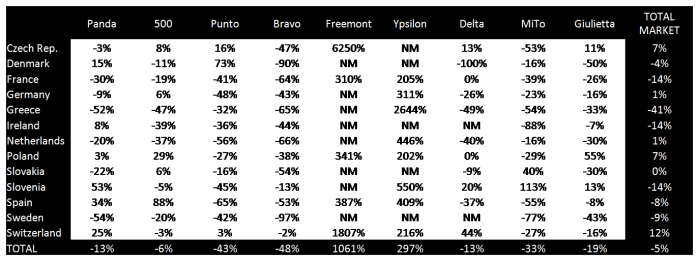
Sales growth of each model in each market for the first half of 2012. Good results for the Ypsilon, Freemont and 500. To bad for the Punto, Bravo and MiTo. Source: http://www.bestsellingcarsblog.net
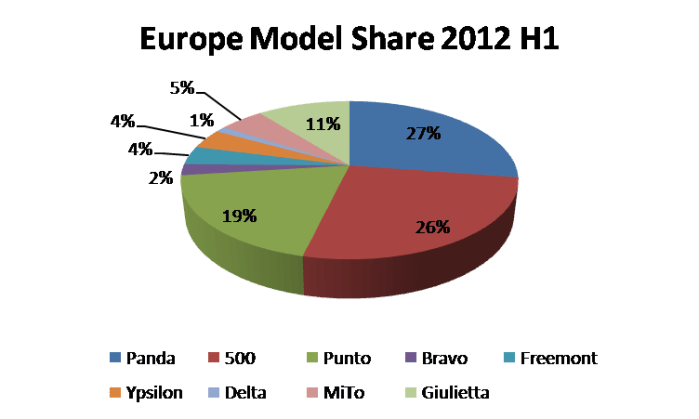
One year ago the Punto was Fiat’s best selling car outside Italy (28% of total sales). In 2012 H1 the fall of its sales allowed the Panda, 500 and Ypsilon to have better share among Fiat models. Source: http://www.bestsellingcarsblog.net

BRAZIL

In Brazil the analysis gets larger as more models are really popular over there. The market is stable with a tiny fall of 0.3% and is expected more sales in the second half thanks to some incentives given by the government. In this context Fiat continues to be the leader and keeps its market share above 22% thanks to one single model, the new Palio. Its registrations have risen 63% and is now the third bestselling car of that country, but it is still far behind from the king of the market, the VW Gol. Although year-to-date numbers are still low, the arrival of the new Siena, aka Grand Siena, has made of this model another great performer and the results will be seen at the end of the year. The Uno, in its second year, falls 11% partly because of the arrival of the new Palio, which could be catching some of its sales (Palio is B-Segment and Uno is A-Segment, but they are close in size and prices), and also because of the success the facelifted VW Fox is having (up 19%), also from A-Segment. But the worse comes from C-Segment: the Linea falls 36% and it seems it will continue like that until a deep facelift arrives. The Bravo stopped its fall in the last month thanks to new engines and features. Good for the Punto (-2%) which got its first deep facelift in July/12, and the Freemont, with 1 thousand units sold per month, not bad considering its high price. The small 500 is doing also good allowing the Toluca plant to keep working. For the second semester things will get hard for Fiat with the arrival of the facelift of VW Gol/Voyage and the all new Hyundai HB20, exclusively designed for Brazilian market.

The new Fiat Palio has had a great start. The new Siena will also change total year’s result. Source: http://www.bestsellingcarsblog.net

CANADA & ARGENTINA

The situation in Canada is not as spectacular as in USA. Chrysler group (included Fiat 500 figures), had the same growth of total market, but it is much more than its competitors from Ford and GM. Actually the group has the second place and sells more than GM, but is now facing the threat of a strong Toyota in fourth place and growing much more. Fiat sold 4.920 cars, up 92% and it seems the small 500 has reached its maximum. The Ram (up 16%) and Grand Caravan (down 6%) are among top 5 best selling cars of that country. In Argentina where total market continues its instability, Fiat is doing good with the new Siena, up 10%, the Uno, up 11%, and the Strada, up a massive 74%, or 2105 units more. Bad for the Palio (the new generation just began local production some weeks ago), the Punto (the restyling will arrive by the end of the year). The small 500 sold almost 2.000 units.

The Fiat 500 sells more than many other Chrysler models. Source: http://www.bestsellingcarsblog.net

*Fiat, Lancia, Alfa Romeo, Chrysler, Jeep and Dodge.

Source: www.carsitaly.net, www.bestsellingcarsblog.net, http://www.goodcarbadcar.net

Italy’s bad results affect Fiat 500-Panda in its battle against VW Up!

Once again the monthly report about the impact the small car of VW is having on Fiat 500 and Panda’s sales. In June things got worse for the Italian couple because of only one country: their native Italy. Compared to May figures, the 500 and Panda grew in most markets except for Italy, where both models falled 26% for the 500 and 15% for the Panda, against the VW Up! which was down 17% in that market. The stong fall in Italy made total European market figures to go down 5% and 4% for the 500 and Panda, while the VW was up 4%. Certainly without taking into account Italy, both Fiat would have had much better results, specially in Germany and France. The 3 models of VW, Up!, Citigo and Mii, got record sales numbers in Germany, which counts for 42% of its total sales. Meanwhile Italy represents 43% of Fiat 500 sales in Europe (the UK is not included) and a massive 63% of Panda figures. At the sixth month of the year, the VW beated the Fiat couple in Austria, Czech Republic, Germany, Denmark, Ireland, Netherlands, Romania and Sweden.

May and June 2012 sales figures for Fiat 500-Panda and VW Up, Skoda Citigo and Seat Mii. Source: http://www.bestsellingcarsblog.net

For the first half of the year the situation is still good for the Italians as they combined sold 3.2 times more than the 3 VW. The Panda continues to be the best selling A-Segment car in Europe but it is really dependant on Italian market, something not good nowadays. The new generation is doing good but not as the second one, which was on sale during better times. The Fiat 500 is also doing good but the arrival of the VW trio will continue to impact its sales and maybe could lose its second place among A-segment cars in Europe. If the UK is included the results are better for Fiat, specially for the 500, which has been in the top 10 for 2 consecutive months and is 12th best selling car of that country. In that case the Panda would continue ruling with more than 102.000 units, followed by the 500 with almost 75.000 (23% of them sold in the UK), and then the german trio with more than 54.000 units. These results can be analyzed from several points of view. For example, the VW cars are completely new cars coming from Europe’s largest car maker and offering 3 and 5 doors. In the other hand the Fiat 500 is pretty old, with more than 5 years in the market and a bit more expensive. Anyway the couple from Fiat must work harder to keep their place in the ranking. VW will lead in Germany, Denmark, northern Europe, Austria and the Netherlands, but Fiat must keep its position in Italy, France, Spain and the UK.

Sales figures for Fiat 500, Fiat Panda and VW Up, Skoda Citigo and Seat Mii for 2012 H1. Source: http://www.bestsellingcarsblog.net


Click here to see Fiat Panda/500 vs. VW Up! July 2012

Click here to see Fiat Panda/500 vs. VW Up! May 2012

A better Punto for Brazil

Brazilian Fiat Punto 2013 T-Jet version with 152 hp and DNA system, €22.590 

Fiat Brazil does not stop. After the presentation of new Siena, the facelift of Palio Weekend and Bravo, now it is time for the Punto, a product that is built locally and points to a specific client in the B-Segment. Basically they present the EVO version already seen in Europe but much better in terms of engines and accesories. Externally it looks just like the Punto EVO in all versions but the top one, the T-Jet, adds some Abarth touch. Inside the car improves a lot, just as what happened with Grande Punto and Punto Evo. The sense of good quality can be seen everywhere and Fiat guys added a interesting feature all over the dashboard with the possibility of giving it some color, as seen in the Fiat 500. There will be 4 options available called Attractive, Essence, Sporting and T-Jet. All of them include double airbag and ABS. Sporting version adds air conditioning, while the T-Jet one comes with rear electric windows, sporty seats, smaller steering wheel, 17″ wheels and subwoofer sound system. In terms of performance, the new Punto offers the new Dualogic Plus gearbox, presented in the Bravo 2013, which allows an easy start in a clamber. But the best new feature comes with the T-Jet. It comes with the DNA system, the same of Alfa Romeos, and now available for the first time in a Brazilian made car. This system changes the way the steering wheel, accelerator and valves opening, work according to the selected option, Dynamic, Normal or All-Weather.

Fiat Punto Sporting 2013 1.8 16V, €18.810

Fiat Punto 2013 interior

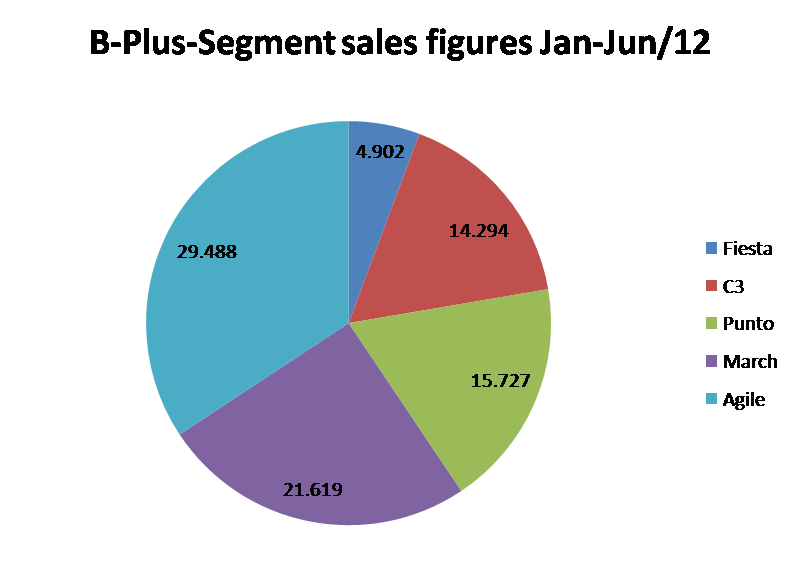
The Punto was introduced in Brazil in 2007 as better and more expensive option than the Palio, also B-Segment. In Brazil there are the regular B-Segment cars such as the Gol, Palio, Corsa, Fiesta, and Sandero, and the B plus segment like the extinct VW Polo, Fiat Punto, Citroen C3, Chevrolet Agile, Ford Fiesta (latest generation) and Nissan March, all starting around R 35.000, or € 14.000. From them the most popular one is the Chevrolet as has cheaper entry versions, but is important to mention the good results that the Nissan has had during the last months. It is made in Mexico, along with the Fiesta, so it means they don’t pay taxes to get in Brazilian market (though new trade agreement between Brazil and Mexico will change that). Since 2007 the Punto has sold 168.000 units (until June/12) and has been among 30 best selling cars of that important market. However Fiat wants to maintain its sales, which has dropped a tiny 2% due to the arrival of the March and Fiesta. The Punto means the next step after the popular Palio and is more or less Fiat’s main ‘luxury’ car in Brazil as the Bravo and Linea are not really popular. The car will be on sale starting at R 38.570 (€ 15.630) up to € 22.590 for the T-Jet version with DNA and Turbo engine with 152 hp.


The Mexicans Fiesta and March are having good sales compared to locally built C3, Punto and Agile. Source: http://www.bestsellingcarsblog.net

June 2012, a quick brief to Fiat-Chrysler results

While the analysis for the first semester gets ready, here it is a quick review of most important facts about Fiat-Chrysler sales figures for June/12. In Italy the bad situation continues with a total market that dropped 24% year on year to 129.000 cars. However Fiat Group managed to increase its market share up 0.4 points. This ‘good’ result is due to the good acceptance of new generation Panda that has become the country’s best selling car above the traditional Punto. The Panda, whose sales include the old and new generation, was again in the podium for 6th consecutive month and its sales were up 5% year on year but down 15% compared to May figures. This is because the summer has just started and normally car sales fall during this time. The old Punto, whose new generation was delayed again, suffers the consequences and falls 34%! Is a pity how Fiat is treating this car and it should tells Marchionne to change his mind, because no matter it is still one of best selling cars in Italy, Fiat could have a larger market share in B-segment with an all new Punto. The best prove: the all new Peugeot 208 managed to occupy place number 13 among best selling cars with more than 2 thousand units sold. It shows the impact that a new generation can have in consumers no matter the bad situation (new Toyota Yaris occupied place number 6!). The Fiat 500 is also doing good as it was the third bestselling car in Italy but its sales falled 26% compared to May figures. One more Fiat to had a good performance was the Freemont with more than 1400 units sold. The same quantity sold by Lancia Delta which had its best month so far. The small Ypsilon continues to impress, especially in Turin, with more than 4200 units and once again the Alfa Romeo Giulietta impresses ahead of VW Golf by more than 400 units. The Giulietta seems to get the leadership of C-Segment while the Golf, still popular, begins to suffer the same illness of Fiat Punto. Very bad numbers for Alfa Romeo MiTo, with less than 1000 units delivered below the Mini and Audi A1. By brands it is important to mention the great result of Lancia which occupied place number 3 mainly because of the good result of the Ypsilon and Delta, as the American models seem to not to take off.

Even the arrival of new sporty versions of the Punto, the car can’t stop its sales drop all over Europe, Italy included

Meanwhile in America the situation is really different. The total market had an awesome growth of 22% year on year. More or less, all Chrysler models had good results: the Ram pickup was the country’s number 10 best selling car, decreasing one position compared to May/12. It sold almost 24.000 units, up 17%, less than the whole market, but much more than Ford F Series and Chevrolet Silverado (11% and 3%). The Chrysler 200 and Jeep Grand Cherokee continue to impress with great sales figures up 51% and 39%. Nevertheless the Jeep sold 1.500 units less than Ford Explorer. In the case of the Chrysler part of the success is explained by the good welcome it has had in California, the largest market in the States. The Wrangler was Jeep’s best selling model with more than 14.000 units, up 28%. Other great performances were the Dodge Avenger (+68%), Jeep Liberty (+50%), Chrysler Town & Country (+32%) and of course the awesome result of Chrysler 300 with almost 7.000 units delivered, up a massive 179%. It seems that finally Americans begin to like it, as it had a very slow begining during 2011. Fiat managed to sell again more than 4.000 units of its 500, growing 122% year on year, and just 172 below the Mini. If the trend continues the successful mini car could meet Marchionne’s first forecast of selling 50.000 units per year, especially now that there is the new Ad campaign. Bad results for Dodge Caravan, up only 1%, Dodge Charger, up 18%, the old Jeep Patriot, down 4%, and Jeep Compass, -15%. Weird what is happening to Dodge Durango, the all new big SUV presented recently. The car is not popular at all as it should be coming from its successful cousin, the Jeep Grand Cherokee. The Durango sold only 3.300 units compared to 12.500 of the Jeep, and was down 43%.  By brands only Dodge/Ram combined grew less than the market, 5%, but Chrysler had an excellent month growing 62.5% (due to 200 and 300 models) and Jeep sold 23% more. At the end, due to Dodge/Ram results, the whole group grew less than total market but it keeps its market share around 11%.

The Chrysler 200 has become the symbol of reborn of Chrysler

Pretty much what happened in Brazil. Fiat registrations grew less than total market which had its second best month ever, up a massive 19% thanks to new incentives given by the government to stop the slow down of last months. Nevertheless Fiat kept its market share but did not get as much as consumers as it could had done. It sold 18% more than one year ago. The only good performance was the new Palio, up 103%, which occupies place number 4 among best selling cars of that country. Even like that it seems the B-Segment Fiat has arrived to its top of sales and will not be able to reach the sales figures of VW Gol. The new Siena is doing well but is taking time to beat its rivals, the VW Voyage and Chevrolet Corsa Sedan. In June it sold 9.500 units, up 8%, just 35 units below the Corsa and 354 above the Voyage. The Uno sold almost 26.000 units and was again Brazil’s second best selling car, but its performance was not brilliant: +1.6%. The Fiat Strada had the worst result. One year ago it was Brazil’s 5th best selling car with more than 10.500 units sold. In June 2012 it sold 8.400. The facelift presented in June must help to revitalize the pickup. Further down, the Punto, whose facelift was presented some days before, sold around 300 units more but lost market share with the rise of Nissan March, imported from Mexico with very competitive prices. Also from Mexico, the small 500 sold more than 1.300 units, but is far from 2.400 units sold in March of this year. The C-Segment is again a problem for Fiat. Though the facelifted Bravo just arrived in June to the dealers, it continues to fall in the list, and during June/12 it was down 8.1% and the Linea, without any facelift, dropped 57% (without taking into account that new generation of Hyundai i30 has not arrived yet).

The new Palio and Fiat 500 in Brazil. Both cars have had an enormous success over there. Photo by 500blog

In Canada Chrysler Group along with Fiat had moderate results. The whole group just grew 0.5% in a market that is slowing down for the first time in 2012. The best performance was the Dodge Caravan, up 10% and reaching more than 6.000 units, very close to the 6.342 Rams delivered. Both cars are number 2 and 3 best selling cars. Fiat sold 48% more but as in Brazil is far away from 1.200 units sold in March and April of this year. For the first time in this year, Argetinian results were negative. The whole market falled 12% and Fiat dropped 23% as it had some problems with production in its Cordoba factory. All models falled except the small 500 that counted 389 units, not far from the record achieved in May. The uncertain situation of Argentinean economy must continue to affect car sales. In Europe things are going really bad. Due to lack of new models Fiat and Alfa Romeo brands drop their sales more than the average of the market, especially in France and Germany. In the UK the good performance of Fiat 500, again in Top 10 during June, allowed Fiat brand to fall  only 1.3%. Lancia improves but its numbers are really marginal. In France only the mini cars, the 500 and Panda, had a ‘good’ result, up 3% and 8%, but the Punto falled a extreme 44%, and the beautiful Giulietta dropped 29% in its third year of commercial life. In Germany the situation with the Punto gets really worrying: the car dropped a spectacular 67% and could not even sold more than 1.000 units, in a market that grew 3% during that month. The 500 falled 3% due to the great success of the VW Up!, while the new Panda grew 6.2%. The Giulietta falled 21%. In the troubled Spain, Fiat brand grew an interesting 22% against the general fall of 12% thanks to great performance of Fiat 500, up 73%, and Panda, up 145%.


Source: http://www.bestsellingcarsblog.net and http://www.carsitaly.net

Is Marchionne doing wrong?

Sergio Marchionne has been Fiat Group’s CEO since 2004. By the time he became the Amministratore Delegato, Fiat was facing very tough times due to an internal crisis that began some years before. Sales figures of all group’s brands were struggling with problems in Italy and all over Europe, as they were trying to solve the divorce with GM. Marchionne found a company full of bureaucracy and with several problems. By the end of that year Fiat Auto sold 20.539 million euros and lost 840 million euros*. It was another bad year for the Italians who were suffering the consequences of very bad decisions taken some years before, during the 90’s when the whole group failed with lot of products all over Europe.  No matter the success of the 2 first generations of the Punto, and the arrival of the new Panda, in 2004 the situation was really dramatic and one of main reasons were quality and after-sales problems. The last years of the 90’s were not really good years to remember. Fiat was introducing a lot of models but forgot that good quality was emerging as one of key factors taken into account by consumers. Eventhough they had unique designs, cars like the Fiat Bravo/Brava, and Marea, Lancia Dedra, Kappa, and Thesis, or the Alfa 166, lacked of good quality and they were made with very low cost materials. Besides, the 3 brands were not quite well represented in several countries of Europe, something that affected the quality of after sale service. Those bad decisions in terms of the quality of the product had a big effect on Fiat’s position in Europe explained by the fact that the Italians were Europe’s largest car maker by sales figures in the 80’s and by the end of the 90’s its market share was dropping significantly. Fiat was no longer the leader.

Fiat Bravo/Brava presented in 1995. Though they had a unique design, their quality was below the average of the segment. A flop

Nevertheless, the arrival of Marchionne meant a big change on Fiat’s understanding of making and selling cars. By focusing on the launch of fresh models with better quality and calling off the agreement with General Motors, Fiat experienced a period of recovery and a better position in Italy and abroad. The first product to prove it was the Grande Punto, launched in 2005 as the third generation of the successfull B-Segment model. They offered a new car with great engines and soon the company realized the importance of efficient and low emission engines. In 2006 Fiat had the largest sales increase in Europe with 18%, above VW Group, the French and Americans, in a whole market that grew only 0.7%**. Certainly the new Punto played a key role on this result (its registrations were up 22%). Eventhough the quality was not still a main characteristic of the group’s products (the Alfa 159 launched in 2005 is a good example), consumers appreciated the new products. But Marchionne did not stop, he wanted more and he wanted to impress the market. That is why in July 2007 Fiat presented what can be considered its best product of the last 3 decades, the new Fiat 500. And they certainly hit the market with a unique car and all-new marketing strategies. In 2007 Fiat Auto (Fiat + Alfa + Lancia) sold 1.847.714 vehicles world wide from which almost 800 thousand were delivered in Italy***. One year later they sold the same amount, but in 2009 Fiat Auto sold 2 million cars , up 9%, thanks to a record year in Germany (Government support to car industry) and Brazil. By that year two events took place and changed Fiat history: the begining of international financial crisis and Chrysler bankruptcy.

The presentation of the Fiat 500 in Turin in July 2007. The small car represents the era of Marchionne and is perhaps Fiat’s best product in the last 3 decades.

What was considered as crazy move by most of specialized press, resulted in Marchionne’s best play. As is usual on him, he saw what most of people could not see. He anticipated European automotive crisis and therefore he decided to purchase Chrysler no matter the bad future it had by that time. Fiat needed a partner to expand its business and ensure its future. Marchionne knew this partner was going to be essential for the coming years. And he was right. 3 years later is not Fiat saving Chrysler but the opposite. And of course the ‘miracle’ experienced by Chrysler is the result of very good decisions made by Sergio Marchionne and his team. The recovery of the Pentastar was another goal of the Italo-Canadian manager. In 2009 he saw that Europe was in the way of collapse in terms of car sales, and that’s why he bought Chrysler so Fiat could survive. After that the story is well known by everyone. The Chrysler/Dodge products arrived in Europe as Fiat/Lancias, with very low sales objectives as the conditions of the market were getting really bad. The rebadged Chrysler 300 and Voyager was a really controversial decision but at the end is part of a mid-term strategy to give Lancia some oxygen for the coming years. At the end Lancia and Chrysler will develop their models and adapt them to their markets. If it was or not a good decision does not really matter as these models (Lancia Thema, Voyager and Flavia) are not expected to have brilliant sales figures (original sales forecast for the first year of both, Thema and Voyager, were 10.000 units each, but Jan-May/12 sales figure indicates only 800 cars were sold so far).

This figure shows the evolution of sales of main models of Fiat since 1988. Notice the continous fall of Fiat Punto since 2001, the growth of small Panda and 500, the flop of C-segment with the latest Bravo, and the disparition of D-segment. Source: http://www.bestsellingcarsblog.net

But the European automotive crisis is being worse than expected and all problems behind it are daily news. Most of all European markets drops with significant falls in what used to be one of world’s largest markets: Italy, Spain and France. The fact that car registrations fall up to 2 digits every month and the trend does not change, has turned on the alarm of all automotive CEOs. Europe is not anymore the big and healthy market of more than 15 million cars per year. Those years could be considered not only the good past but also the unreal one, as it seems car sales figures were extremely high and contaminated by government helps. Europe will keep buying cars but much less. The problem is that all car makers built their European future based on the best years and therefore they increased their production capacity with more and more plants and employes. Of course, with current conditions it is not feasible to keep the statu-quo. Things must be changed in order to face the coming years. First it came the disparition of Saab and then the big problems of the big of Europe: Fiat closed its factory in Sicily in december/10, and now PSA is fighting with French government to fire 8000 employes and close one of its French plants. The same is happening to Ford and Opel. VW sees how its best sellers Golf and Polo decline their registrations. All these problems are the consequence of a market that does not buy as before because of an economic crisis that affects all.

This figure shows the position got by main models of Fiat Auto since 1988 in Europe. In 1997 the Fiat Punto was Europe’s best selling car but its leadership has fallen and is no more in Europe’s top 10. Good evolution of minicars with Panda and 500. Notice how far is the current Fiat Bravo from the great places gotten by its predecessors in the 90’s. The same situation for D-segment where Alfa has no more representation. The Ypsilon has had a continuos fall and is no more in the top 50. The other Lancias are not popular at all. Source: http://www.bestsellingcarsblog.com

In this context Fiat’s position is not the best. It depends a lot of Italian market, one of region’s most affected. Besides, there is the debate about Italian competitiveness and labor conditions. Fiat is having aditional problems with its labor force in Italy and this is making it more exposed to the crisis. They are losing money with Italy as their plants located world wide are more competitive and generate more cash. But again is something well known by everyone. The point is the way Sergio Marchionne wants to get out of the crisis. Certainly his decisions cause always controversy. People may agree or disagree but at the end most of them recognized he is perhaps Fiat’s main ‘asset’. His capacity of work and the way he anticipates the future are without any doubt a great tool for Fiat-Chrysler group. Now, after 8 years managing the company, he must take the hardest decisions ever. And is when more controversy appears. He wants to reduce Fiat’s dependance on Europe by increasing Fiat-Chrysler presence in Asia. He wants to find a partner to become more global. He wants to increase Fiat’s capacity in Brazil. And Europe? in Europe he wants to wait. He believes the worst has not occurred and he prefers to delay the launch of several new models. Why? he believes doing the opposite would mean a suicide with current conditions. It means that a key model such as the old Punto will have to wait for its successor. It means Fiat’s decision to surpass the crisis is by doing and expending less. But is it a right decision?

The Punto is with the Corsa (both share the same platform) the eldest of the segment. French are the latest to arrive with awesome products.

Fortunatelly just before the crisis began, the new generation of Fiat Panda was almost ready. It allowed the best seller to ensure its future with a modern successor. But things do not work like that for the rest of the range and becomes dramatic when taking into account that Marchionne’s decision of delaying new launches includes the successful and vital Punto. Yes, he might not consider the fact that the B-Segment car has been Fiat’s main product for the last 19 years. The same situation applies for the other segments: in the C-Segment the Bravo will have to wait until late 2013 for a successor that will come from China, the Giulietta won’t have the expected Station Wagon version until 2014, while the Delta will be in the catalogue for at least 2 or 3 more years. Alfa will wait till 2014 to see the new Giulia for D-Segment while the MiTo won’t have a 5 door version till the same year. The SUV expected for Alfa Romeo has not even a date of presentation. The only progress to be seen in the horizon is the 500 family that will be enlarged by the arrival of the 500L by September 2012, and then in 2013 the presentation of the 500X (the small SUV). It is my believe that Fiat can delay all future launches of its cars but should not jeopardize the future of the Punto. Marchionne must have very solid reasons to put off the new generation and he constantly says that starting production of the new generation with current market conditions would be flop. And of course car companies as all others exist to earn money. If his financial and market forecasts tell him it is not the right time to launch the new Punto, then he is right. Yes, nowadays Europeans don’t buy cars as before and it seems it will be like this for 2 or 3 more years. But there is something wrong in all this. Or at least is what I think.

20 years ago Fiat was strong in A, B, C and D-Segments. Nowadays it is just popular among mini cars. Slowly it has lost presence in larger segments, as it does not have anymore D-segment models, while in the C-Segment is losing a lot of market share. The next segment to be affected by the lack of new models will be the B one.

Fiat is not VW. It means it does not have the financial strenght to allow itself to mistake. VW can have problems with its gear box in China but its excellent position in the market allows it to answer to this problem in a short time offering the best solution. Fiat-Chrysler does not have the right to do wrong as it has had lot of problems in recent past. And is this particular topic in which I consider Marchionne is repeating the history. Fiat did wrong in the 90’s with quality problems and still suffers the consequences of bad image in the whole continent (Italy included). They realized how important is to do the right things. Now, for the first time, I disagree with Mr. Marchionne and I believe they are making a mistake as big as the one of the 90’s: they abandon current clients and tell them to move to other car makers as Fiat products don’t change. As simple as that. Yes, Fiat is saving money or at least not losing it by investing in the development of new cars. And yes, it does not make sense to invest in new C or D-Segment cars when the position of the company is not really strong in those segments. But the situation changes when talking about small car segments, Fiat’s core business. What is more risky? to invest in the launch of new Punto and the sequent low sales proper of current situation, or to lose the current Punto clients and then have less market share in this important segment? people may be delaying their decision of changing their car, but at the end every month there are almost 1 million Europeans doing so. The market is smaller but it exists, and Fiat should think about it. Or why Peugeot just launched the 208? Or Renault presented the awesome new Clio? they have the same problems of Fiat, but eventhough they continue. At the end the only beneficiary of this decision will be VW and Koreans who will increase even more their market share. If Fiat wants to sell more they must offer more. The 500L is a product that can work but is not enough. The MiTo and Ypsilon are not competitive and do not offer anything new. Dealers can not wait more for new products. European autoshows can not continue being the scenario for lack of new products. Alfa Romeo can not resist anymore with only 2 models. Fiat-Chrysler should act according to how the market evolves. They should forecast not only sales but also the production and future development costs. Just time will demostrate how right is Marchionne’s decision. But time will also prove how difficult will it be for Fiat to regain the lost clients, who will be surely inloved with their VW Polo, Peugeot 208 or Renault Clio.

* DATI PRELIMINARI DELL’ESERCIZIO 2004 E RISULTATI DEL QUARTO TRIMESTRE FIAT Spa

** Fiat sales boost leads Europe in 2006. Fiat News New Zealand

*** http://www.carsitaly.net

More production of successful Jeep Wrangler

Jeep Wrangler Unlimited Altitude version. Photo by netcarshow.com

Chrysler Group has announced they will add more work force to their Toledo Assembly plant to increase production of Jeep Wrangler. Chrysler wants to maintain the enormous success of this Jeep but is struggling to rise production as Toledo plant is the only one that produces it in the entire world. Currently there are 500 people working there, but they are now expanding the capacity and 1100 more workers will be hired by 2013. The Wrangler and Grand Cherokee are Jeep’s chosen products to make Jeep a global brand, according to Marchionne. Last year the old style Jeep sold more than 150.000 world wide from which 122.460 were delivered in the US market, up 30%. This year the success continues as it has sold 56.410 units in the first 5 months of the year, up 35%, making of it the 5th best selling car of the group in America, after the Ram, Jeep Grand Cherokee, Chrysler 200 and Dodge Caravan. Since the 5 door version (called Unlimited) was introduced in 2007 sales have been always rising and now that American car market seems to be recovering, it’s time to gain more market share and go abroad.

Source: Good Car Bad Car

The VW Up! takes off and hits Fiat 500

After the first analysis made by FGW about the sales performance of the new Fiat Panda and VW Up! and the Fiat 500, it is time to see how were May figures to these 3 minicars. When VW Up! was finally available in the market there was a special attention on how the leader of the segment would respond and how consumers would change their mind and shift to Europe’s largest car maker. 5 months after official launch of the German minicar and third generation of Fiat Panda, things began to get complicated to Fiat. Or at least is what sales figures show. Because from what happened last month there can be several different analysis and approaches as the comparison is made among two different family cars: in one side there are the 3 VW, Up!, Citigo and Mii, all in 3 and 5 door versions. And in the other hand there are Fiat 500 (only 3 door) and Fiat Panda (only 5 door). But results can be seen also from the different moments they are living: the Germans and the Panda are enjoying their first months of commercial life, while the unique Fiat 500 will soon have its 5th birthday (July 4th) without any specific facelift or deep change. However here are the results.

Fiat Panda’s dashboard

VW Up! dashboard

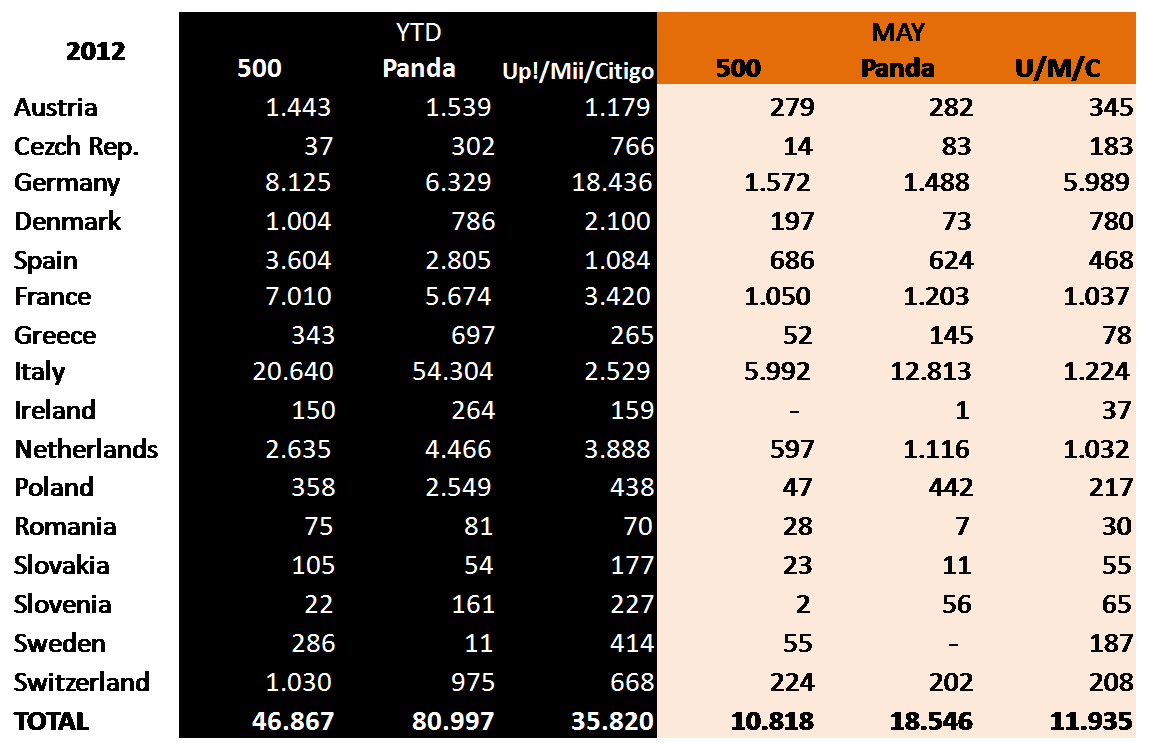
The first thing that must be considered is that UK sales figures were not included in the analysis as there is only data for 10 best selling cars. The lack of UK results affects considerably Fiat 500 as it was the tenth best selling car in that country during May/12 with 2.823 units. So the countries to be analyzed were the same of April’s analysis: Austria, Czech Reublic, Denmark, Germany, Spain, France, Greece, Italy, Ireland, Netherlands, Poland, Romania, Slovakia, Slovenia, Sweden and Switzerland, or in other words, those European markets with available data. In May/12 the trio Up!/Citigo/Mii sold more than Fiat 500! it is the first time the small VW have better results than the popular 500. The Germans sold 11.935 units, up 44%, against 10.818 Fiat 500, up 23%. Unlike what one would think, the difference is explained by what happened in smallest markets because both models sold pretty much the same in their native countries: 6.000 units in Germany and in Italy, and vice versa, 1.224 units of VW sold in Italy and 1.572 of 500 sold in Germany. In France they both sold more or less the same, around 1.050 units. But the big differences come from Netherlands and Denmark where the VW Up! has become really popular. In the rest of small markets people are shifting from Fiat to VW. But the analysis must be also done taking into account Fiat Panda figures.

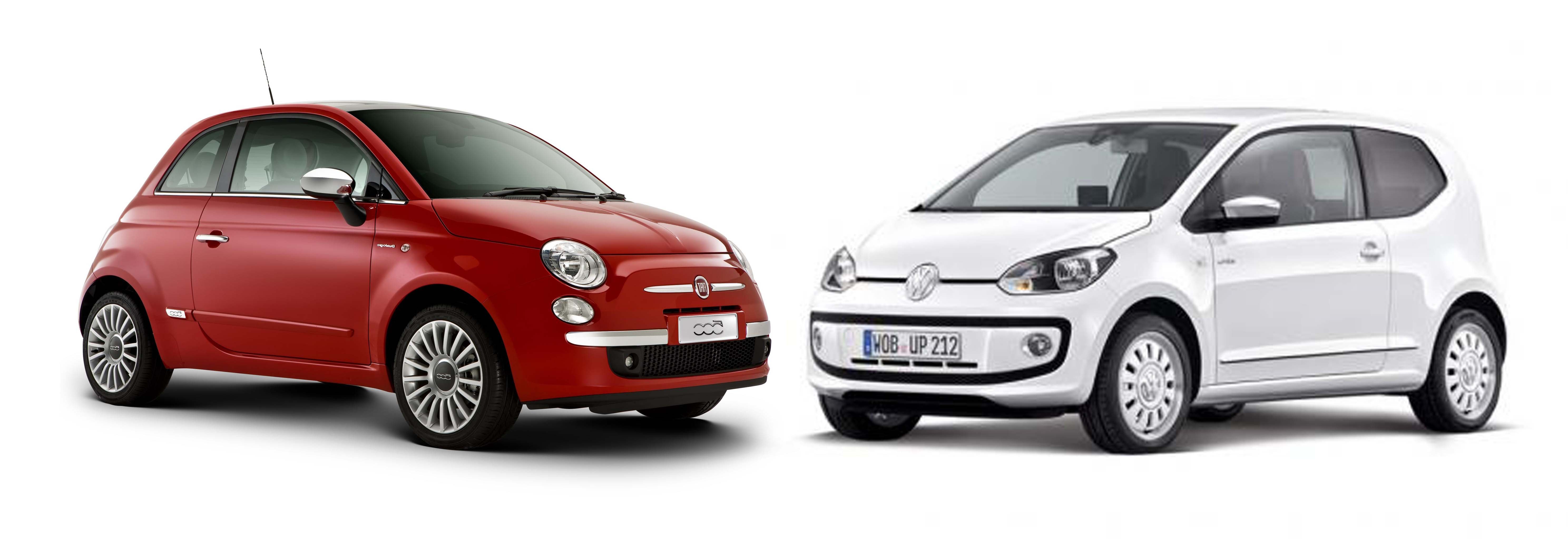
The Fiat 500 has to compete with not only one member of VW family but 3: the VW Up! 3d, Seat Mii 3d, and Skoda Citigo 3d

The third generation is doing quite well in Europe. Although it has not reached yet its predecessor sales numbers, the small Fiat continues to increase the number of units delivered. In May 18.546 Pandas were sold in these countries, up 11%, less than its brother and Germans competitors, but is still the absolute leader of the segment (it was Europe’s 9th best selling car). Of course it depends a lot on Italian market, where it sold 69% of the total, but the new car had interesting numbers in the Netherlands (beating the German trio), and Germany. Anyway in Panda’s figures there are included both, the previous and new generation. It had some problems in Austria, Denmark and Spain, but its registrations in Italy rised 19% compared to April figures. Both Fiat results indicate that the brand is still the leader of the segment as they sold 2.5 more times than the 3 VW. And that’s the point to be considered. It is true the Germans passed Fiat 500 sales by more than 1000 units, but it is also true that in that comparison there are included 3 ‘different’ models (Up!, Citigo and Mii) against just one, the Fiat 500. It is also true that though the German trio sold more than Fiat 500, in the first case there are included two body types, the 3 and 5 door versions, while the Fiat 500 is only available in 3 door version. At the same time the comparison does not take into account that Germans are in their first months of commercial life, while the 500 is on its 5th year. And in the case of the Panda, the same problem of body type could apply. It is also relevant that Italy represents a big part of Europe’s A-segment car sales, and it is now facing really tough times.  In terms of costs is very important to mention that the 500 and Up!/Mii/Citigo are all made in low labor costs countries (Poland and Slovakia) while the latest Panda is made in Italy, where labor cost is higher. And finally one important thing to consider is that Fiat may be the leader of A-Segment but is now competing with the big power and excellent marketing of Europe’s largest car maker.

Fiat Panda offers much more habitability than its German competitors as it is conceived as a small utility vehicle and not as a regular A-segment car.

Year-to-date results show that Fiat Panda reigns and accumulates sales equivalent to the sum of Fiat 500 and VW Up!, Skoda Citigo and Seat Mii. The German trio is still behind Fiat 500 by 11.000 units as it had a very bad begining. But things seem to change and they finally begin to be a threat to Fiat 500 leadership, unlike what happened during April 2012. The VWs reigns in Germany but with very far sales numbers from what is seen in Italy with Panda. And also in the land of Skoda Citigo, Czech Republic; in Denmark where the VW Up! could become the country’s best selling car. Also in Slovenia, Slovakia (the country where they are produced) and Sweden. On the other hand both Italians are extremely popular in Italy, France, and somehow in Germany and the Netherlands. No matter what the reason is for this change in A-segment market, it is clear that Fiat must do something to maintain the sales of its beauty 500 or maybe accelerate a big facelift, well they can not loose market share in the only segment where they feel secure.

Sales figures for Fiat 500 and Panda, and VW Up!, Skoda Citigo and Seat Mii. Source: bestsellingcarsblog.net


Click here to see Fiat Panda/500 vs. VW Up! June 2012

Click here to see Fiat Panda/500 vs. VW Up! April 2012

New versions for Ram, 500, Bravo, Linea and Giulietta

Ram 1500 Laramie Limited. Photo by netcarshow.com

The ending week brings a lot of news related to the coming versions of Ram pickup, Fiat 500 and Bravo, and the first restyling of Fiat Linea. The offer of the bick truck from Ram will add a luxury version called Laramie Limited, featured with heated steering wheel, ventilated front seats and heated rear seats, to replace the Laramie Longhorn version. It will be Ram’s most expensive pickup and is part of the strategy of the brand to cover a the fast growing segment of luxury trucks. Chrysler has seen an opportunity among those clients that are not cowboys but want a big truck to use in the city.  In fact this kind of pickups are allowing Ram to rise the average price of its products. Last year, 13% of light -duty Ram pickups were sold for at least $40.000 (+9% compared to 2010), and among heavy-duty one, those pickups with prices above $50.000 represented 29% of total sales (+22%). In other words a new subsegment has born and Ram is ready to cover it. For the coming months, though, they should develop an exclusive model (not only an update of current model) in order to address more directly this kind of client. Last year, Ram sold around 315.000 units, 78% of them in the US, up 23% on 2010 figures,  double of growth that had its eternal rivals, Ford F-150 (+11%) and Chevrolet Silverado (+12%).

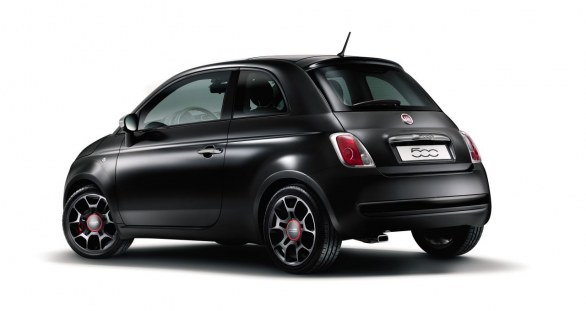
Fiat 500 Street MY 2013

Meanwhile in Italy Fiat has introduced the 500 Model Year 2013. Available in both body types, 3 door hatchback and cabrio, the car is now offered with 6 new colours and 2 new versions. The MY 2013 introduces the blue “Dipinto di blu”, the purple “Dolce”, gray “Colosseo”, red “Diva”, yellow “Sole” and Beige “Cappuccino”. They will be also available with 2 more interior options: Cioccolato/Avorio (Chocolate/Ivory) and Gray/Black. Lounge version is now possible to have with 14 axes rim of 15″. In terms of accessories, there are 2 more versions: the Street (Black Matt color, 16″ rims, spoiler, new seats, crome gearbox) starting at €13.750 for the 1.2. The other version is called Color Therapy, that according to Fiat, it develops the pop and coloured soul of the 500 through colours that had made this model so famous. MY 2013 does not mean any change in design, as Fiat is waiting for the first real facelift in the coming months in order to enhance in a better way the new rivals.

Fiat Bravo Sporting for Brazilian market

After some weeks of the presentation of Fiat Bravo MY 2013 for Brazilian market, they have showed the Sporting version. From next week Brazilians will be able to buy the Bravo with 17″ rims with new sporty touch outside and inside. It adds a red frame in the grill, a spoiler and a suspension 25mm lower than its ‘common’ brothers. Sky Dome roof is standard. Will be available with both gearbox, manual or Dualogic starting at R$58.140 (€23.000). Is then more expensive than Essence version R$53.140 (€21.000) and cheaper than Absolute (€24.600) and T-Jet versions (€26.200). The engine is 1.8 E-torQ and is only available with 4 different colors: yellow, white, red and green. Fiat , which is Brazil’s best selling carmaker, is trying to recover its market share in C-segment due to the fall of sales of its Bravo and Linea. During the first 5 months of 2012 they have sold 3.478 Bravos and 3.419 Lineas, far away from the leader of the segment, Toyota Corolla with 20.681 units sold so far.

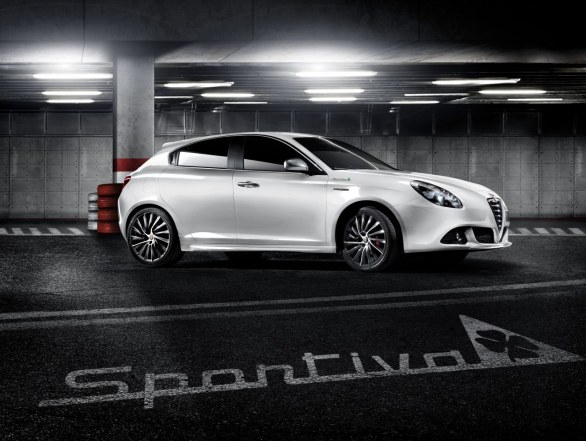
Alfa Romeo Giulietta Sportiva

Alfa Romeo wants to keep the good results of its C-segment Giulietta. In April and May it was Italy’s best selling car in its segment surpassing VW Golf. After the arrival of entry level version of 1.4 T with 105 HP, now is turn for a more sporty version. The Supersportiva will arrive soon offering an interesting sporty package with 1.4 MultiAir 170 HP , 2.0 JTDM 140 HP or 2.0 JTDM 170 HP. It comes with 18″ rims (the same of QV version) with Brembo brakes, darken stop lights, matt external mirrors; sporty pedals, leather seats with red stitching, among others. A good way to keep shaking the market in a moment when all segment sales are droping. This year is expected to be really hard for Alfa Romeo’s sales figures as they just count on 2 models and Giulietta one is now having problems outside Europe with the arrival of new competitors. In Italy this car should take the comand of C-Segment sales, thanks to a wider range of versions and GPL options, now more appreciated by Italians. YTD sales figures indicate the Giulietta is just 2.951 units behind the Golf, but it seems this gap will reduce as the Giulietta was in May, for second month in a row, the best selling compact in Italy.

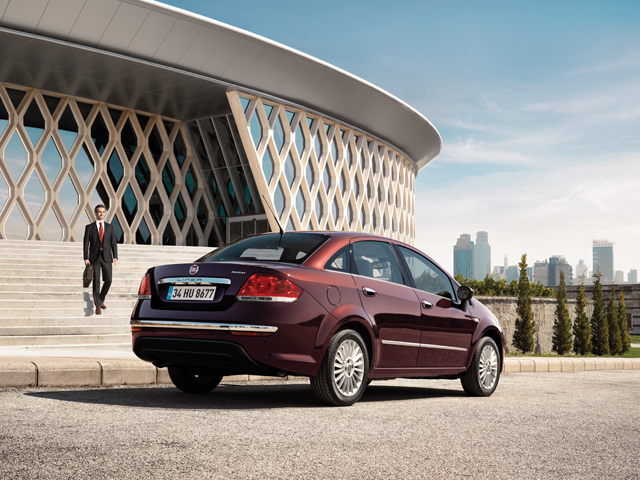
Fiat Linea 2013

Finally from Turkey arrives the last news. The Linea, Turkey’s  best selling car, has received its first facelift since it was introduced in 2007. The make up affects the outside and inside design and allows it to look much better and elegant. Now it comes with a rear spoiler and inside there is a new design for the steering wheel and redesigned instrument panel, and a new dashboard. Engines don’t change: 1.4 Fire with 77HP, 1.3 MultiJet 95 HP and 1.6 MultiJet 105 HP. Inside the whole dashboard and panel were changed and took from the Punto Evo but adding better looking materials. Fiat produces the Linea along with local producer, Tofas, and this year it has become country’s best selling cars beating its rivals from Renault, the Thalia and Fluence. Jan-Apr sales figures indicate that 8.710 units of this sedan (C-segment in Turkey) were delivered, up 13% in a whole market that drops 19%. Eventhough the good result, it is practically the unique successful model of the company as the Albea sedan (B-segment) is getting really old and its sales falling dramatically. Turkey is an important market that is expected to grow to interesting levels in the next years.

Fiat Linea interior

Source: Automotive News, FGA, Auto Esporte