
October/12: Fiat Brazil at its highest market share

Brazilian car market continues to be the place of good news for Fiat. Last month the brand got its best market share so far this year with 26.17%. It is also the highest share since April 2009. This great result was possible thanks to a big growth in Fiat’s registrations much more than industrywide gain. Fiat was up a massive 45% (the second best performance of this year) while Brazilian car market was up 23%. Compared to October 2011 Fiat sold 20.313 more passenger cars, most of them because of more registrations of the couple Palio-Siena. After the historical record in August for both, Brazilian market and Fiat itself, partly inflated by the fact that IPI reductions could be cut, a big fall was evident in September. Since then, with two extensions of IPI and political measures looking to facilitate credit to buyers, the market is back in October with almost 327.000 units. IPI, for Imposto sobre Produtos Industrializados, is a Brazilian basic tax applied to industrial products produced in or outside Brazil. In the case of Brazilian products, the IPI is calculated based on the sales price, while in the case of imports, it is on sales price plus shipping costs and import duty. Dilma Roussef government places auto industry as one of the most important for future economic development. It is why they decided to reduce this tax as an incentive for the industry and when it all seemed the reduction was going to be cut at the end of August, the government decided to keep the reduction until December 31st. It allows Brazilians to buy cheaper cars, most of them locally produced as there is one ‘Super IPI’ with a higher tax that applies to imported cars. For example, a locally produced Gol with 1.0 liter will pay 0% of IPI until the end of this year, while an imported Picanto with the same engine has to pay 30% of IPI.
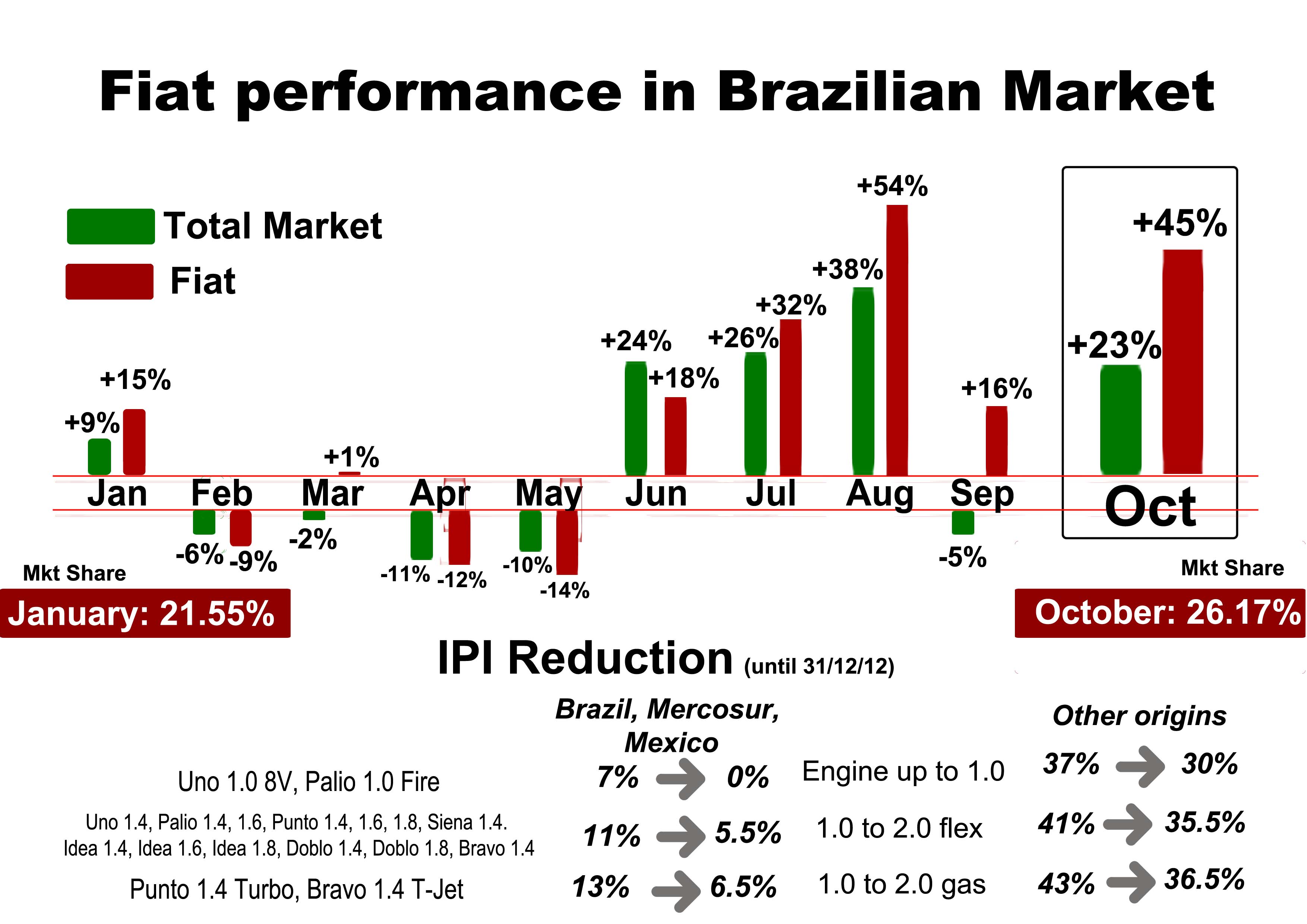
Sales figures for passenger cars. In October Fiat sales grew up two times more than industrywide. Thanks to the reduction of IPI tax, which is applied to final price of the car, most of Fiat models increased their registrations. Source: carsitaly.net, Auto Esporte

Fiat is making use of this tax reduction. The Palio had its best month in terms of share and the second best result in terms of units delivered. Compared to October/11 the ‘B-Segment’ car is up 113% which is an awesome result for mass product such as the Palio. More than 10.000 more Palios were sold last month, accounting for 49% of total rise. The introduction of the sunroof feature may had an impact on this result. The same happened to the ‘B-Sedan’ Siena, up 135%! during that month the Siena got the first place among small sedans. The rise of Palio and Siena counted for 17.195 more cars, 85% of the total. They were both the main stars of Fiat performance in October as the small Uno is up just 3%. The result of Palio and Uno should warn Fiat people as there may be a sort cannibalism between them, specially with the basic versions of the Palio. Down in the list the Strada continues to be Fiat’s most stable model as it keeps being the leader of the ‘C-Pickup’ segment and it is pretty old now. Other good performances: the Punto, boosted by the strong facelift and the small 500 which sold again more than 1 thousand units. Compared to competition, the Palio continues to be behind the Gol but it seems to resist, at least for now, the arrival of all-new Hyundai HB20 and Chevrolet Onix, both models to difficult Palio and Gol’s domination. In other segments, the Idea loses share against the new Spin from Chevrolet, which though it is not considered a small MPV (it is closer to a ‘C-MPV’) its features and prices affects directly the Fiat model. The 500 should be preparing for the arrival of Brazilian-made VW Up!. Anyway, Fiat continues to be Brazil’s leader but coming months will complicate its leadership as more competition will arrive and no new Fiats are expected to arrive shortly. All of that takes place in a market strongly healthy and not dependent on government incentives, well the IPI tax is just that, and when the government reduces it, the market reacts positively as it can buy cheaper cars. The opposite situation of toxic government helps that took place in Europe for years, which allowed many people to buy a car without taking into account the fact that they did not even need one.

Brazil, October 2012. The Uno keeps being Brazil’s best-selling city car but it seems a facelift is needed. The new Palio and Siena are doing great. Just the most expensive cars (500, Bravo and Linea) are doing bad. Source: bestsellincarsblog.net

 

Click here to see Brazil November 2012 Results

Click here to see Brazil September 2012 Results

Colombian market, next step on Fiat LATAM plans

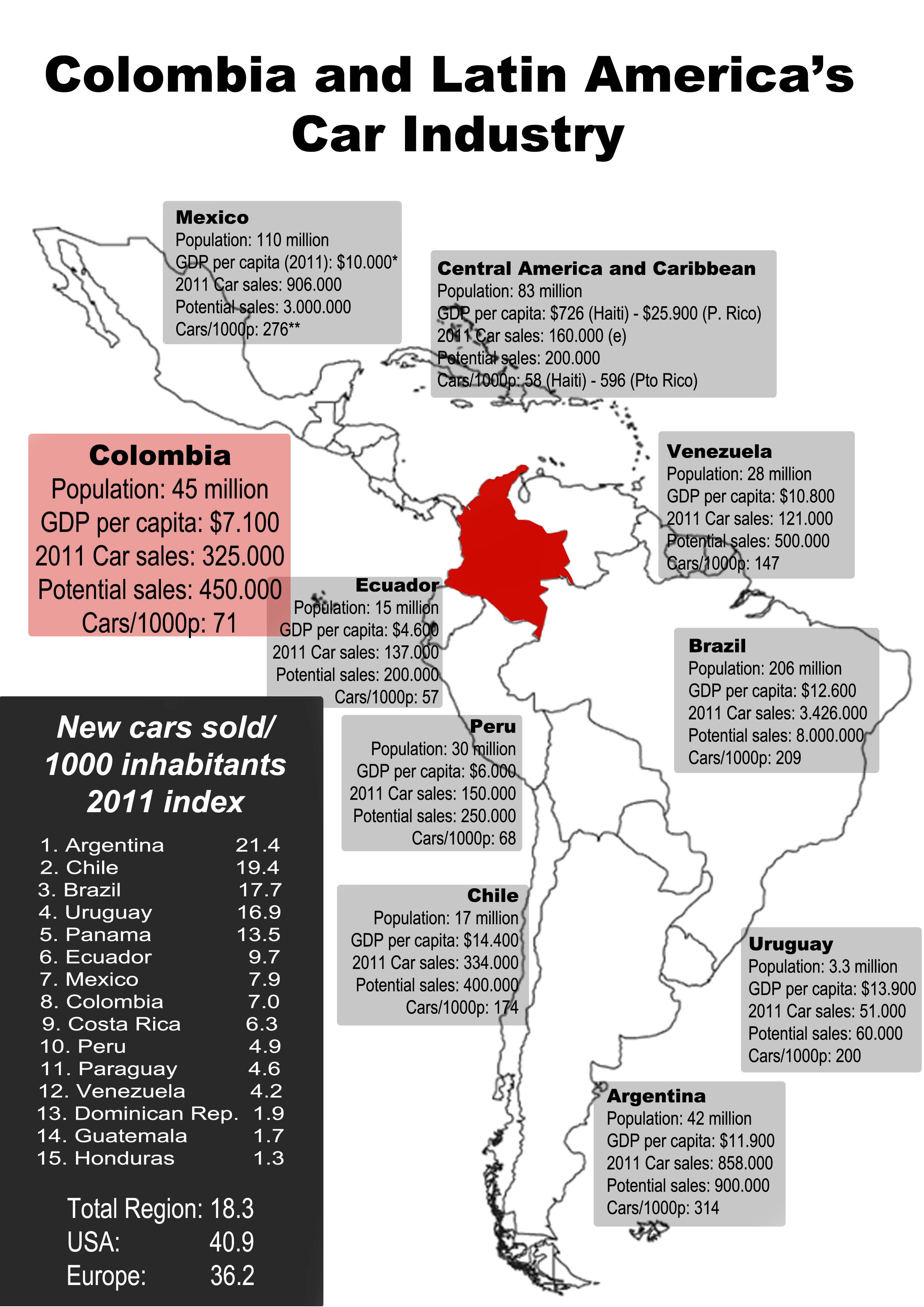
Fiat Latin America has become one of most dynamic divisions of the group. The continent was along with North America, the big two regions to increase revenues in the third quarter of 2012, according to the latest report. Most of Latinamerican economies keep growing no matter the turbulence in developed world. Its young population grows as middle class becomes the largest one in countries like Brazil, Argentina, Uruguay and Chile. Other countries, like Mexico or Colombia, deal with their own problems but their economies show that sustained growth is possible. Fiat-Chrysler is one of top 3 carmakers of the region as it is the leader in Brazil and one of top 5 in Argentina and Mexico, the largest car markets in Latin America. Their continuous investments in those countries (a second Brazilian plant is expected for 2014) and the development of products exclusively for them, allowed Fiat, in Brazil and Argentina, and Chrysler, in Mexico, to gain an interesting market share. The three markets counted for 80% of total region’s car sales and they are expected to keep growing in the next years as most of their population doesn’t have a car yet, according to new-cars-sold/1000 inhabitants index. Last year’s figures shows that Argentina was the country with the highest index with 20.3 new cars/1000 inhabitants. That result is really far from developed markets like USA with 40.7 or Europe 36.2 new cars/1000 inhabitants. Brazil occupied third position (17.7) and Mexico is in place number 8*. It shows not only how low car sales numbers are compared to total population but also the enormous potential the whole region has in coming years.

Latin America’s car industry 2011. No matter its strong growth in the last years, there is still a big potential as a big part of the population lacks of car. Colombia, strategically located, occupies place # 3 in terms of population but # 5 in car sales figures. Source: GDP per capita, Banco Mundial; Cars/1000p, Banco Mundial; ALADDA

But the region is not only Brazil, Argentina and Mexico. There are other markets that may be small now but can become really attractive in the future as they have big populations and stable economies. Colombia is a good example. It is Latinamerica’s third largest populated country (47 million inhabitants) and a fast and stable economy that seems to keep attracting foreign investment. The strategic location of this country, just in the middle of the Americas with two shores in Atlantic and Pacific oceans, makes of it an ideal place for making business. It is a country with so many problems but it is also full of opportunities: a small but rising middle class that will be enlarged thanks to better economic and political conditions. Besides, it has become ‘the other Chile’ in terms of free trade agreements and an open economy. Last governments have signed several trade agreements with lots of countries allowing Colombian market to receive goods and services with less import taxes and at the same time to export its products to countries like Mexico, South Korea, Canada, USA, Chile, Peru, Turkey and Russia. Now it is easier to import cars in Colombia and much easier for Colombians to buy them as prices decreased thanks to lower taxes and a stable currency exchange. Last year a record of 325.000 cars were sold there, more than Swedish, Swiss or Polish markets and close to Austrian one. However, it was the region’s fifth largest market no matter it is the third largest population. ALADDA index shows that Colombia occupies 9th place with only 7 new vehicles/1000 inhabitants, which explains how big the market can be in coming years. It is why it could be considered as one of the most competitive ones (along with Chile): not only the traditional car makers from Europe, Japan/Korea and American brands are present but also Chinese and Indian have an important role.

This year Colombian market is expected to stabilize at around 330.000 units. The market is mainly dominated by Korean products from Chevrolet, Hyundai and Kia and locally produced cars from Chevrolet and Renault-Dacia. Fiat’s share has been always low but they want to increase it with a wider range of products coming from Brazil, Mexico, Serbia and Italy. Source: Revista Motor, FGW Data

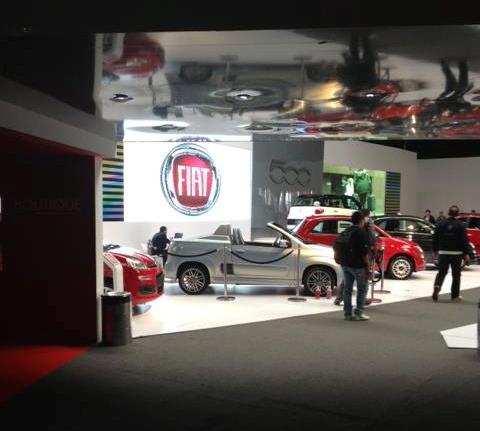
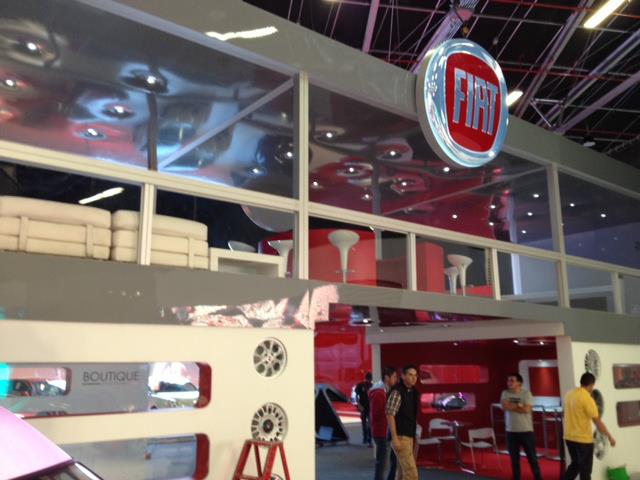
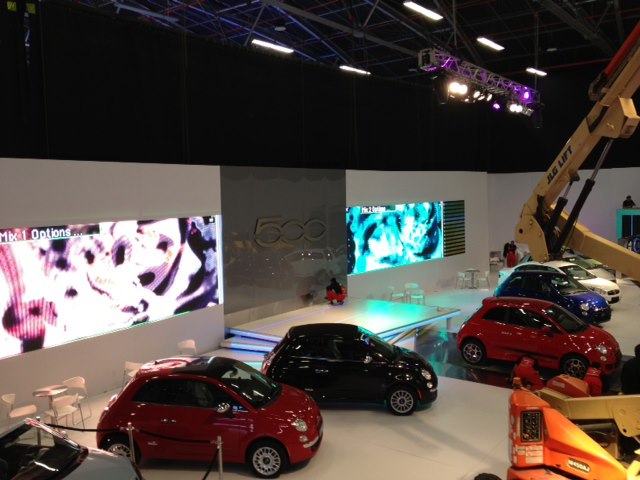
Fiat sells its cars through an important distributor (Colitalia Autos S.A.) with several dealerships all over the country. Thanks to their long experience with the brand in Venezuela, they are now investing a lot in Colombian market as they see it as a great opportunity. As I’ve been saying, Fiat can not depend on only one or two markets in a region full of opportunities. It can’t do the same what happened in Europe with Italy, where its strong dependence affects its operations in that continent. What Fiat guys from Colombia are doing is a good example of diversification of sales and pointing at an interesting market that can become important for global Fiat-Chrysler. A proof of their commitment with Colombian market is what they just did in Colombia’s largest auto show, the XIII Salon Internacional del Automovil of Bogotá. The event, that takes place from November 14th to 24th, is an interesting show of what all car makers with operations in Colombia can do. No matter there are other more important auto shows in the region in terms of public media and presentations, Bogota’s event has become the place for big business and unexpected presentations. One of it was the first presentation of Fiat 500L in the Americas. For the first time the new B-MPV from Fiat crossed the Atlantic ocean for its first official appearance in Colombia. It was all possible thanks to Colitalia’s effort to make of Fiat’s stand one of the best of the show. Along with highly innovative interactive technologies and design, Fiat’s show included the very first appearance of the new Panda in South America, and the introduction of the new Grand Siena, coming from Brazil. In terms of quality of the presentation, Bogota’s stand is not far from what we normally see in Geneva or Sao Paulo. Of course, the 500L and Panda are just Show cars looking to increase Colombians’ awareness.

Fiat’s stand at Salon Internacional del Automovil of Bogota. The new Grand Siena will be one of the stars of the exhibition.

The importance that Fiat and its local representative gives to Colombian market is not only a matter of a show. Next week it is expected the visit of important Fiat LATAM executives and the plans for coming months are full of launches. In 2013 they will introduce the Serbian 500L just after Fiat does it in USA. Then the new Palio and Siena will make their debut to compete in the tough Colombian ‘B-Segment’. Meanwhile they keep selling the Mexican 500, which has become really popular in Colombia thanks to its attractive mix of price-product. Colitalia will also introduce the Abarth 500. For the entry-level, they are negotiating a product that could have a very competitive price (around $12.000 or 9.500 euro) but nothing is for sure yet. Their idea is to offer different products for each segment so they can gain more market share. According to confidential sources all these future products will allow Fiat to achieve its forecast for next year: 3.000 units or 1% of the market. It means 43% more than 2012 forecast, which will be boosted by 320 units expected to be sold in Bogota’s auto show. Thanks to a responsible work, strong commitment and several marketing strategies, such as social networks contests, the brand will be able to achieve a better market share and awareness among Colombians and at the same time look to expand Fiat’s domination in this important region. Good for that.

For Bogota’s auto show they took the Uno Cabrio concept and one Italian Panda as show cars.

The new Fiat 500L made its debut in the Americas with the presentation in Colombia. Will be available next year

A great stand with innovative features allowing more interaction with visitors. Good for the image and positioning of the brand

The whole 500 family is present in the event. Even the Abarth version is presented as a show car and available from next year.

Alfa Romeo is also present in Colombian market. The TCT gearbox helped to boost its sales during the last months.

*ALADDA index, Asociación Latinoamericana de Distribuidores de Automotores

Europe: “We need to get this issue under control”, Marchionne

Here there are the main highlights of Sergio Marchionne’s interview with Luca Ciferri, Editor-in-Chief of Automotive News Europe:

  • Inevitable the move of merging Fiat and Chrysler by the year 2014
  • Big effort on relaunching Europe operations
  • 2013 total sales target: 4.3 million from which 2.6 million (60%) correspond to Chrysler. It means Chrysler sales will grow 8% while Fiat ones would decline 6%
  • Problem with distribution of production in North America
  • “Success” for the coming Chrysler 200, to be presented in Detroit 2013
  • Regarding Chrysler 100 he thinks “is a great idea to provide dealers in the U.S. with two options in the compact segment”
  • If Chrysler 100 gets produced will come to Europe as the new Lancia Delta
  • Reason for poor results of Lancia Thema/Flavia/Voyager: selling a premium brand in a difficult market is tough. The market is getting smaller
  • The Dodge Dart effectively started rolling out in late September. The target is unchanged
  • He wants different body types for the next generation Chrysler Town & Country and Dodge Grand Caravan. Marketing study is on the way
  • Fiat 500 results in America: great product. Different approach from different people in charge of its sales
  • Jeep can reach 1 million units but it does not have the capacity right now
  • The new SUV from Maserati, the Levante, will be built in Mirafiori, Turin with a lot of the underpinnings coming from the U.S.
  • Jeep’s production in China: the company will remain in USA. It can do CKD units but everything coming from U.S. market.
  • Alfa Romeo to VW: “there are some things that are not available for sale… I have zero interest in selling Alfa”

Source: Automotive News

A possible solution to troubled Italian sales

Photo by: ilgiornale.it

It is my belief that during difficult times such as current European car industry crisis, any idea looking for solving it is welcome, no matter the impact it may have. The situation is that bad that European authorities are finally considering Sergio Marchionne’s idea of assisting the industry and control over capacity problem. But even the most optimistic previsions indicate that next year will be at least as bad as current one. The reasons for this scenario are well-known by everybody but not the possible solutions. Not all car makers are struggling to sell their products. In one side there are French, Italian and American brands trying to resist. In the other side there are VW, BMW and Mercedes, relatively comfortable as they keep earning money in China. That’s why getting to a common solution is difficult, well interests are different and VW, the European leader, is some how benefiting from the mess in which Fiat, PSA, Renault, Ford and Opel are nowadays. In the case of Fiat, the Italian car maker has two big problems: its Italian factories working at 50% of capacity (and therefore the problems with union labors) and the sharp drop of Italian car registrations (along with Spain, Italian fall is the worst of big European markets). Italy represents 54% of Fiat’s sales in Europe. YTD figures show that Italian market has dropped 20% and of course Fiat, as the leader of that market, experiences a big fall too.

Looking for solutions implies understanding the problem. Italians stop buying cars because of economic situation and the bad perspective for coming years. The country is part of a deep recession in most of Europe which is the result of high public expenditure, low revenue and high government inefficiencies. After years of this terrible combination, European governments finally decided to execute a severe austerity plan, firing public employes, and increasing taxes. Italy is part of that austerity plan and Italians are suffering the consequences: less money to save as they have to pay more taxes, and the worst, less job offer. Those looking for a job are coming thru a difficult time, while those having one struggle to keep it in an economy that will shrink 2.4% this year, with unemployment rate around 11%, according to predictions of Confindustria, Italy’s employers’ lobby group. The uncertainty that reigns among Italians is big enough to diminish their spending of everything that is not strictly necessary. Cars is part of that decision and Fiat knows that. If people are not sure of their economic future they cut expenses and they begin with the things that are not vital. Cars are not a basic need so when someone is not sure of keeping his job in coming months, one of the last things this person will think about is buying a car. It explains why Italian market sinks and will continue to do it as far as the economic situation and job offer don’t get better.

The problem is that Fiat can’t wait till things get better. They need to sell cars and increase production levels of its Italian factories and must do it as soon as possible. Understanding the client’s needs and behavior is always a good way to have the appropriate approach in order to sell. And that’s exactly what Fiat should do at least in Italy, its homeland. If the problem for a big part of the population is keeping its job in coming months, then Fiat could use its strategic position as the major private company in Italy to offer some buyers the possibility of buying their new cars with a sort of unemployment insurance. I mean, Fiat as a big player of Italian economy, is able to neutralize the risk of possible future unemployment of potential buyers. They can offer clients to buy their cars (through a credit) and give them the possibility of suspending monthly payments if they ever become unemployed. Of course, it would not apply to everybody, and only in those cases in which Fiat, using its strategic position, makes a close analysis of several companies that could be considered candidates as they might not have problems in the future. That is, Fiat would assume part of the risk the client has of becoming unemployed and so in case that happens (Fiat should only work with those companies with less than 10% of probability of collapse), that client could suspend payments for the time he does not get a new job. The client that could be benefited from this should pay certain quantity of money down and of course a higher interest rate for the credit. For this, Fiat should make a deep analysis of all industries and companies and then make a classification according to their economic situation and future perspectives. Only those buyers working on those companies with low risk exposure could applied for this particular purchase. And in case they become unemployed, they would keep their debt and will be able to use the car. In other words, Fiat would be offering the opposite of normal credits without any money down: instead of not receving the money now, Fiat would get it now but might not receive it in the future, if things get bad for the client. Anyone could say that this could be a good idea of buying a car and then stop paying for it. But when anyone becomes unemployed the very first thing this person looks for is to find a job immediately.

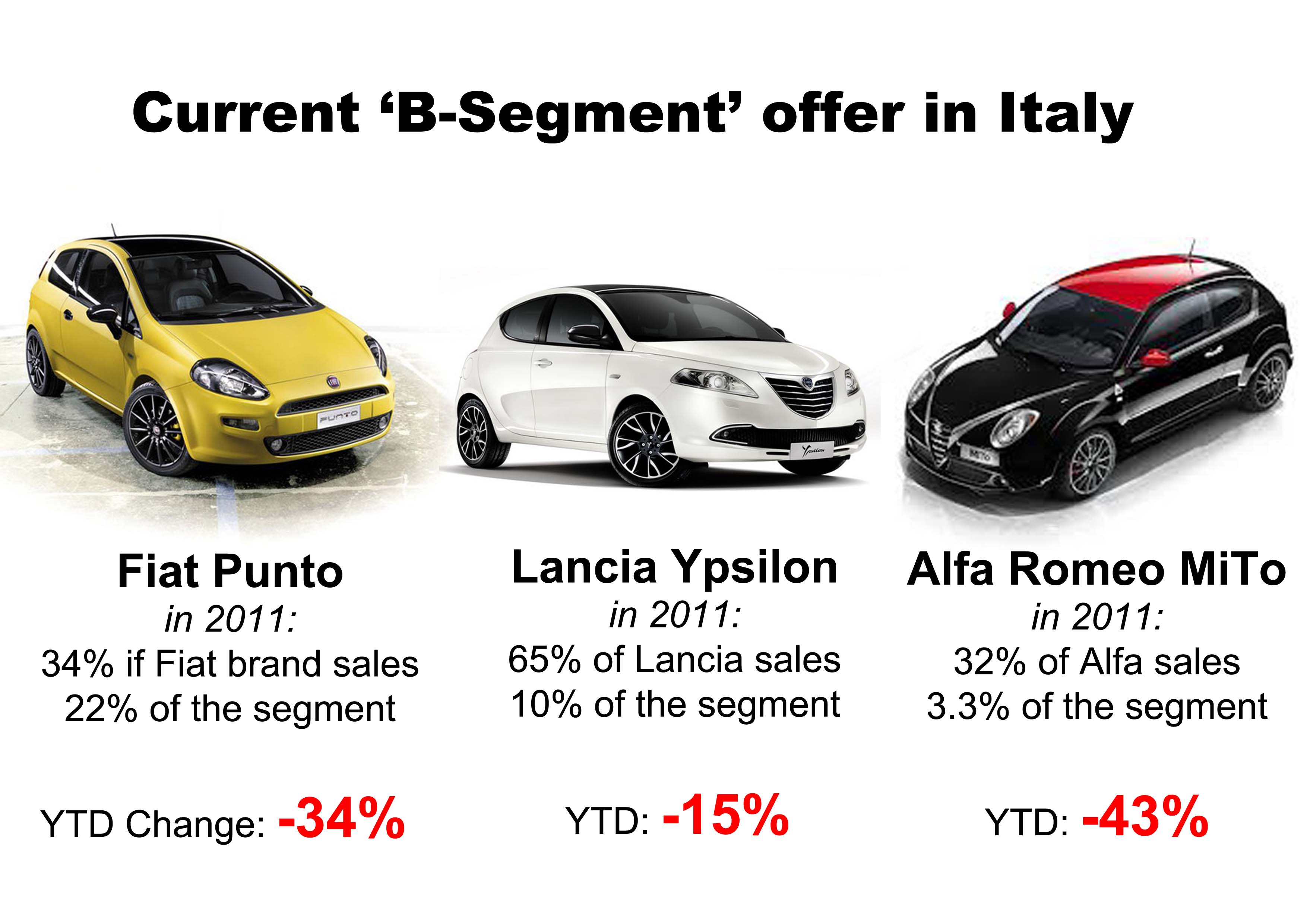
This approach could be a good way of telling clients that Fiat understands their situation and it can support them in case they need help. Fiat would not be risking too much as they would only give this possibility to ‘safe’ companies’ employees and might increase its car registrations, currently affected by this uncertainty about job among potential buyers. The bad side of the equation is that it would not be a good message for the employed people who can’t apply for the credit. Fiat would be telling them their job is not secure and making business with them would not be a good deal. One last thing: this credit should only apply for Fiat Punto, Lancia Ypsilon or Alfa Romeo MiTo. ‘B-Segment’ is Fiat’s major problem nowadays, with the Punto that shrinks 34% so far this year, and the Ypsilon that, no matter its youth, fell 32% in October and 40% in September. And there is the MiTo, which never took off in terms of sales. Most of Fiat’s fall in sales is due to Punto’s drop as the Panda is stable, up 3% YTD. Those thinking more of their job whose income really depend of it, are considered middle-class Italians who normally buy ‘B-Segment’ cars. One person in this situation would not buy a 500, the chic and expensive citycar. They would not buy either the Bravo/Giulietta/Delta models, which are more expensive. If they wanted to change their car they would choose a Punto or Ypsilon, which are affordable and some how comfortable. So the target fits perfectly the products, and in the case of the MiTo, it needs more promotion to get a proper level of sales figures, and this could be a good idea to do it. Or what do you think of this idea?

Last year the Punto counted for one third of Fiat brand sales in Italy while the Ypsilon is almost doubles that number. YTD change for the period January-October 2012 vs. January-October 2011. Source: carsitaly.net and FGW Data basis

USA market and Chrysler slow down in October/12

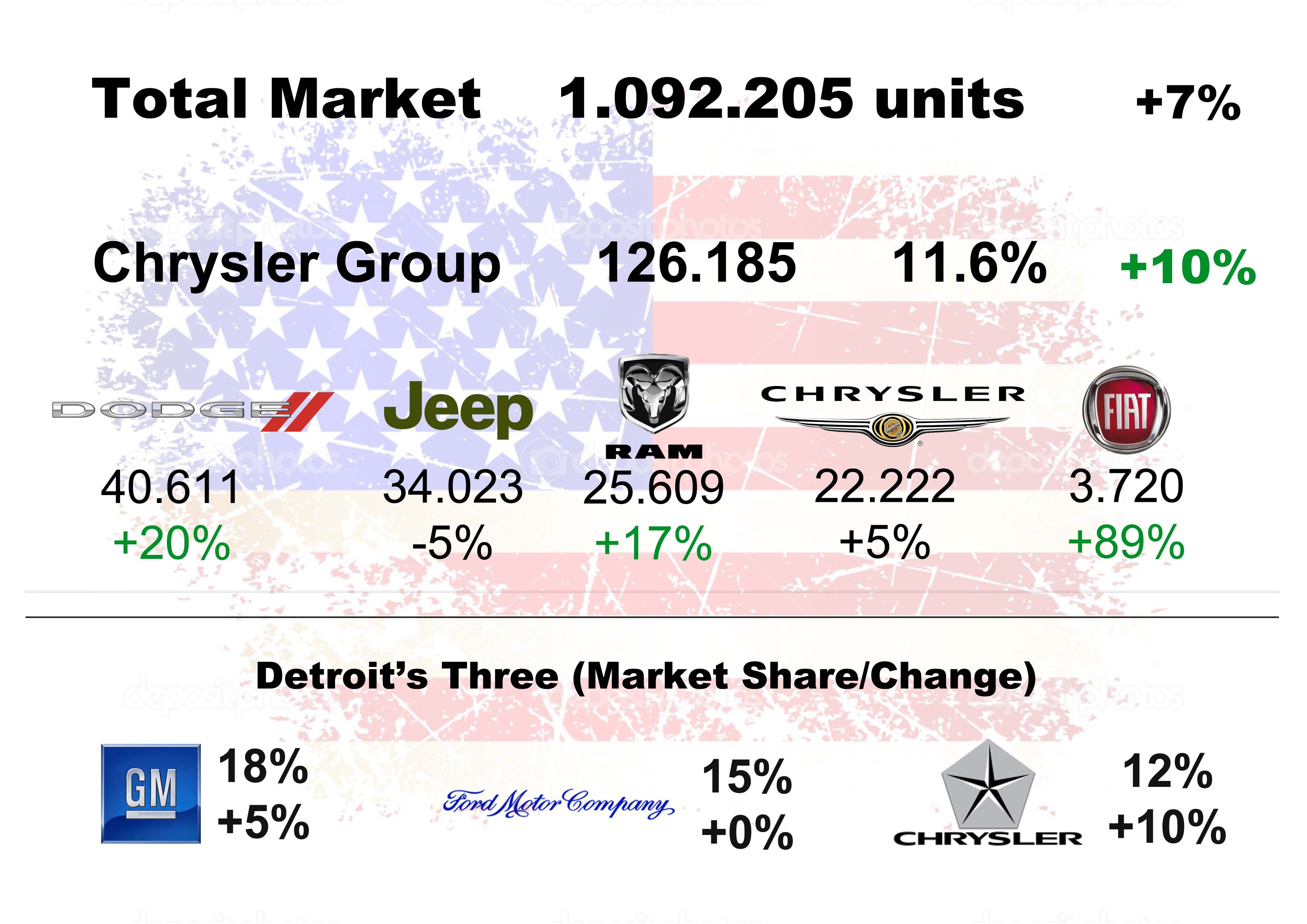
Once again Chrysler along with all American car market slow down their growth after months of spectacular results. It does not mean that the market is now in a decline phase. The market seems to be stabilizing though it is still far from pre-crisis records. The same happens to Chrysler, still the best performer of the 3 from Detroit. The Group increased its sales registration 10% while the market was up only 7%. Its market share grew from 11.2% last year to 11.6%, which is pretty good but still far away from Chrysler’s target of reaching 13% by the year 2014. One important fact to considered is that hurricane Sandy had an impact on car sales at the end of the month as the area affected contributes to 25% of total sales of the country. The good result of Chrysler Group could had been better if it wasn’t because of the hurricane and Jeep brand, which had a fall for the first time since April 2010. However the group’s results are well-distributed among its 5 brands so Jeep’s tiny fall was compensated by the good performance of the major of them, Dodge, up 20%, and Ram, up 17%. Chrysler brand lost market share as it had lower increase than total markets’ (+5%) while Fiat 500 continues to grow. Compared to competition, Dodge did much better than Ford and Chevrolet, and only VW, among big ones, had a better growth. Jeep lost market share in SUV segment, which was gained by GMC, just 453 units behind. Due to the great sales performance of the group during March-September, October results are under total year’s average: 126.185 units vs. 137.686.

USA car sales registrations October 2012. Chrysler Group continues to be Detroit’s best performer thanks to good results of Dodge and Ram. Its market share is still distant from 2014 target. Maserati and Ferrari sales figures not included. Source: www.carsitaly.net, bestsellingcarsblog.net, Good Car Bad Car

The Ram Pickup did quite well, up 20% or more than 4 thousand units. It is still the best performer of the 3 pickups from Detroit (Ram, F-150 and Silverado) and it allowed it to increase its market share among them from 19.09% last year to 20.94%, almost 2 points. Far behind, more than half of Ram sales, there is the Jeep Grand Cherokee, with lower positive increase but now behind the Explorer more than 1.600 units. Wrangler’s sales registrations were as many as Grand Cherokee’s, both counting 67% of Jeep’s total sales. The reason for Jeep’s fall is that the small Compass was down 52%, its worst result so far this year. It seems the facelift it received has not been successful at all. In the other side there is Dodge  with its Caravan, up a massive 49%, when one year ago its sales dropped 13%. The reason for this resurrection is unknown but this minivan is quite old to have this good results. Coming generation should arrive in late 2013, early 2014. The arrival of the Dart is also helping boost sales registrations as other models slow down their growth. Even though the new ‘C-Segment’ sedan is expected to finally take off in January 2013 when it is expected the highest production levels in Belvidere plant (12.000 units/month). Fiat sold 3.720 units, making US market the world’s largest one for this model, and 36 units above Italian figures. The 500 was up 89% compared to October 2011 when the small Fiat began to have troubles in terms of sales in USA (until February 2012). Abarth version continues to boost its sales but also the arrival of the 500 Turbo, on sale since October.

Good for the Ram, with more market share among the 3 large pickups. Bad for the G. Cherokee that loses its battle against Ford Explorer. Very good for MPV, the absolute leaders of the segment. Source: bestsellingcarsblog.net

The Dart has not taken off yet but gained market share among ‘C-Segment’ models. It just sold 220 units more than September but it is expected to reach around 12.000 from next year. Source: bestsellincarsblog.net
 

Click here to see USA November 2012 Results

Click here to see USA September 2012 Results