Fiat/Abarth 500 continues to impress British market

Once again, second month in a row, the successful Fiat 500 continues to hit British. In May 2012 it was again among 10 best selling cars in that important market. Last month 2.823 units were delivered to clients making of it the 10th best selling car and number 1 among small cars. The good sales performance is even more impressive if is taken into account that the UK is the land of Mini, the eternal archenemy of the small Italian (though they don’t belong to the same segment). Year to date results indicate the 500 has reached 14.113 units sold, compared to 25.607 units it sold for the whole 2011. The good results of it can be explained by several and continous promotions made by Fiat that include very interesting financial plans, and also by the good reputation the model has in the UK.

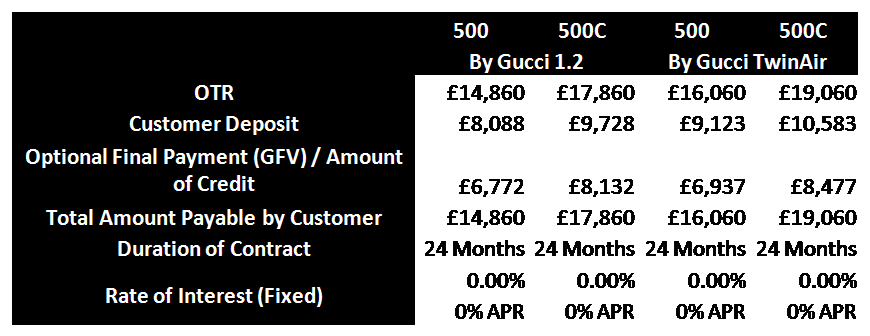
Fiat 500 and 500C Financial payment offers for the UK, June 2012. Source: http://www.fiat.co.uk


Fiat 500 and 500C financial offers June 2012 with Fiat Advance Payment Plan. Source: http://www.fiat.co.uk

In fact one of the success key factors that allows the good sales figures is the depreciation index of the car. Some days ago CAP, British market leading provider of vehicle valuation data, published the list of best and worst depreciated cars in that country. The study includes only three-year-old cars with more than 48.000 km and Abarth 500 and Fiat 500C occupied very important places. The first one retains an average value (after 3 years/48.000 km of use) of 60% of its initial value, while the cabrio version costs 58.4% of what it used to cost 3 years before. These results allowed them to occupy number 3 and 4 places among the best depreciated cars in Britain, after the Audi Q5 and Skoda Yeti. It is certainly an excellent result that tells about the good image the car continues to have after 5 years of its launch. In the other hand another member of the family, Fiat Bravo, appears in the bottom of the list, keeping just 34.4% of its original value. Something to think about.

CAP’s April 2012 Depreciation Survey in the UK. Source: Auto Express

Why so good in America and so bad in Italy? Opinion

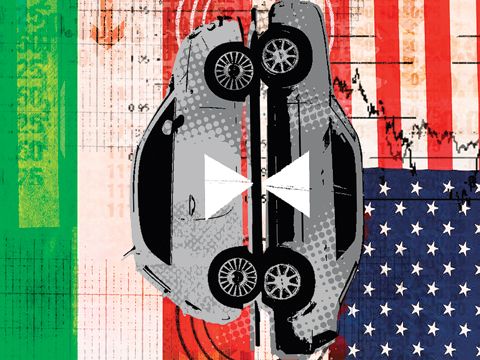
Illustration by Automobile Magazine

On friday Fiat SpA released the Group’s results for May 2012 in Italy and USA. Unsurprisingly sales figures confirmed the recent trend: America’s rise up and Italian deep crisis. Those are frequent results since last year when the new Fiat-Chrysler Group began to see a shift in car registration growth from its native Italy to its new native America. 3 years ago, when Marchionne signed the deal with Obama’s government, was Fiat saving Chrysler from bankruptcy. Now is not that Chrysler is saving Fiat from disaster, but because of several facts to be explained in this article, Chrysler Group is now leading the match to make of the Group one of ‘big six’ of the world, while Fiat Group deals with big problems in Europe and tries to maintain its success in Brazil. To try to explain the reasons of this situation with only one fact would be unsuitable. Behind the uprising of Chrysler and the crisis of Fiat, there is a connected net of things that can explain why Chrysler, without any all-new model is having continuos sales growth while Fiat, with some new models, is looking deseperate for solutions to not to sink.

First of all there is the Economic crisis reason. The financial problems that took place in USA in late 2008 affected first American economy and then European one. But while America is more or less getting over it Europe add the debt crisis of some of its EU members like Greece, Ireland, Portugal, Spain and Italy. Althouhg developed countries are all facing the new scenario in which emerging markets are catching investment flows, the situation of America is much better than Europe’s. The worst has already passed in the US, but not in Europe where is expected a full year 2012 and 2013 with lot of difficulties in terms of unemployment, demand and social destabilization. Italy is part of both, the problem and the solution. Its debt problems are making Italian authorities to rise taxes, and therefore restrict consumption. And with no good perspectives in the short term, here comes the second reason of the gap between F-C sales in USA and Italy. Italians are pesimistic about their future, about getting a job and go ahead. Americans are still having problems but their mood is different as they see the light at the end of the tunnel. And mood is a factor that explains perfectly the situation. When people don’t believe in better things to come they don’t care about the future and rather think of their present as a survival exercise. In the other hand, when some of main economic indicators show that the worst of the crisis has just passed, then people start to change their habits and be more positive about coming days. The mood certainly affects car industry, as a car is a product that costs, and is part of people’s main assets.

Auburn Hills now shines. Photo by http://news.ottawadodgechryslerjeep.com

Actually the mood among citizens (or buyers) can be seen in other fields. If one watches any interview or statement of Sergio Marchionne, it will be evident the change of mood when he talks about Chrysler and America and when he mentions Fiat and Italy. His face changes. Yes, Fiat Italy is just giving him problems, but the good mood he projects when he is in Auburn Hills should be the same or better when he is in Mirafiori. People notice it and coming from him, has an impact on the organization, composed by powerful labor unions that every day communicate Italians their dissatisfaction with corporate decisions. It is not the intention to evaluate who is right in their demands, but this tense situation between board of directors and labor unions is generating a bad image of Fiat among Italian buyers. And that’s the other reason that can explain the gap between Chrysler’s sales in USA and Fiat’s in Italy. All car makers are having sales drops in Italy, but Fiat also worries because of the economic impact of its latest corporate decisions. Italians don’t like the idea of shifting production abroad (Poland, Serbia, USA, Mexico and now China), and they blame Fiat of being part of the unemployment problem there is now in Italy. If it is true or not, the reality is that ‘Fabbrica Italia’ plan has not been enough to project the idea that Fiat works for Italy. And that is probably the main problem now: Italians are tired of the status quo that has not brought the solution for their problems, and Fiat is part of the status quo.

Of course it is also a matter of offer. Although the new Panda was introduced in late 2011, and new Ypsilon or the rebadged Fiat Freemont are doing a good work since their launch in Geneva 2011, it has not been enough to change the trend. Fiat has decided to postpone the launch of new models waiting for better economic scenario arguing that most of European car makers are loosing money with their latest products. Fiat may not be loosing money but they are certainly loosing market share. The Punto, which was among Europe’s best selling cars, is now passing through its 7th year of lifecycle with remarkable sales drop Italy included, and there is no replacement model until 2014. Fiat Group’s model range in Italy is dramatically reducing: Fiat just offers 3 different small cars, Alfa has just 2 models at all, and Lancia survives thanks to its Ypsilon, that by the way is only successful in Italy. In this context, selling cars become a hard job. Fiat can not depend on economic cycles to develop its models. The models must be able to generate cash and support the production eventhough there is a big economic crisis, so a decision like the postponement of next Punto is going to increase the sales drop in a market that loves A and B-segment cars.
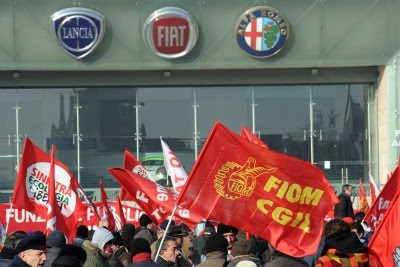
FIOM Labor Union protests. Photo by selvicenza.blogspot.it/

Finally, another fact that is playing against Italian Fiat’s sales is the role of government. Italian authorities continue to atack car industry through new taxes (super bollo, etc.) and making more expensive the price of gas. It has a direct impact on the demand in a moment in which people are struggling to keep their jobs and go on. The coming incentives for low emission and electric cars may be a good solution, but at the end an industry that depends on economic help is a none feasible industry. The role of government should be of generating good conditions for the whole industry and not creating new obstacles or distorting it with artificial and unsustainable incentives. Fiat made a good move with the gas promotion announced recently. All of these factor explain the increasing gap between the results in both sides of the Atlantic. What is next is to learn from what’s happening in America and anticipate it in Italy, but quickly, really quickly.
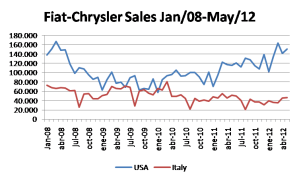
Italy’s figures include Fiat, Alfa and Lancia numbers only. Source: carsitaly.net, Chrysler Communications and Quattroruote.it

Italy: Fiat-Chrysler falls 11% in a whole market that drops 14%

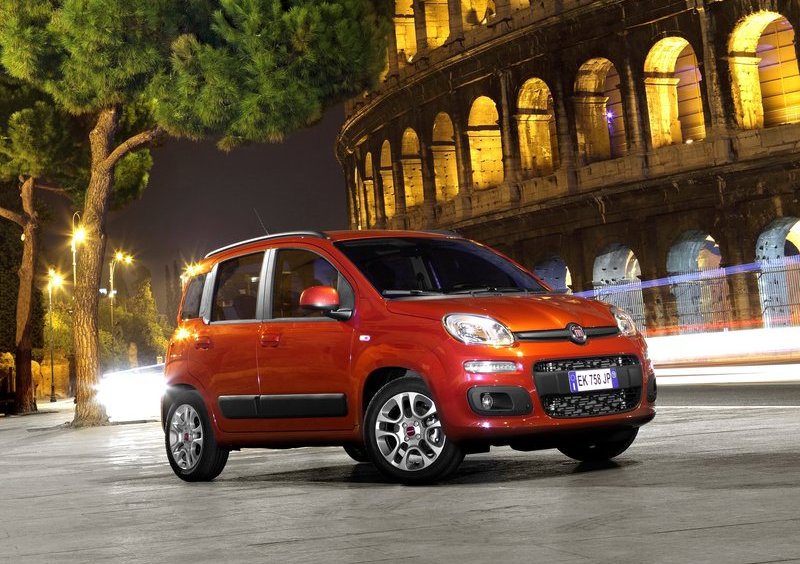
It seems that Fiat Panda will become Italy’s best selling car this year dethroning Fiat Punto, always #1 since 1993. Photo by netcarshow.com

Again bad news coming from Italy. In May the whole market falled 14.3% with sales of 147.102 units against 171.559 of May/11. Economic crisis and high prices of gas continue to affect negativelly Italian’s will of buying new cars. Nevertheless the overall fall May 2012 is the best performance in the whole year after even worse months in Jan-Apr/12. It does not mean that the trend is changing but it means it is more or less stabilizing. Of course Fiat-Chrysler Group is feeling the bad results. Unlike what happens in the USA, the group continues to see bad numbers and May was not the exception eventhough the total number of registrated cars falled less than the whole market allowing to have a better market share. In the last month the whole group quota rised to 31.6% more than the result obtained in 2011 when it was 30.57%. In other words Fiat is suffering the car industry crisis but not as much as its competitors (especially Ford). It is good news in a bad context.

The lack of new generation is affecting negativelly the performance of Fiat Punto, on market since 2005. Photo by netcarshow.com

The rise of F-C’s market share is explained by excellent performance of Fiat Panda during May/12. A total of 12.813 new Pandas were registrated, 27.5% of the 46.500 units sold by the whole group. The Panda has had the best market share (8.7%) since May 2009 when it reached 8.8%. It has been also the best month of the year for the small car and it grows 6.2% compared to May 2011. The rise on the whole group’s market share is also explained by the good results of Lancia Ypsilon, which was up 15.1% on an annual basis. Other models that did quite well were the Alfa Rome Giulietta, +3.1%, Fiat Freemont, up 239% (it was introduced one year ago) and Jeep Grand Cherokee, up 278% from 47 to 178 units. But all these good results were not enough to offset the bad performance of Fiat Punto (-26.4%), Fiat 500 (-19.5%), Lancia Delta (-36%), Lancia Musa (-40.5%), Alfa Romeo MiTo (-41.9%),  and others. Certainly the fall of Punto is dramatically affecting the group’s results. B-segment is Italy’s biggest one and Fiat seems to postpone and postpone the arrival of new generation making buyers to move to other brands such as Toyota or Peugeot (the new Yaris was up 31.4% and new 208 begins to like Italians). In the case of Fiat 500, total sales were down but it had its best month during the year and is still far away from its new feared rival, the VW Up! that seems to finally take off with 1.224 units delivered. It is also important to mention that Alfa Giulietta sold more units than its eternal rival, the VW Golf: 3.473 vs. 3.116. The lack of a Station Wagon for the C-segment Alfa does not allow to obtain much better numbers as this kind of body type is really appreciated in Italy (in May they had a market share of 8.4%). The VW Golf had a spectacular fall of 44.8%. All brands falled: Fiat was down 9.8%, Lancia (-10.1%), Alfa (-20.8%), Jeep (-13.6%). The luxury ones had the deepest fall, Maserati (-86.6%) and Ferrari (-58.6%), explained mostly by the superbollo tax that affects considerably expensive cars.

In May/12 the Alfa Romeo Giulietta sold more units than its eternal rival, the VW Golf. Photo by netcarshow.com

May 2012 leaves two main conclusions: Italian car market will not stop dropping for long and new models of the Group (Panda, Ypsilon, Giulietta, Freemont, Grand Cherokee) are doing their best to compensate the fatigue of old Punto, Bravo, Delta and MiTo. But this situation is unsustainable and if new generations are not coming, Fiat will see its home market share to drop dramatically.


Source: Unione Nazionale Rappresentanti Autoveicoli Esteri and bestsellingcarsblog.com

May 2012, another great month for Fiat-Chrysler sales in USA

Thanks to Chrysler Communications Facebook site, global results of Chrysler Group in the US have been released. The good momentum continues during the fith month of 2012. The whole group (included Fiat brand) had sales growth of 30% over May 2011, selling a total of 150.041 cars, or 34.678 more cars than the ones delivered one year ago. Are really good numbers compared with total market growth and competitors performance. The main source tells that 7 models got more than 10.000 units sold volume, lead again by Ram Pickup, up 29%. By brands Dodge delivered 45.793 units (+14%), closely followed by Jeep with 44.198 (+24%), Chrysler up a massive 81% with 29.674, Ram with 26.373 (+23%). Finally Fiat had another record sales with its 500 delivering 4.003 units, up 128%. More analysis in the next days.

Italy: buy a Fiat and get more than 3 years of gas at $1 Euro

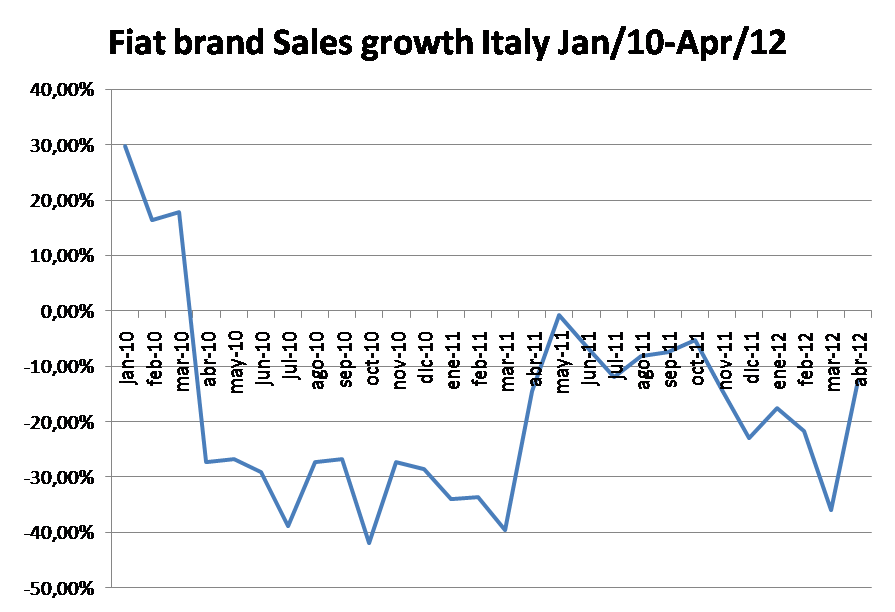
Today Fiat announced its latest promotion. All the people in Italy who buy a Fiat (only Fiat brand) until July 31/12, will have gas price at $1 Euro/Liter until December 31 of 2015! The user will be able to buy the gas in any IP gas stations (3.700 in Italy) using a card that only works for his Fiat. The promotion varies depending the model: for example, with this price, the Fiat Panda will have available up to 1.200 liters during the period of time, while the Punto will have 1.700 liters and the Bravo up to 2.000 liters. It is certainly an interesting promotion especially if it takes into consideration that the price of $1 Euro/L will not change until December 31 of 2015. Fiat brand is facing a drop on sales in Italy since April 2010 because of European debt crisis that is affecting Italy and other European markets.

Fiat brand has not been able to have positive sales growth in Italy since April 2010

The Mexican Fiat 500 grabs Latinamerica

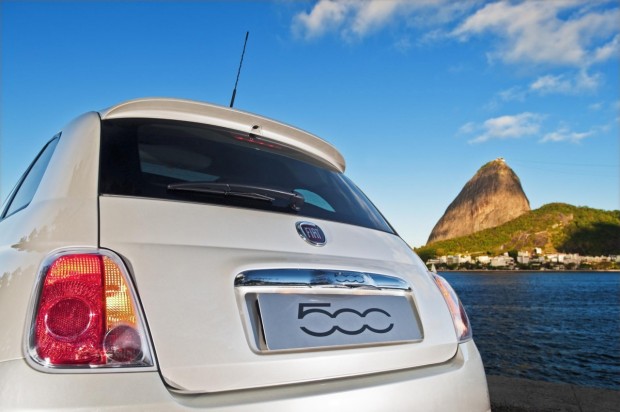
Mexican Fiat 500 in Brazil starting at R$39.900 (US$19.700). Photo by carplace.virgula.uol.com.br

When Sergio Marchionne chose Chrysler factory in Toluca, Mexico, to produce the small 500 for the return of the brand to American market, he was not only thinking of labor costs. Certainly Mexico is a good place to produce small cars due to less expensive labor costs that allows car makers to have more profits per car produced (normally small cars have less profit). With less production costs then it would be easier to positionate the Cinquecento in the complicated American market, as the small Italian with interesting prices. Mexico is part of NAFTA, North America’s Free Trade Agreement, with the US and Canada, and therefore all products produced within these 3 countries can be exported to their partners without paying import taxes. But besides America and Canada, Marchionne’s mind was also heading to the south. Latinamerican market has become in one of world’s most dynamic, as it has not been affected by financial crisis of last 3 years, and sales continue to grow due to good economic moment and excellent perspectives for the coming years. Brazil, Argentina, Colombia, Chile and Peru are some good examples of amazing growth of car sales. In 2011 the whole region sold 6.466.328 units (included Mexico, Central America and the Caribbean), up 7% compared to 2010, which means that 12.3 new cars were sold per 1000 inhabitants, still far from developed countries (USA, 40.7 and EU, 36.2). Nevertheless all car makers are investing in the region for coming years as a big part of the population will buy its first car.

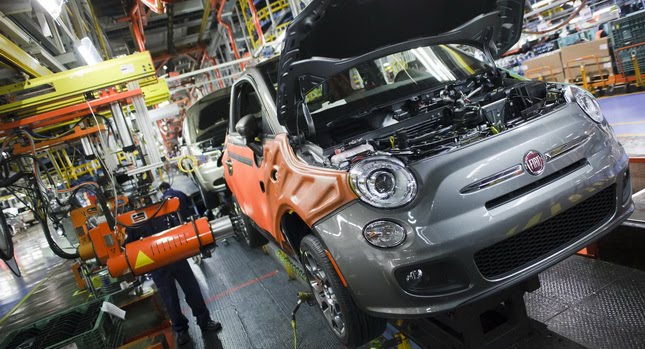
Fiat 500 production in Toluca, Mexico, from where it is exported to USA, Canada, Brazil, Argentina, Colombia and Chile, and soon China. Starting at MXN$199.900 (US$14.000)

Fiat-Chrysler has an important presence in this region. They have factories in Brazil, Argentina, Venezuela and Mexico and they sell everywhere. And Mexico has become an interesting production pole because of its economic agreements with other Latinamerican countries. It is while Chile and Peru the country with more free trade agreements signed. But unlike Chile and Peru, Mexico is a big car producer. In the region it has free trade agreements with MERCOSUR (Brazil, Argentina, Uruguay and Paraguay), Colombia and Chile, and it means they can export their cars paying zero taxes. It allows Fiat-Chrysler to export its Mexican cars to those countries with very competitive prices. One of the latest cars to make useful of this advantage is the Fiat 500. Marchionne was also thinking of this great opportunity because Mexico is the only country that can sell everywhere in the Americas with vert high quality standards and very competitive prices. That is why the Cinquecento is now grabing Brazil, Argentina and Colombia after the bad results that had the European version sold with vert high prices. Now Brazilians can buy it stating at US$19.700, while the car is available in Argentina starting at US$17.600, and US$20.000 in Colombia. In all markets is available with 1.4 8v 85hp or 1.4 16v 105hp. This good price can be seen in total sales. In the first 4 months of 2012, 6.764 units have been delivered to Brazil and 1.135 to Argentina. Eventhough are not big numbers as they are in Italy or in the US, the results of the small Fiat must be analyzed carefully from other point of view.

First of all, Latinamerican market is mostly composed of small and economic cars. The 500 is small but has never been a cheap car, not even in Europe. In Latinamerica this car is positionated as the cheaper competitor of Mini Cooper. It means it is sold as a mini exclusive car. This kind of clients are not really abundant. Secondly, Fiat’s image outside MERCOSUR countries is really bad. That is why selling a Fiat in Colombia, Chile or Peru can become a hard task to accomplish (in 2011 Fiat-Chrysler’s market share was 3.8% in Chile and 1% in Colombia, most of it thanks to Dodge models). And finally, the results obtained by the Mexican model must be compared to the Polish one. One year ago, the European version was not even in the top 100 best selling cars in Brazil, Argentina or Colombia. Year to date results show that Fiat 500 occupies place number 35 among best selling cars in Brazil (# 103 in 2011), and number 56 in Argetina (# 122 in 2011). In Colombia there is no official data but it has been known that the small Cinquino has been a success thanks to its low prices. Though there is not data for sales by model, the arrival of Cinquecento in Mexico has allowed Fiat brand to increase its sales up 112% in Jan-Apr/12. It all means that slowly the Fiat 500 is grabbing Latinamerican buyers as it has done in the other markets where it has been introduced.

Payment promotion: Chrysler America to maintain its sales growth


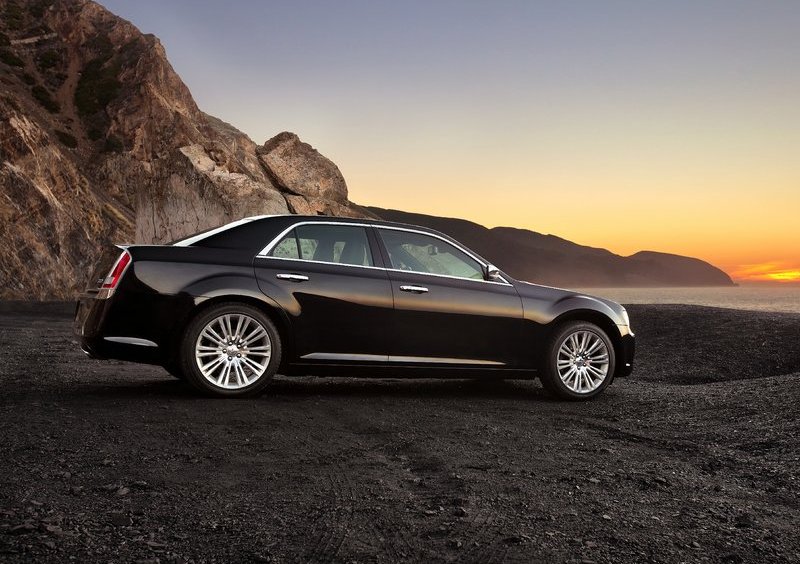
Chrysler 300. Photo by netcarshow.com

Chrysler 300. Photo by netcarshow.com


Chrysler America wants to mantain the good sales records. For this month they are offering people to take any model from their dealers of Chrysler, Dodge, RAM, Jeep and Fiat, and then begin to pay 90 days after. This will certainly boost their domestic sales which have grown up 33% in the first 4 months of 2012 in an overall market that grew 10%. Therefore, it is expected May sales to reach another record, and being much higher than May/11 when the whole group sold 115.363 vehicles, up 10% compared to 2009 figures. So far, best selling models have been the RAM Pickup, up 23%, Grand Cherokee, up 51% and Wrangler, up 30%. The only models to see decrease their sales are Chrysler Town & Country, down 16%, and Dodge Charger, down 7%.

What comes for Jeep

Jeep, as Alfa Romeo, is considered one of Fiat-Chrysler’s best brand names. This SUV company is valuable for its global recognition, its glorious past and its promising future. It is one of the few only-SUV manufacturers and this allow it to specialize, offer great products and fulfil a fast growing segment in the whole world. There is certainly a long way to go to reach 800.000 units by the year 2016 as Marchionne said, but maybe it is a small number considered its big potential.

Jeep Wrangler. Photo by netcarshow.com

Jeep Wrangler. Photo by netcarshow.com

The SUVs from Jeep are present in several markets, but the big part of their sales are located in North America. Last year they had great sales numbers thanks to American economic recovery and very assertive marketing campaign. Although the range has not been deeply modified, during the last years (the only all-new model is the Jeep Grand Cherokee), the brand is going through a good period thanks to what they did very well some years ago: its popular Wrangler. This mid size Off-road still enjoys of high monthly sales figures due to its incredible mix of hard working vehicle with classic design. But Wrangler is not the only one. The all new Grand Cherokee has become a referent of large and luxury SUVs. It has been recognized as an excellent product with no problems when it has to compete with Germans or British. These two successful cars make part of a range of products that include also the compact SUVs, Compass and Patriot, not as popular as their brothers but with some interesting numbers. Jeep sells around 80% of its cars in the USA, 8% in Canada and has some presence in Mexico, Europe and the Middle East. By models, Grand Cherokee counts for 30% of total sales, followed by the Wrangler with 29%, the old Cherokee with 15%, and then the couple Compass/Patriot with 11,7% and 14,4%. Their sales performance in the US has been positive since May/10, while in the total sales for the year 2011, were up 44% (the total market grew up 10%).

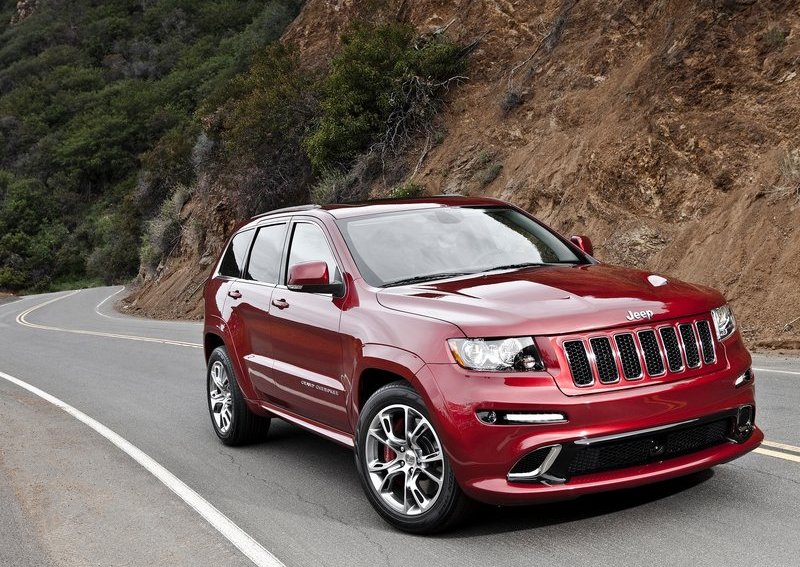
Jeep Grand Cherokee SRT8 with 465 HP. Photo by netcarshow.com

Jeep Grand Cherokee SRT8 with 465 HP. Photo by netcarshow.com

Those numbers must be considered as the begining of next 5 years plan in which Jeep must reach 800.000 units globally. For doing so, they have to expand their business and consider growing markets outside the US. They have to increase their presence in the Middle East, where SUV segment had a market share of 34%, world’s largest. For that they must develop new concepts of SUV, larger ones than Grand Cherokee and focus on luxury. Something that is becoming popular in other markets such as China (where SUV segment has an enormous potential; in 2011 it was 13,5% of total sales) and Russia. The last  news from Russia tell that there will be a factory for bulding Jeeps there in order to have a better access to this important market. In that context, Jeep could reach around 55.000 units in the whole Middle East region (GCC), 34.000 in China and 15.000 in Russia. On the other hand, Europe can become an interesting market only if they develop a unique succesor of the Compass/Patriot to be more competitive and look more compact just as Europeans like them (Ex: Nissan Qashqai). In this continent they can reach 132.000 units, 47.000 of them in Italy. Meanwhile they should forget that rumor of sharing a small SUV with Fiat, as Jeep is known for its hardiness and big SUVs. In other words, they have a great name and a big challenge to become global, but doing the right things in the right moment, will become a reality.

Jeep Renegade Concept. Rendering by hyundaigenesisblog.com

Jeep Renegade Concept. Rendering by hyundaigenesisblog.com